Table of Contents
- Produced Water as a Mineral Resource
- Lithium in Oil Produced Water
- Concentration Does Not Equate to Resource Potential
- How to Recover Lithium from Produced Water?
- Technologies for Extracting Lithium
- Modules Near Water Management Facilities
- EOR and Operational Compatibility
- Challenges in Utilizing Produced Water
- Decision Matrix for Businesses
- Water Digitization and Traceability
- Conclusions
- References
- Frequently Asked Questions (FAQs)
A hypersaline stream that once drove up disposal costs may contain part of the mineral supply required for the energy transition. The difference between waste and resource lies in geochemistry, traceability, and separation technology.
Produced water cannot be viewed solely as an effluent from the oil industry. In mature fields, shale, gas, and enhanced oil recovery (EOR) projects, this stream contains concentrated salts, hydrocarbons, metals, and—in specific basins—recoverable lithium. Its valorization requires advanced treatment, mineral recovery, water reuse, and operational efficiency.
Produced Water as a Mineral Resource
Produced water is the fluid that comes to the surface along with oil and gas. It may include formation water, injected water, operational chemicals, dispersed oil, solids, dissolved gases, salts, metals, naturally occurring radioactive material (NORM), and organic compounds. Its composition varies among wells, formations, and stages of the asset’s life cycle.
In this context, discussing lithium in oil production water requires precision. It is not enough to simply detect the element; its concentration, flow rate, stability, recoverability, and conversion pathway to a commercial product must be demonstrated. A brine may contain lithium and still not be viable if the matrix has a high load of competing ions, metals, silica, hydrocarbons, or fine solids.
The conceptual shift is profound: a stream sent for reinjection, disposal, or minimal treatment is now viewed as industrial brine with mineral recovery potential. This does not replace environmental management; rather, it makes it more rigorous, measurable, and value-driven.
Lithium in Oil Produced Water
Lithium is critical for batteries, stationary storage, electrification, and low-emission industrial systems. Deep brines may contain lithium because they have interacted over long periods with rocks and minerals under pressure, high temperatures, and high salinity.
In some basins, the concentration justifies pilot projects; in others, the value per barrel treated will be insufficient. Technical criteria must consider lithium concentration, water volume, infrastructure, available energy, pretreatment quality, and demand for lithium carbonate or hydroxide.
Recovering the resource from produced water has an advantage over primary sources: it utilizes a stream already mobilized by the oil operation. At the same time, it presents a disadvantage: the matrix was produced to extract hydrocarbons, not to feed a high-purity chemical plant.
Concentration Does Not Equate to Resource Potential
One of the most common mistakes is evaluating a basin solely based on the volume of water produced. A field with high flow rates but low ion concentration requires processing millions of barrels to yield little product. In contrast, a formation with a lower volume and a better Li/Mg or Li/Na ratio may be more attractive.
Recoverability depends on the complete chemistry of the brine. Monovalent and divalent cations compete with Li+, increase chemical consumption, promote scaling, and complicate purification. Therefore, characterization must include total dissolved solids (TDS), hardness, alkalinity, silica, metals, hydrocarbons, gases, temporal variation, and compatibility with direct lithium extraction.
The continuity of the resource must also be evaluated. An attractive sample may lose value if the flow rate changes, if the well mix dilutes the concentration, or if the chemistry is altered by stimulation, inhibitors, biocides, or operational changes. The actual resource is the brine that is available, treatable, and monetizable.
How to Recover Lithium from Produced Water?
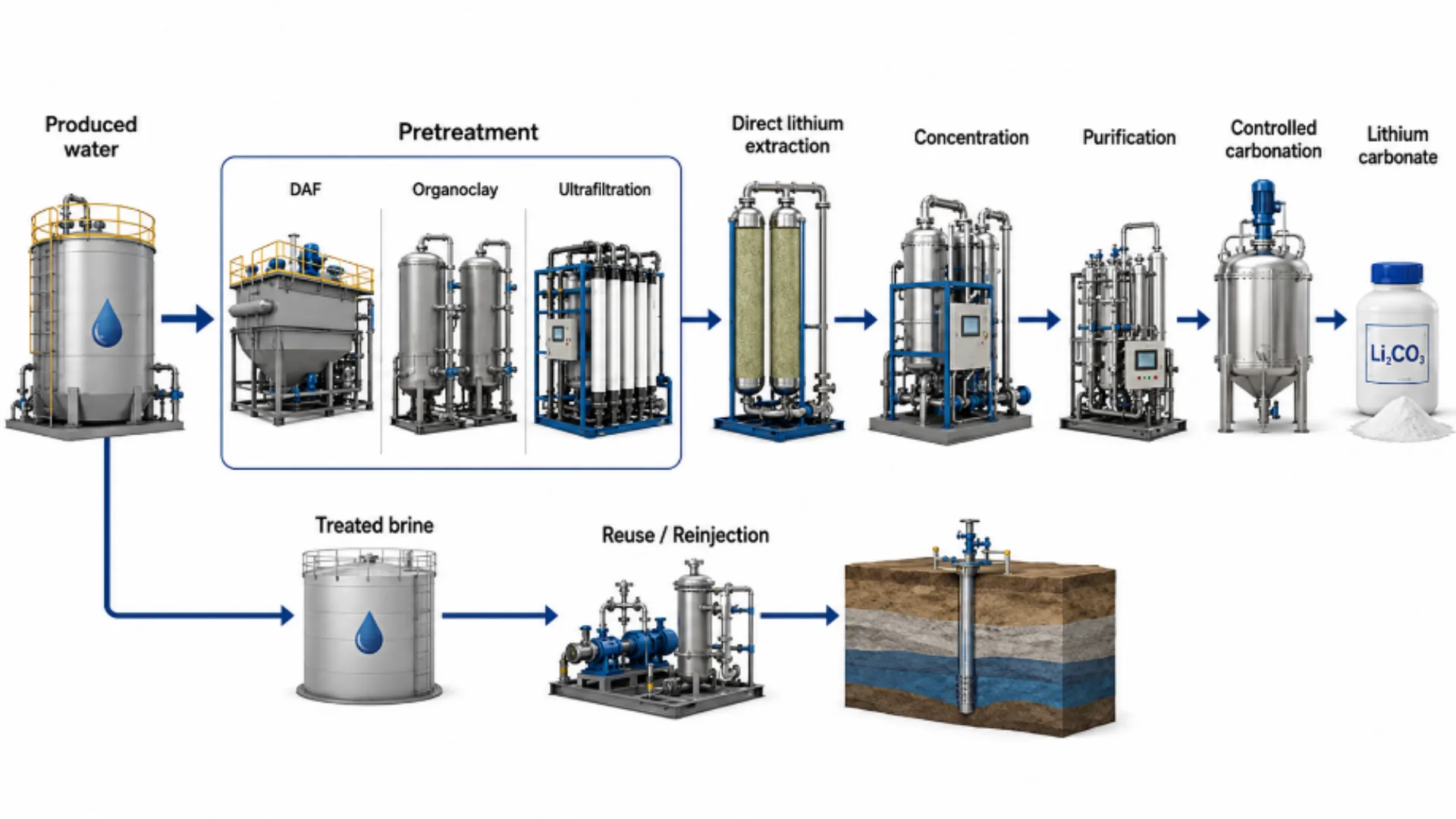
The key question is not just how to recover lithium from produced water, but how to do so without disrupting operations. A viable process must begin with oil separation, solids removal, scale control, pH adjustment, removal of interferents, and protection of the selective materials.
Next comes the concentration stage or direct lithium extraction. The goal is to capture Li+ in the presence of a vast number of other ions. Selectivity is crucial because lithium is typically present in much lower concentrations than sodium, chlorides, calcium, or magnesium. If the system carries too many contaminants, chemical and energy costs increase.
The following video from “CBC News: The National” shows how a byproduct stream from oil operations can be transformed into a mineral resource through applied geochemistry, traceability, and direct extraction technologies.
Pre-treatment and Matrix Control
The project’s technical pre-treatment includes oil-water separation, filtration, flotation, selective coagulation, softening, iron removal, silica control, degassing, and microbiological management. In high-salinity waters, it is important to anticipate corrosion, scaling, and chemical compatibility.
For feedstocks containing emulsified oil, fine solids, and organic compounds, the treatment train may incorporate dissolved-air flotation, filters with organoclays or organophilic clays, and cross-flow ultrafiltration. These stages help protect membranes, resins, and adsorbents from fouling, pore blockage, and loss of efficiency.
To characterize the matrix, it is advisable to use representative sampling and recognized methods: API RP 45 for oilfield water, EPA SW-846 Method 6010D or ASTM D1976 for metals by ICP-OES, and EPA Method 1664B or ASTM D7066 for oil and grease. The testing process must include quality assurance and quality control (QA/QC), duplicates, blanks, sample preservation, and chain of custody.
Direct Lithium Extraction
Direct lithium extraction (DLE) encompasses technologies that capture lithium from brines without relying on extensive evaporation. Typically, adsorbents, ion exchange, solvents, membranes, electrochemical materials, or hybrid systems are used.
In produced water, DLE must demonstrate stability in the presence of residual hydrocarbons, high TDS, temperature fluctuations, and competing cations. An adsorbent that performs well in the laboratory may lose performance in the field if it becomes fouled, degrades, or requires costly regenerants.
Lithium recovery should not be evaluated solely by extraction percentage. Other important factors include the service life of the selective material, washwater consumption, the need for acid or base, eluate concentration, the quality of the remaining brine, and the management of secondary waste.
Conversion to a Commercial Product
Recovery does not end with the concentration of Li+. The enriched stream must be converted into lithium carbonate, lithium hydroxide, or an intermediate salt, depending on the defined commercial route. This stage requires chemical polishing to remove boron, hardness, trace metals, sulfates, and organic compounds that may affect the final quality.
The refining phase may involve crystallization, ion exchange, nanofiltration, reverse osmosis, electrodialysis, or zero-liquid-discharge systems, depending on the feedstock and regulatory criteria. Selective precipitation must be integrated as a controlled step, not as an improvised closure, to prevent the carryover of impurities and losses of the target ion.
When the goal is high-specification lithium carbonate, controlled carbonation is critical. The dosage of sodium carbonate, pH, temperature, supersaturation, precipitation kinetics, and solid washing must be adjusted to reduce impurities. Simply precipitating carbonate is not enough; a stable purification process, quality control, and traceability are required.
The following video details the process of converting the material into a commercial product, focusing on the chemical polishing and refining required to produce lithium carbonate.
Technologies for Extracting Lithium
Technologies for extracting lithium from oilfield brines are typically combined into hybrid processes. The choice of technology depends on the chemistry, temperature, salinity, viscosity, contaminants, flow continuity, and purity target.
Adsorption and Ion Exchange
Adsorption uses materials with an affinity for Li+, such as manganese oxides, titanates, aluminates, or functionalized adsorbents. Its advantage is selectivity; its risk is loss of capacity due to fouling, aggressive regeneration, or leaching of the material.
Ion exchange can help remove hardness, metals, and interferents before or after DLE. In complex matrices, the sequence matters just as much as the material. A suitable resin in synthetic brine may fail if the actual stream contains oil, iron, silica, bacteria, or production polymers.
Membranes and Electroseparation
Membranes allow separation based on size, charge, or chemical affinity. Nanofiltration, electrodialysis, selective membranes, and redox-electrochemical processes aim to concentrate lithium with a smaller physical footprint than evaporation.
Modules Near Water Management Facilities
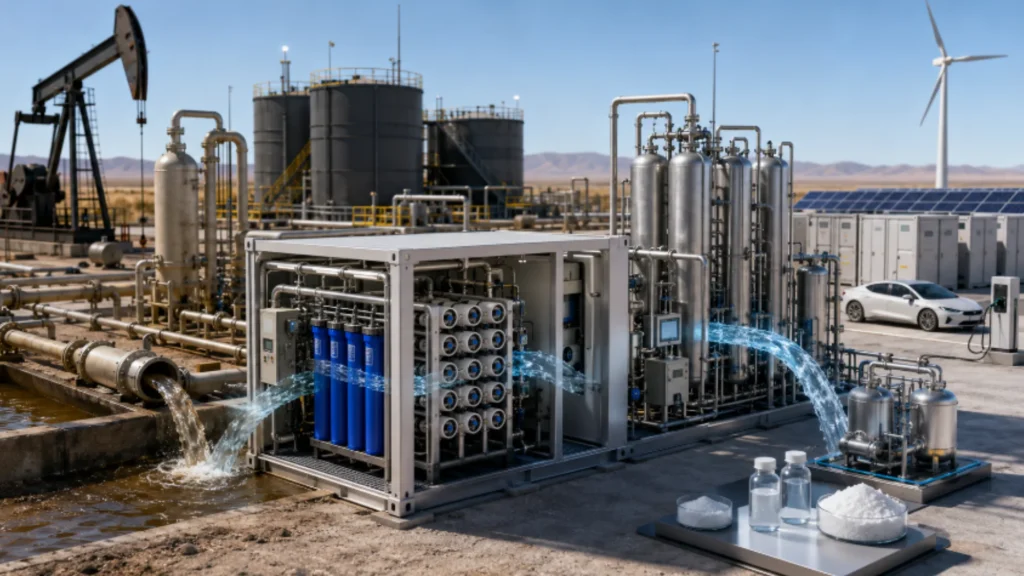
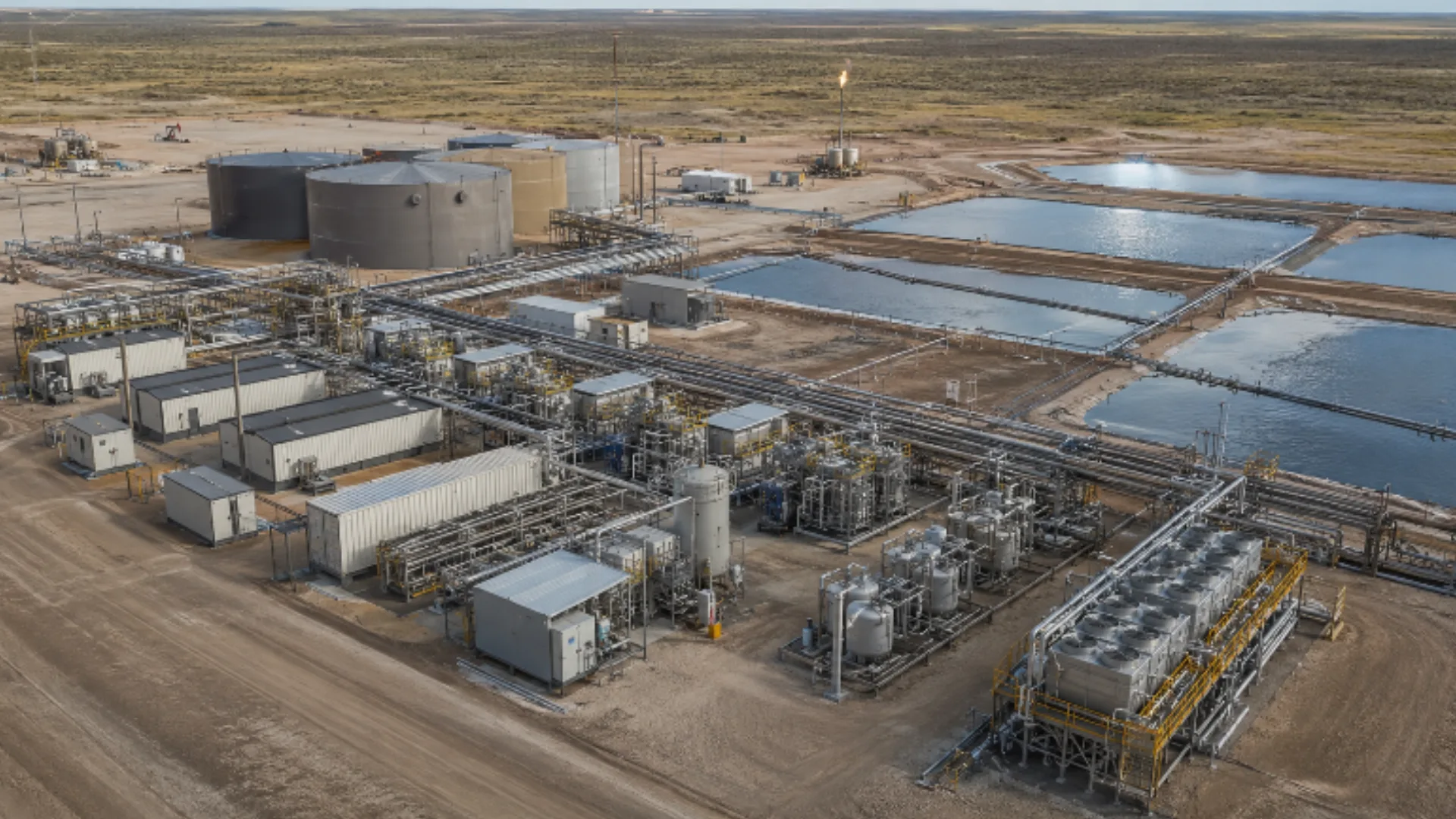
A viable industrial solution must bring the technology closer to where water is generated or concentrated. Therefore, modular plants located near water management, recycling, storage, or disposal facilities can reduce transportation, improve traceability, and facilitate seasonal testing.
This approach allows for the installation of pretreatment, DLE, and concentration units in scalable phases. First, the behavior of the actual brine is validated; then capacity is increased; finally, the module is integrated with reinjection, reuse, or chemical conversion. Modularity avoids large upfront investments and allows the design to be tailored to each asset.
For operating and service companies, the modular model also opens up a business opportunity: converting water management facilities into mineral recovery platforms. Not all streams will warrant lithium extraction, but those that do could transform a recurring cost into an additional source of value.
EOR and Operational Compatibility
The reuse of production water in oil and gas operations must be integrated with the reservoir strategy. In EOR, waterflooding, or reinjection projects, some of the water may be necessary to maintain pressure, improve sweep efficiency, or reduce fresh water consumption.
If the chemistry is modified, salts are extracted, or the stream’s destination is changed, rock-fluid compatibility, scaling potential, corrosion, polymer stability, injector performance, and well integrity must be evaluated. Mineral recovery must not affect hydrocarbon recovery or create hidden operational risks.
The most robust solution is typically to segment the streams: one fraction for reinjection, another for advanced treatment, another for lithium recovery, and another for industrial reuse. This architecture requires data, quality control, and economic models on a per-asset basis.
Challenges in Utilizing Produced Water
The challenges in utilizing produced water with lithium potential are technical, environmental, and regulatory. The first is variability: a single sample does not represent a resource. A comprehensive data collection effort is required, broken down by well, season, operating regime, and mix of flow streams.
The second challenge is scale. A pilot project can demonstrate recovery, but a commercial operation must sustain thousands of hours of operation with flow variations, shutdowns, maintenance, chemical regeneration, and waste management. The stability of the extracted material, reagent consumption, and energy balance determine the process’s environmental footprint.
The destination of the treated water must be defined. Reinjection, reuse for fracturing, discharge, industrial reuse, or zero liquid discharge each require different water quality standards. No project should proceed without an environmental baseline, post-treatment monitoring, and verifiable compliance criteria.
Decision Matrix for Businesses
The decision should not begin with the purchase of technology, but rather with a feasibility matrix. The first step is to characterize the water chemistry: Li+ concentration, total dissolved solids (TDS), Li/Mg and Li/Na ratios, hardness, silica, metals, oil and grease, total organic carbon (TOC), naturally occurring radioactive material (NORM), sulfates, chlorides, and solids.
Next, the operational balance must be evaluated: daily flow rate, resource continuity, generation points, disposal costs, transportation, reinjection, and energy availability. The third stage requires bench and pilot testing with actual water, not just synthetic brine.
Finally, mineral recovery must be compared with recycling, reuse, off-site treatment, and regulatory risks. The best solution may be modular and applied only to streams with higher concentrations.
Water Digitization and Traceability
Digitization transforms data on flow rate, conductivity, pH, pressure, temperature, oil-in-water content, and solids into decision-making criteria. These indicators make it possible to isolate streams with greater potential, anticipate scaling, and estimate lithium recovery on an operational basis.
Traceability will also be a competitive advantage. A product derived from production water must demonstrate environmental control, verifiable measurements, and regulatory compliance. With this integration, the Digital Oilfield goes beyond mere monitoring to become a technical support system for validating the circular economy.
Conclusions
It is important to evaluate produced water as a complex geochemical matrix, not merely as an effluent from the oil industry. Its potential for lithium recovery depends on the ion concentration, the ratio to competing cations, the available flow rate, chemical stability, pretreatment, and integration with reinjection, EOR, or industrial reuse.
Feasibility requires representative sampling, pilot tests with actual water, fouling control, energy balance, analytical traceability, and controlled conversion to a commercial product. At suitable assets, mineral recovery can transform production water management into a technical platform for value creation, sustainability, and operational efficiency.
References
- U.S. Department of Energy. (2024, 18 de junio). Fact Sheet: Produced Water from Oil and Gas Development and Critical Minerals.
- U.S. Geological Survey. (2024, 24 de septiembre). Could energy wastewaters be a viable source of lithium?
- Gerardo, S., & Song, W. (2025). Lithium recovery from U.S. oil and gas produced waters: Resource quality and siting considerations. Environmental Science: Water Research & Technology, 11, 536–541.
Frequently Asked Questions (FAQs)
How is lithium extracted from produced water?
It is extracted through pretreatment, selective capture of Li+, and chemical conversion. The process train may include filtration, adsorption, ion exchange, membranes, electrodialysis, precipitation, and crystallization.
What technologies recover lithium from this water?
The most relevant are DLE, selective adsorbents, ion exchange resins, nanofiltration, electrodialysis, electrochemical processes, and crystallization. The combination depends on the specific brine.
Why is this of interest to the lithium sector?
Because it transforms a waste stream from the oil industry into a potential source of critical minerals. Additionally, it leverages existing infrastructure and can reduce disposal costs.
What technical challenges are involved in its utilization?
High salinity, residual oil, solids, competing cations, scaling, corrosion, chemical variability, reagent consumption, and the need for a final product of commercial purity.