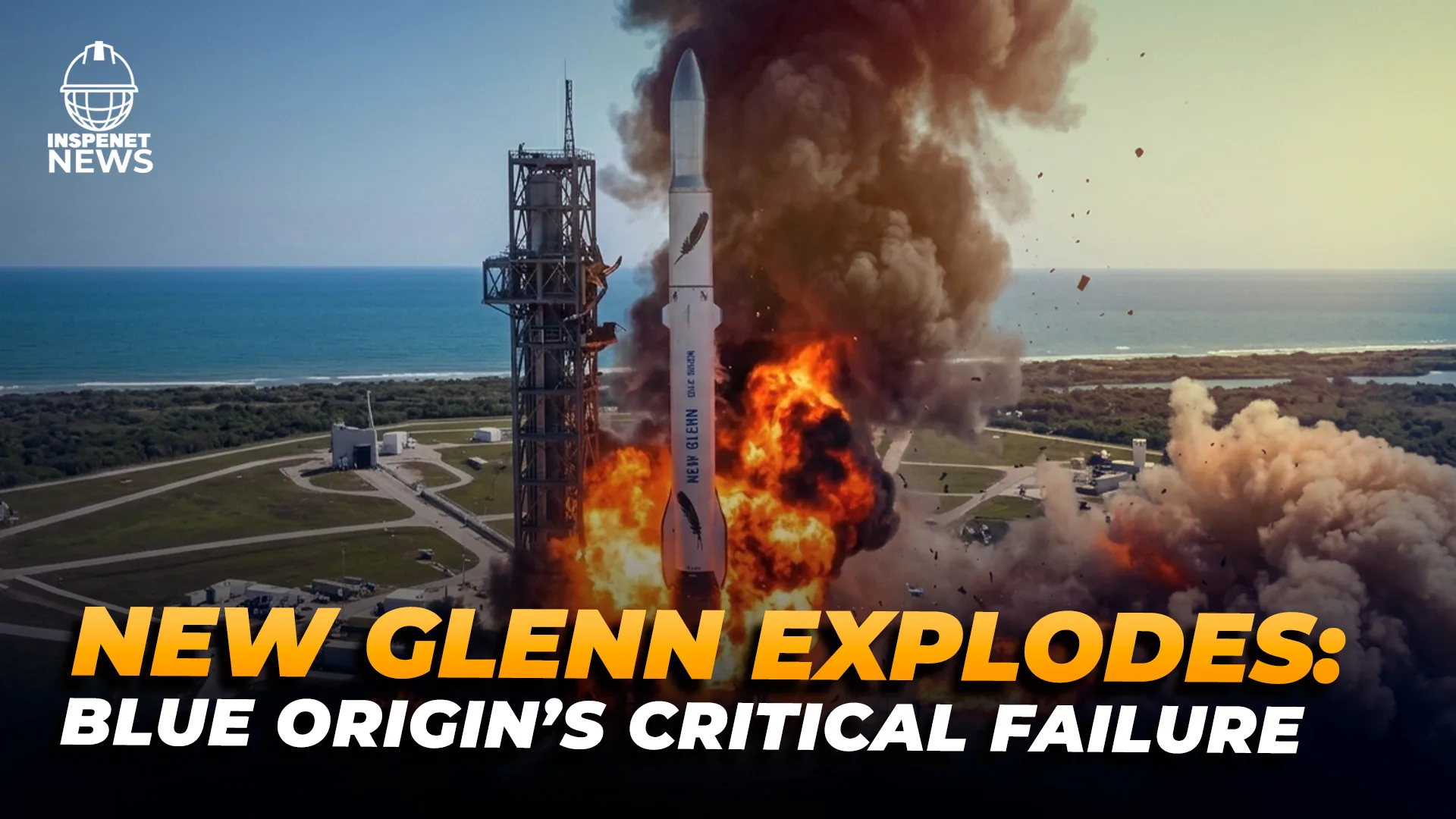
New Glenn explosion complicates Blue Origin’s plans
The New Glenn explosion during a static fire test at Cape Canaveral represents one of the most significant setbacks for Blue Origin in recent years. The incident destroyed the rocket's first stage and caused significant damage to the launch infrastructure as the company prepared for a mission linked to Project Kuiper.
Although no injuries were reported, the accident comes at a particularly sensitive time for the company founded by Jeff Bezos, which seeks to increase its presence in the space launch market and close the gap with SpaceX.
What happened during the static fire test?
The New Glenn incident occurred during a routine test conducted at Launch Complex 36 of the Cape Canaveral Space Force Station.
During this procedure, engineers activate the vehicle's engines while it remains secured to the platform. The objective is to verify the behavior of the systems before authorizing an orbital launch.
On this occasion, the rocket used its seven methane-fueled BE-4 engines. However, an anomaly recorded during the operation triggered a powerful explosion that generated a large fireball visible from several points along the Florida coast.
For now, Blue Origin has not detailed what caused the failure, and investigations are ongoing in coordination with various agencies related to space operations.
The damage caused by the Blue Origin rocket explosion
In addition to destroying the vehicle's first stage, the Blue Origin rocket explosion caused significant damage to ground infrastructure.
Initial reports indicate that several structures at the launch complex were affected. Among them is at least one lightning protection tower that was rendered inoperable after the accident.
The extent of the damage could necessitate extensive repair work before the platform can become operational again. This poses an additional challenge for the company because LC-36 is a fundamental facility within the New Glenn program.
How does the accident affect project kuiper?
One of the main questions following the New Glenn explosion is related to Project Kuiper, the satellite constellation with which Amazon aims to compete in the global satellite internet market.
The rocket involved in the test was being prepared for a mission planned to transport satellites for this program. Although the payloads were not on board at the time of the incident, the accident could alter the network's deployment schedule.
Any additional delay could put pressure on Amazon's expansion plans in a sector where other constellations already have a significant presence.
A new challenge for Blue Origin against SpaceX
The accident also rekindles the debate about Blue Origin's ability to consolidate itself as a solid alternative within the aerospace industry.
While SpaceX maintains a high frequency of launches and an infrastructure distributed across several facilities, Blue Origin is still working to make New Glenn an operational system capable of executing missions regularly.
The company considers this vehicle a fundamental part of its growth strategy. Therefore, any delay in its development can have consequences for commercial contracts, government projects, and future business opportunities.
Investigation seeks to determine the origin of the anomaly
Currently, there is no official explanation for the causes of the New Glenn explosion. Teams from Blue Origin, military authorities, and agencies linked to space operations are participating in the investigation.
Meanwhile, the company has reiterated that safety remains a priority within its development and testing program.
The results of the investigation will be crucial to understanding the true scope of the New Glenn incident and to establishing when Blue Origin can resume its launch plans. What happened at Cape Canaveral not only affects a particular vehicle but also tests the timeline of several strategic projects that depend on the rocket's success in the coming years.
Additional news of interest
DeepOcean expands work with Equinor in Norway
DeepOcean secured new contracts from Equinor to carry out subsea work in several fields on the Norwegian continental shelf between 2027 and 2028. The work includes projects in Visund, in the North Sea, and Johan Castberg, in the Barents Sea, as well as potential involvement in Snorre A. The agreement strengthens the relationship between both companies after similar collaborations in recent years.
In Visund, the company will replace gas and oil export pipelines through a SIMOPRO operation, a method that allows complex tasks to be executed while the platform continues to produce. In Johan Castberg, DeepOcean will be responsible for installing subsea infrastructure to connect the Isflak field with the existing floating production unit. The scope also includes studies, connections, and pre-commissioning activities for the systems.
Trans mountain accelerates oil growth
Trans Mountain Corp. is preparing a new tender round to add an additional 72,000 barrels per day to the capacity of its pipeline connecting Alberta to Canada's west coast. The company also plans to add 90,000 barrels per day by using friction-reducing agents, a measure that will allow more crude to be transported without building new main infrastructure.
The company is already advancing a process to expand the proportion of capacity committed through long-term contracts. These moves come after the recent expansion of the system, which increased its capacity from 300,000 to 890,000 barrels per day after years of delays and increased construction costs. Additionally, there are plans to add another 210,000 barrels per day within an optimization program that could be completed by the end of 2028.
DNV enhances training for hydrogen vessels
DNV introduced a new recommended practice that establishes competency requirements for crews, inspectors, and technical personnel working with hydrogen systems on board vessels. The guide seeks to strengthen operational safety as this fuel gains presence in the maritime industry, where seven vessels are already in service and several dozen are under development.
The document defines the knowledge and skills necessary to manage risks associated with hydrogen, such as potential leaks, its high ignition sensitivity, and the demands of storage at high pressure or extremely low temperatures. The reference will also serve as support for operational procedures, emergency plans, and training programs in shipping companies, educational centers, and certification bodies.
Strohm lands in Egypt with subsea contract
Strohm secured its first contract in Egypt to supply a 2,000-meter thermoplastic composite pipe for a project in the West Delta Deep Marine development, operated by Burullus Gas Company. The infrastructure will be installed by Oceaneering International in waters approximately 600 meters deep and will replace an existing steel pipeline.
The solution employs a pipe manufactured with carbon fiber and PA12 polymer designed to operate at high pressures. Thanks to its low weight and flexibility, it can be installed using a horizontal laying method that reduces the need for specialized vessels. This will simplify project logistics and decrease installation costs. Furthermore, it will be the first application of this TCP technology in the region.