Table of Contents
- What Are Magnetic PIGs?
- MFL Technology in Inline Inspection
- What Do Magnetic PIGs Detect?
- Corrosion Mapping and Integrity Data
- Advantages Compared with Other ILI Tools
- Limitations of Magnetic PIGs
- Comparison with Other Inspection Technologies
- When to Use Magnetic PIGs in Pipelines
- How Magnetic PIGs Improve Corrosion Mapping
- Applications in Corrosion and Metal Loss Assessment
- Pipeline Integrity and Decision-Making
- Conclusion
- References
An unexpected pipeline leak rarely occurs without prior warning signs. The real problem is that these indicators often remain hidden until the damage becomes critical. In this context, high-resolution magnetic PIGs have revolutionized the way internal pipeline conditions are assessed, enabling the detection of corrosion, metal loss, and anomalies with a level of detail previously unimaginable. Thanks to advanced MFL Technology, these tools not only identify defects but also transform how pipeline integrity and operational reliability are managed.
What Are Magnetic PIGs?
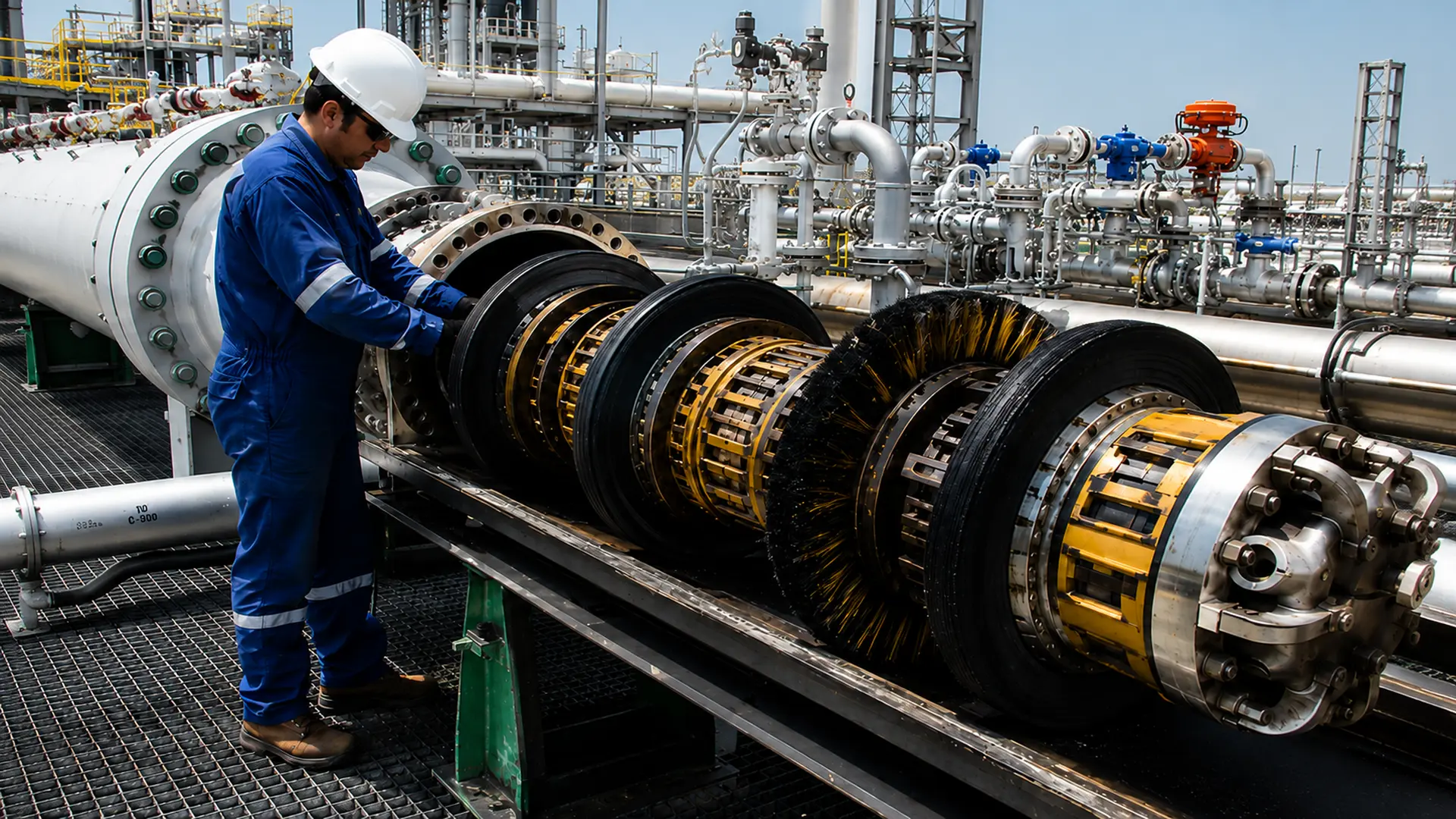
Magnetic PIGs are instrumented devices that travel through pipelines propelled by the product flow. Their primary purpose is to perform pipeline inspection without interrupting operations.
These tools use magnetic sensors to identify changes in the magnetic field caused by wall thickness loss. This technique allows operators to assess pipeline condition without excavation or operational shutdowns.
High-resolution magnetic PIGs represent a technological evolution that improves detection sensitivity, enabling the identification of smaller defects and enhancing the overall asset assessment.
In practice, magnetic PIGs provide significant support for modern condition-based maintenance programs, especially in critical systems where pipeline integrity is a top priority.
MFL Technology in Inline Inspection
The technological foundation of these systems is Magnetic Flux Leakage (MFL) Technology, widely used in inline inspection (ILI) of metallic pipelines.
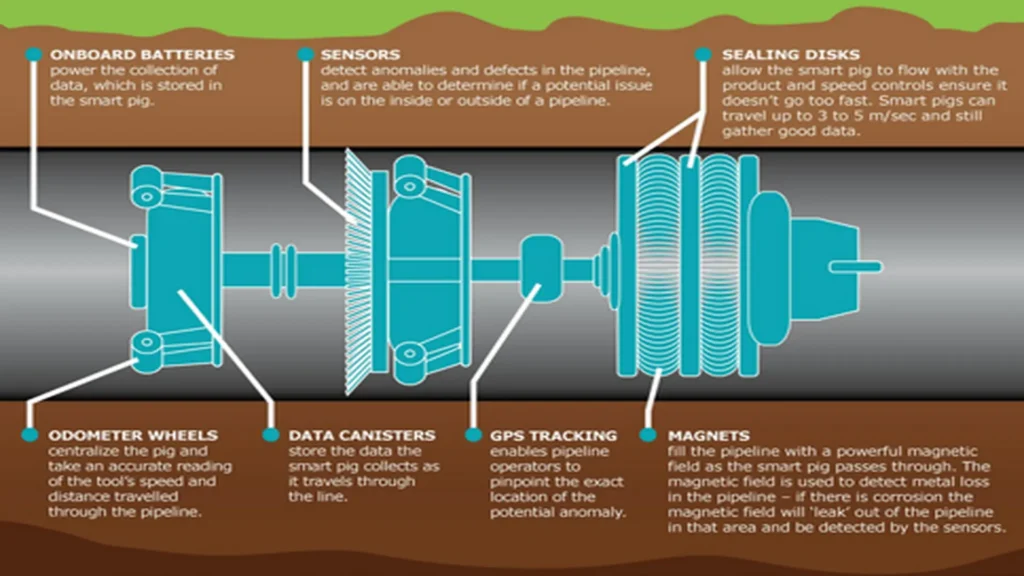
When a magnetic PIG passes through a pipeline, it magnetizes the pipe wall. If corrosion or metal loss exists, part of the magnetic flux escapes or “leaks,” generating signals that are recorded by high-precision sensors.
MFL Technology therefore provides a continuous assessment of pipeline condition, supplying valuable information for integrity analysis.
Modern high-resolution magnetic PIG systems incorporate dense sensor arrays that improve corrosion mapping quality and enable the generation of detailed digital models of the pipeline’s internal condition.
This transforms inline inspection into a predictive rather than merely reactive tool.
What Do Magnetic PIGs Detect?
Magnetic PIGs are designed to detect a wide range of anomalies in metallic pipelines.
Among the main detections are:
- Internal and external corrosion
- Wall thickness loss
- Pitting corrosion
- Mechanical damage caused by pressure or impact
High-resolution magnetic PIGs significantly improve the ability to detect small discontinuities, enabling more accurate pipeline inspection.
Thanks to MFL Technology, these systems can generate detailed corrosion maps, identifying even early-stage degradation areas.
From an inline inspection perspective, this represents a strategic advantage because it allows operators to anticipate failures before they evolve into leaks or ruptures.
Corrosion Mapping and Integrity Data
Corrosion mapping is one of the most valuable outputs obtained through magnetic PIG inspections.
This process involves generating digital representations of metal loss within the pipeline, allowing visualization of critical areas and degradation trends.
High-resolution magnetic PIGs provide greater data density, resulting in more accurate and reliable corrosion mapping.
This enables engineers to make decisions based on more robust data when assessing pipeline integrity.
Furthermore, advanced software integration allows inspection results to be correlated with operating conditions, improving maintenance planning.
In this context, inline inspection becomes a key tool for predictive asset management.
Advantages Compared with Other ILI Tools
Compared with other inline inspection technologies, magnetic PIGs offer significant advantages:
- High accuracy in metal loss detection
- Extensive coverage over long pipeline distances
- Capability to operate without extensive pre-cleaning
- Continuous assessment without interrupting flow
- Excellent cost-benefit ratio
High-resolution magnetic PIGs outperform conventional technologies by providing improved defect resolution.
Additionally, MFL Technology delivers more consistent data for pipeline integrity analysis, which is critical in hydrocarbon transportation systems.
Compared with ultrasonic or caliper tools, magnetic PIGs stand out for their operational robustness and versatility.
Limitations of Magnetic PIGs
Although high-resolution magnetic PIGs provide excellent results for detecting corrosion and metal loss, they also have limitations.
The main limitation is that MFL Technology has lower sensitivity for detecting very fine cracks or defects without significant wall loss. Likewise, internal debris, speed variations, or complex geometries may affect inline inspection accuracy.
For this reason, they are often complemented with other specialized technologies in certain applications.
Comparison with Other Inspection Technologies
Different inspection tools are used to evaluate pipeline integrity. Each offers specific advantages depending on the expected damage mechanism.
| Inspection Technology | Operating Principle | Detected Defects | Advantages | Limitations |
|---|---|---|---|---|
| Magnetic PIGs (MFL) | Detect magnetic flux leakage caused by metal loss | Corrosion, wall loss, pitting | High speed and excellent corrosion mapping | Lower sensitivity to fine cracks |
| Ultrasonic PIGs (UT) | Use ultrasonic waves to measure wall thickness | Localized corrosion and wall loss | High thickness measurement accuracy | Usually require liquid coupling medium |
| EMAT PIGs | Use electromagnetic acoustic waves | Cracks and SCC | Excellent crack detection capability | Greater complexity and cost |
| Geometric PIGs | Detect mechanical deformations | Dents and ovalities | Evaluate internal geometry | Do not detect corrosion |
EMAT (Electromagnetic Acoustic Transducer) technology uses electromagnetic acoustic waves to identify cracks associated with fatigue and stress corrosion cracking.
In many advanced pipeline inspection programs, multiple technologies are combined to obtain more comprehensive diagnostic results.
When to Use Magnetic PIGs in Pipelines
The use of magnetic PIGs is recommended under various operating conditions:
- When internal corrosion assessment is required
- In risk-based maintenance programs
- Before extending pipeline service life
- During pipeline integrity audits
High-resolution magnetic PIGs are particularly useful in aging pipelines or systems with a history of active corrosion.
Pipeline inspection using this technology is ideal when a balance between accuracy, cost, and operational continuity is required.
They are also essential for periodic inline inspection strategies aimed at monitoring damage progression.
How Magnetic PIGs Improve Corrosion Mapping
One of the greatest advantages of high-resolution magnetic PIGs is their ability to enhance corrosion mapping.
Thanks to increased sensor density, greater diagnostic resolution is achieved, enabling the identification of smaller defects with higher accuracy.
Modern magnetic PIGs generate large volumes of data that, once processed, allow the construction of detailed models of the pipeline’s internal condition.
This significantly improves decision-making in pipeline inspection because engineers can prioritize repairs based on quantitative evidence.
Furthermore, the application of MFL Technology enables more accurate correlation between corrosion depth and extent.
Applications in Corrosion and Metal Loss Assessment
The primary applications of magnetic PIGs are related to corrosion and metal loss detection.
In the energy industry, these systems are essential for ensuring operational continuity and safety.
High-resolution magnetic PIGs provide a more detailed assessment of critical pipelines, particularly in aggressive environments where corrosion rates are accelerated.
MFL-based inline inspection helps identify high-risk areas before structural failures occur.
In addition, the data obtained enable the development of mitigation strategies based on actual conditions, strengthening long-term pipeline integrity.
Pipeline Integrity and Decision-Making
Pipeline integrity depends directly on the quality of the information obtained through pipeline inspection.
Magnetic PIGs provide critical data for risk assessment, repair prioritization, and asset life extension.
High-resolution magnetic PIGs offer a more comprehensive view of the pipeline’s internal condition, facilitating evidence-based decision-making.
When integrated into integrity management systems, inline inspection results become strategic tools for operational planning.
This reduces the risk of catastrophic failures and optimizes maintenance costs.
Conclusion
High-resolution magnetic PIGs represent a major advancement in modern pipeline assessment. Their ability to detect corrosion, metal loss, and internal defects through MFL Technology makes them an essential tool for inline inspection. In addition, they improve corrosion mapping and strengthen pipeline integrity through accurate and reliable data. Their use is fundamental in pipeline inspection programs focused on reliability, safety, and maintenance optimization.
References
- American Petroleum Institute. (2021). API Recommended Practice 1160: Managing System Integrity for Hazardous Liquid Pipelines (5th ed.). American Petroleum Institute.
- American Petroleum Institute. (2022). API 570: Piping Inspection Code: In-service Inspection, Rating, Repair, and Alteration of Piping Systems (5th ed.). American Petroleum Institute.
- International Organization for Standardization. (2021). ISO 12747 Gas Industries — Pipeline Transportation Systems — Pipeline Integrity Management Systems. ISO.
- NACE International. (2021). SP0206-2021: Internal Corrosion Direct Assessment Methodology for Pipelines Carrying Normally Dry Natural Gas (DG-ICDA). NACE International.