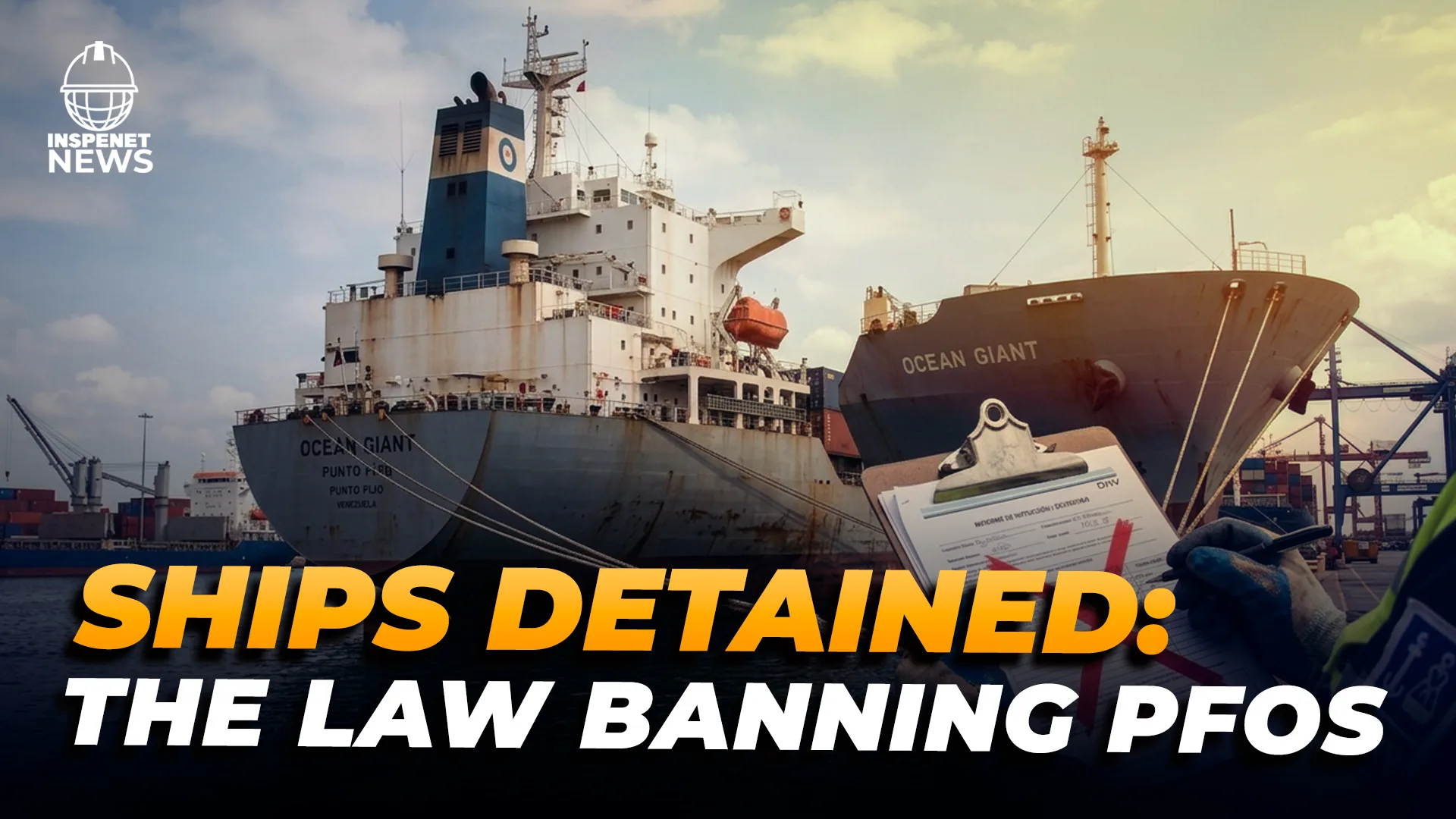
PFOS free foam: how to meet 2026 inspections
From 2026, shipowners and maritime operators will need to pay particular attention to the documentation of their fire protection systems. The ban on PFOS in foams used on board is entering a practical verification phase, requiring proof of compliance during regulatory inspections. In this context, demonstrating that each PFOS free foam has the required documentation will be essential to passing safety checks without incident.
PFOS document control enters a new phase
From the first safety equipment inspection carried out after January 1, 2026, inspectors must verify that all firefighting foam on board is PFOS-free. This requirement applies to both fixed firefighting systems and portable equipment used in daily operations.
The measure is part of international efforts to remove substances considered harmful to the environment and ensure that ships operate in accordance with current maritime safety requirements .
What documentation will be valid during an inspection?
To demonstrate that a free foam meets the established requirements, companies must have verifiable documentation that clearly identifies the product used on board.
There are three accepted alternatives to prove the absence of PFOS.
Manufacturer's statement
First, the manufacturer can provide a formal declaration confirming that the firefighting foam does not contain PFOS. This document must include sufficient information to link the certification to the product being transported or installed on the vessel.
Accredited laboratory report
Companies can also use an accredited laboratory to analyze samples of the foam. The report must demonstrate that the PFOS concentration remains below 10 mg/kg, equivalent to 0.001% by weight.
TA or MED certificates
Furthermore, some TA or MED type approval certificates already include explicit references to the absence of PFOS. When this information is included in the official documentation, it can be used as valid evidence during inspection.
Traceability will be a determining factor
In addition to presenting valid documents, operators must demonstrate that these correspond exactly to the foam used on board.
To this end, the documentation must contain information such as the manufacturer, foam type, batch number, production date, and references to TA and MED certificates. Similarly, the vessel's containers and records must facilitate product identification to ensure complete traceability.
This requirement seeks to avoid discrepancies between the documentation submitted and the fire extinguishing agents actually available on the vessel.
What will happen to foams that cannot be certified?
When a company cannot provide any of the accepted documentary evidence, the foam must be replaced with another that does have sufficient evidence of the absence of PFOS.
The replacement will affect both fixed systems and portable equipment. For this reason, shipping companies and fleet managers are reviewing inventories and records further in advance to avoid problems during regulatory checks.
Preparations to avoid incidents during inspections
With the new inspections approaching, organizations like DNV recommend starting the collection of documents and the review of the foam installed on each ship as soon as possible.
Early preparation will allow for the correction of any shortcomings before the inspection and will reduce the risk of partial inspections, regulatory observations, or restrictions related to the vessel's authorization conditions.
The maritime sector strengthens control over fire extinguishing agents
The implementation of these controls marks a further step in the shipbuilding industry's adaptation to stricter environmental requirements. The need to certify PFOS-free foam will drive greater levels of documentation control, traceability, and technical management of fire protection systems.For shipowners and operators, the review of documentation will no longer be a secondary administrative task, but an essential element to maintain regulatory compliance and ensure the operational continuity of their vessels.
News of additional interest
New acoustic technique allows detection of hidden tunnels
Researchers at Oak Ridge National Laboratory in the United States have developed a method that identifies hidden underground tunnels using acoustic signals generated from the subsurface and directed to the surface. Unlike traditional techniques, which send signals from above, this approach reverses the process to improve the detection of structures that can easily go unnoticed beneath roads, railways, and other critical infrastructure.
During the tests, scientists placed a sound source several meters underground and used sensors on the surface to record the ground's response. The system detected a characteristic signal that appeared only when a tunnel was present, allowing for more precise identification of its presence. The results suggest that the technique can overcome some limitations of conventional methods, especially in complex geological environments.
Costa Azul LNG begins testing, but the first shipment drifts away
The Energía Costa Azul LNG (ECA) Phase 1 terminal , developed by Sempra in Ensenada, Mexico, has begun showing signs of startup after gas flaring activity was detected at its facilities. Satellite data and gas flow logs indicate that the project has already entered early testing stages, a process that marks the introduction of gas into the plant's systems and the start of operational verifications.
Although this progress represents an important step for the 3.25 million tonne annual terminal, timelines observed in similar projects suggest that commercial production could take longer than anticipated. Gas flows to the facility have steadily increased in recent weeks, supporting commissioning activities. However, key technical phases remain before liquefaction can be achieved and the first LNG shipment can take place.
Conflict in the Middle East shakes mining markets
The escalating conflict in the Middle East is generating significant strain on global metals and mining markets, according to an analysis by Wood Mackenzie. Disruptions in the Strait of Hormuz and operational problems at industrial facilities in the region are impacting the supply of essential raw materials such as sulfur, oil, liquefied natural gas, and chemicals used by the mining and metallurgical industries.
One of the most exposed sectors is nickel in Indonesia, which relies heavily on sulfur from the Middle East. Impacts are also being felt in markets such as aluminum, where some regional production capacity has been affected, and steel, whose costs have risen due to increased raw material and fuel prices. Furthermore, reduced maritime traffic and increased logistics costs are putting pressure on global supply chains.
Gothenburg promotes biogas for maritime transport
Construction has begun on a liquefied biogas plant in the port of Gothenburg, Sweden, a project developed by Nordion. Energi aims to expand access to renewable fuels for sectors such as maritime transport, heavy transport, and industry. The facility will transform biogas from the grid into liquefied fuel, facilitating its distribution and use in regions lacking gas infrastructure.The plant will have a production capacity of approximately 50 tons per day when operating at full capacity and is expected to be operational during 2027. The project already has the support of producers and consumers in the energy sector, while several shipping companies that regularly operate in the port plan to increase their use of biogas once the facility is available.