Table of Contents
- Tank Internal Coating and Mechanical Integrity
- Selection by Service: Chemistry and Temperature
- Coatings according to type of stored fluid
- 100% Solids and high build coatings
- Surface preparation and anchor profile
- Application and quality control of coatings
- Internal corrosion and tank service life
- Traceability, specification, and management of change
- Conclusion
- References
- Frequently Asked Questions (FAQs)
The service life of an Tank internal coating is defined before it is applied: it depends on selecting the proper system according to service, chemical resistance, temperature, and immersion, as well as ensuring quality control in surface preparation, anchor profile, dry film thickness, and each applied layer.
An internal coating is not a “resistant” paint; it is a protective barrier designed to control internal corrosion, prevent product contamination, and extend inspection intervals. In hydrocarbon, chemical, industrial water, or potable water tanks, selection must start from ISO 16961, API RP 652, verified technical data sheets, and evidence of compatibility.
Tank Internal Coating and Mechanical Integrity
Tank internal coatings must be specified as a mechanical integrity barrier, not as an industrial finish. Their function is to isolate the steel from the corrosive medium, reduce the permeation of water, oxygen, and aggressive ions, limit electrochemical cells, and maintain protective continuity during equipment operation.
This difference is important: while external coatings are selected primarily based on UV radiation, moisture, chlorides, and industrial atmosphere, the internal coating of tanks is defined by the stored fluid, immersion, temperature, and chemical compatibility.
In atmospheric tanks, internal corrosion usually concentrates on bottoms, the sediment line, areas with free water, drains, sumps, welded transitions, and areas where contaminants accumulate. At these points, the internal coating helps preserve containment capacity, but it does not replace tank inspection or thickness evaluation according to integrity criteria.
Selection begins with a service matrix: stored product, presence of water, pH, chlorides, sulfides, aromatic content, oxygenated fuels, blends with biodiesel or ethanol, sediments, temperature, cleaning, steam, abrasion, cathodic protection, and bottom condition. With these data, it is determined whether a conventional epoxy, phenolic epoxy, epoxy novolac, vinyl ester, polyurethane, polyurea, 100% solids system, or reinforced coating is appropriate.
Standards and Technical Selection Criteria
ISO 16961:2024, “International standard for internal coating and lining of steel storage tanks in petroleum, gas and lower carbon energy industries,” establishes criteria for surface preparation, materials, application, inspection, and testing of internal coating systems in steel tanks for crude oil, hydrocarbons, and water.
API RP 652, Recommended Practice of the American Petroleum Institute for Linings of Aboveground Petroleum Storage Tank Bottoms, complements system selection on tank bottoms, where the coating is used to control product-side corrosion. Its application must be integrated with the integrity inspection, because a lining must not hide thickness loss, active pitting, deformations, settlements, or pending repairs.
A well-selected system protects the asset starting from engineering; a poorly selected one can maintain a good initial appearance and fail due to blistering, loss of adhesion, permeation, chemical attack, lack of cure, low thickness, or incompatibility with the stored product.
Selection by Service: Chemistry and Temperature
The selection of the internal tank coating must respond to the service, not to the commercial name of the product. The first filter is chemical resistance: crude oil with water, diesel, oxygenated gasoline, biodiesel, fuels with alcohols, produced water, brine, wastewater, or process chemicals generate different demands.
In clean hydrocarbons or moderate industrial water, protective coatings with an amine epoxy or polyamide epoxy matrix can offer good adhesion, hardness, and barrier properties. In refined products, hot crude oil, aromatic blends, oxygenated fuels, or more aggressive chemical exposure, phenolic epoxy and epoxy novolac offer higher crosslinking density, lower permeability, and better chemical resistance.
Temperature modifies polymer behavior. When a coating approaches its glass transition temperature, known as Tg, it can lose rigidity, increase permeability, and allow greater mobility of small molecules and aggressive ions. Therefore, compatibility must be verified with operating temperature, thermal cycles, cleaning frequency, and actual immersion conditions.
Epoxy, Phenolic, and Novolac Linings
Conventional epoxy lining is a common solution for industrial water services, moderate hydrocarbons, and non-extreme internal environments. Its performance depends on proper surface preparation, thickness control, complete curing, and compatibility with the stored fluid.
Phenolic epoxy is used when higher resistance is required against hydrocarbons, fuels, refined products, and certain solvents. Its tighter matrix improves the barrier against small molecules and reduces permeation in more demanding services.
Epoxy novolac is reserved for conditions of greater chemical or thermal severity. It is useful in certain services with aromatics, reformulated fuels, chemicals, hot crude oil, and aggressive industrial waters. It should not be selected simply for being “more resistant” in general terms, but because the fluid, temperature, concentration, and operating regime justify its use.
Coatings according to type of stored fluid
There is no universal coating for all tanks. Each service must cross-reference fluid, concentration, temperature, hydrostatic pressure, abrasion, cleaning, repairability, and expected life. A good specification avoids extrapolating compatibility from one service to another.
| Tank Service | Common Systems | Technical Reason for Selection |
|---|---|---|
| Crude oil with water and sediments | High-build epoxy, phenolic epoxy, 100% solids, glass flake | Control corrosion under free water, sludge, and deposition zones |
| Diesel and clean fuels | Epoxy, phenolic epoxy | Good barrier and resistance to moderate hydrocarbons |
| Oxygenated gasoline or biofuels | Phenolic epoxy, epoxy novolac | Better performance against alcohols, aromatics, and additives |
| Industrial or process water | Epoxy, polyurethane/polyurea, 100% solids | Resistance to immersion, barrier, and high thickness |
| Potable water | Potable water-approved epoxy | Sanitary compliance and control of extractables |
| Wastewater or service with H2S | 100% solids epoxy, novolac, vinyl ester | Chemical resistance, abrasion, and potential biogenic attack |
| Chemicals or brines | Novolac, vinyl ester, rubber, or specialized system | Specific compatibility with concentration and temperature |
| Bottoms with abrasion or pitting | Reinforced systems or glass flake | Longer diffusion path and mechanical resistance |
The table functions as a pre-selection guide. Thickness, temperature, and curing ranges must be taken from the technical data sheet, the chemical resistance chart, the project specification, and the manufacturer’s documented experience in equivalent services.
100% Solids and high build coatings
100% solids coatings should not be presented as an isolated novelty, but as consolidated technologies in industrial linings for immersion, tank bottoms, water, hydrocarbons, and services where high thickness, low solvent emission, and shorter return-to-service times are required. Their main advantage is forming high-thickness films with low volumetric shrinkage, lower VOC emissions, and good barrier capacity.
In internal applications, they can improve coverage on bottoms, welded transitions, and hard-to-reach areas, provided the system is approved for the service. The critical condition is the application: these products usually require proper equipment, temperature control, mix ratio, pot life, application pressure, ventilation, and cure verification.
100% solids is not an automatic solution; its performance depends on chemical compatibility, surface preparation, thickness, continuity, and quality control per layer. Along this line, glass flake-reinforced systems, lower permeability formulations, and digital tools for recording DFT, environmental conditions, and application quality are also growing.
Surface preparation and anchor profile
Surface preparation defines the adhesion of the coating and its initial resistance to the service. For internal coatings, the steel must be free of oil, grease, salts, oxides, mill scale, degraded paint, dust, moisture, and contamination from the stored product.
For high-performance coatings, Sa 2½ or SSPC-SP 10/NACE No. 2 grade is usually a common base; in severe services or under specific manufacturer requirements, white metal may be required.
The anchor profile must be measured and compared with the range allowed by the specification and the system’s technical data sheet. A low profile reduces mechanical adhesion; an excessive one leaves peaks with low coverage, increases consumption, and favors points of discontinuity. ASTM D4417 allows measuring the profile of abrasive-prepared surfaces using field methods.
Salts, moisture, and osmotic blistering
Soluble contaminants generate osmotic blistering and loss of adhesion. The measurement of soluble salts, along with dust control, steel temperature, relative humidity, and the difference relative to the dew point, must be documented before application. In tanks that stored crude oil, produced water, or chemicals, washing and degassing do not guarantee ionic cleanliness.
Osmotic blistering occurs when water permeates the film, dissolves salts trapped under the coating, and creates a concentrated solution at the steel-lining interface. The resulting osmotic pressure can lift the film and expose the steel to localized corrosion.
The cold-wall effect can aggravate this risk when a thermal difference exists between the hot internal fluid and the cooler exterior of the tank. This gradient favors moisture migration through the polymer matrix. Therefore, selection must consider temperature, immersion, residual salts, and the thermal condition of the tank.
Application and quality control of coatings
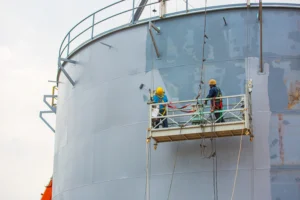
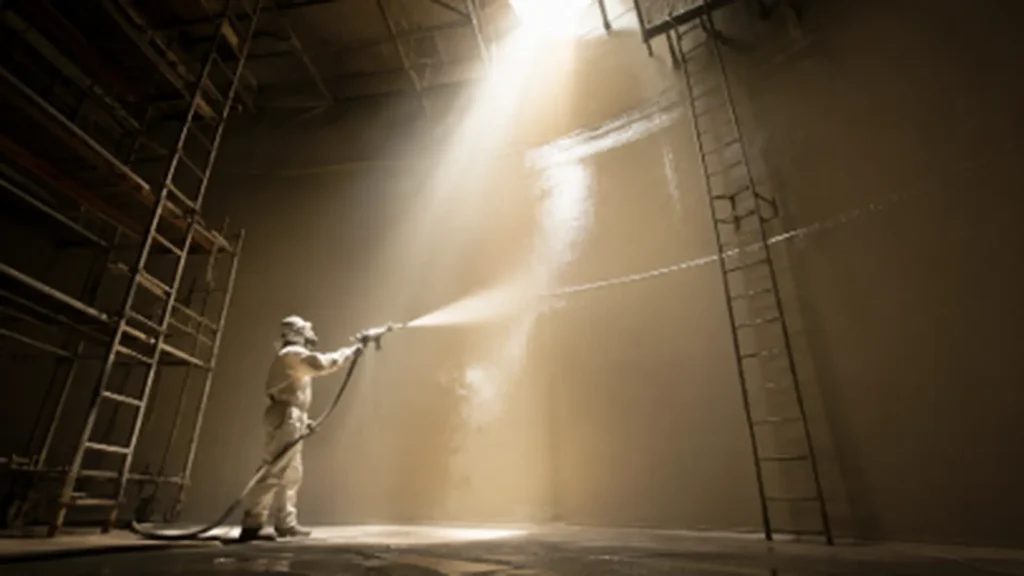
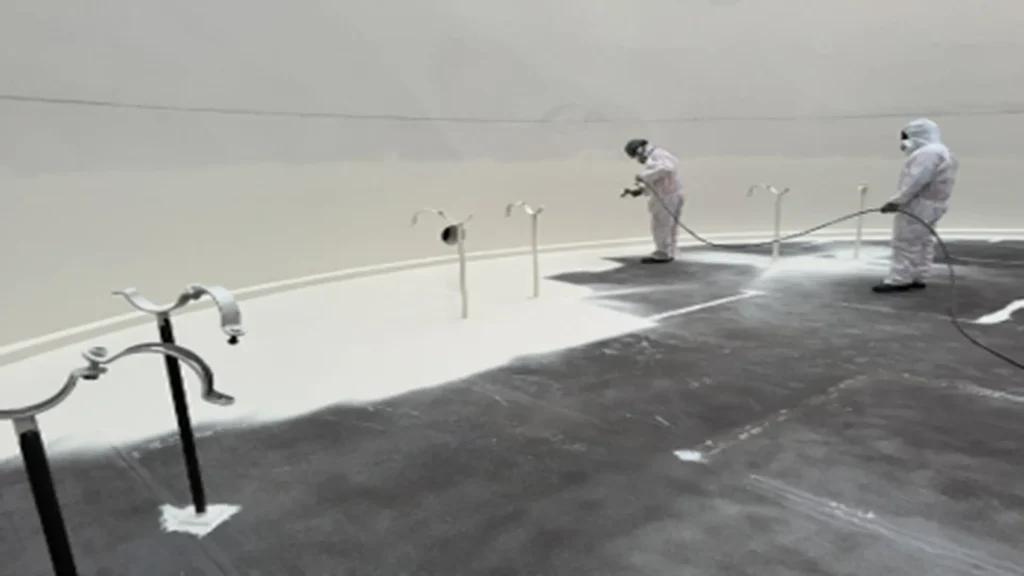
The application of the internal coating requires a controlled sequence: surface release, environmental verification, mixture preparation, stripe coat application, wet film control, recoat window, dry film thickness, curing, and final release.
The stripe coat is especially important in critical geometries: edges, welds, corners, transitions, nozzles, drains, and areas where spraying may leave low thickness. Its function is to reinforce coverage before the general coats.
Dry film thickness is a design variable. Insufficient DFT reduces barrier, chemical resistance, and immersion life; excessive DFT can retain solvent, crack, generate incomplete curing, or lose flexibility. ASTM D7091 and SSPC-PA 2 are common references for measuring and accepting coating thicknesses using non-destructive methods.
Coating release tests
The release of an internal coating must be based on a quality control matrix, not on a single test. Before applying, cleanliness, visible contaminants, soluble salts, anchor profile, steel temperature, relative humidity, dew point, abrasive condition, and compressed air cleanliness are verified.
During application, control must cover mix ratio, pot life, induction time when applicable, application method, wet film thickness, recoat windows, and continuity between layers. After curing, visual inspection, final DFT, adhesion, hardness, solvent rub test, or cure evaluation may be applied, depending on the system, technical data sheet, and specification.
The holiday test should be used when the coating, thickness, substrate, and service require it. It is relevant in non-conductive linings on conductive metal substrates, but it should not be treated as a universal test for any system. Its value lies in confirming continuity when required by the specification, not in replacing the rest of quality control.
Internal corrosion and tank service life
Coatings for internal corrosion control combine chemical selection, application quality, and tank inspection. In bottoms evaluated under API 653, the coating can reduce product-side corrosion, but integrity also depends on remaining thicknesses, external corrosion, settlement, welds, drains, internal connections, and foundation condition.
In tanks with water residues, the risk is concentrated in the aqueous phase, sediment line, and chloride accumulation points. In hydrocarbons, corrosivity increases with free water, H2S, CO2, organic acids, bacteria, sediments, or aggressive cleaning.
The coating must not hide structural damage either. Before application, the tank requires visual inspection, thickness measurement, pitting evaluation, review of critical welds, and definition of repairs. Covering active pitting, laminations, severe corrosion, or contaminated areas turns the coating into a short-lived surface barrier.
Traceability, specification, and management of change
Traceability must connect product batch, mix ratio, pot life, temperature, humidity, equipment, nozzles, abrasive, profile, DFT maps, release tests, repairs, and final acceptance. A good coating dossier allows differentiating an isolated defect from an application failure, a specification deviation, or an un-evaluated change of service.
A robust specification must follow this sequence: define actual service, confirm chemical compatibility, select the system, set surface preparation, establish anchor profile, define DFT, require applicator qualification, control environmental conditions, document tests, repair defects, and link the coating to the integrity plan. The goal is not to buy the most expensive coating, but to reduce technical and operational uncertainty.
When the product changes, temperature increases, the cleaning procedure becomes more aggressive, or the tank operation is modified, the system must be reviewed through management of change. The chemical resistance approved for one service must not be automatically extrapolated to another stream; every change can alter the lining’s service life and the reliability of the internal corrosion barrier.
Conclusion
The Tank internal coating must be treated as a mechanical integrity barrier linked to the service, not as generic steel protection. Its performance depends on chemical compatibility, surface preparation, anchor profile, thickness control, curing, adhesion, continuity, and application traceability.
ISO 16961 and API RP 652 allow organizing the specification from system selection to final inspection, while ASTM, SSPC/AMPP, and operator procedures back the measurement and acceptance criteria. In hydrocarbon, water, or industrial service tanks, the value of the lining lies in reducing internal corrosion with verifiable evidence, without hiding structural damage or replacing the tank integrity evaluation.
References
- Out in the Oil Field: Tank Coating; February 9, 2023; Corrosion CONTROLLED, Corrosion Essentials, Coatings; ampp.org.
- ISO 16961; 2024-05; Oil and gas industries including lower carbon energy — Internal coating and lining of steel storage tanks; https://cdn.standards.iteh.ai/samples/80034/41aacc2fb7704e0482326c2b5612cd87/ISO-16961-2024.pdf
- API Recommended Practice 652; Linings of Aboveground Petroleum Storage Tank Bottoms; https://www.api.org/~/media/files/publications/whats%20new/652_e4%20pa.pdf
- https://www.carboline.com/solution-spot/posts/3-factors-to-consider-when-selecting-steel-water-tank-linings
Frequently Asked Questions (FAQs)
What coating should be used inside a tank?
It depends on the stored product, temperature, free water, sediments, cleaning, abrasion, and expected service life. In moderate services, conventional epoxies can be used; in more demanding fuels, crudes, or chemicals, phenolic epoxy, epoxy novolac, 100% solids, vinyl ester, or reinforced systems may be required.
Why does immersion service matter?
Because the film will be continuously or intermittently exposed to the fluid, water, sediments, and hydrostatic pressure. Immersion requires low permeability, wet adhesion, complete curing, and validated chemical resistance for the actual product.
What tests validate a tank lining?
Validation can include visual inspection, anchor profile, soluble salts, environmental conditions, wet film thickness, dry film thickness, adhesion, hardness, cure evaluation, and discontinuity detection when applicable. The matrix depends on the system and the specification.
What does a 100% solids coating provide?
It allows forming high-thickness films with low solvent emissions and good barrier capacity. It is useful for bottoms, immersion, and services where a fast return to operation is required, provided there is chemical compatibility and strict application control