Table of Contents
- Thickness loss in pipelines: causes and risks
- How to evaluate a thin-walled pipeline
- Maintenance options for thin-walled pipelines
- Mechanical sleeve for repairing pipelines while in service
- Materials used in a mechanical enclosure
- Solutions available for in-service repairs
- Voices from the Industry
- ASME PCC-2 for pipeline repair
- Factors to consider when choosing an in-service repair
- Benefits of repairing a pipeline without interrupting operations
- Conclusions
- Frequently Asked Questions (FAQs)
- References
Thin-walled pipelines are one of the conditions that most concern those responsible for mechanical integrity and reliability. Wall thinning due to corrosion, erosion, or wear can compromise safety and operational continuity.
However, a reduction in wall thickness does not mean that the pipe must be replaced immediately. A technical assessment can determine whether there are safe and viable repair options.
The selection of the solution will depend on the mechanism of damage, operating conditions, the asset’s remaining useful life, and the criteria established by applicable standards. A proper diagnosis prevents unnecessary interventions and optimizes maintenance resources.
In this article, you will learn about the main causes of wall thickness loss, methods for evaluating in-service piping, and pipe repair alternatives recognized by ASME PCC-2, including the use of a mechanical sleeve when its application is technically appropriate.
Thickness loss in pipelines: causes and risks
Thickness loss in pipelines is one of the deterioration mechanisms that most significantly affects the mechanical integrity of piping systems. Its occurrence progressively reduces the material’s strength and can compromise operation if the damage is not identified and controlled in a timely manner.
This phenomenon does not have a single cause. Process conditions, the operating environment, construction materials, and operational variables directly influence the rate at which the thickness of the metal wall decreases.
Main mechanisms that reduce thickness
Internal corrosion remains the most common cause of wall loss in process piping. It is caused by the action of water, CO₂, H₂S, oxygen, and other corrosive compounds present in the fluid. In addition to this mechanism, there is erosion caused by high-velocity particles or fluids, and corrosion under insulation (CUI), which damages the outer surface and often goes unnoticed until it reaches critical levels.
Other important mechanisms include microbiologically influenced corrosion (MIC), which can cause deep pitting, and flow-accelerated corrosion (FAC), which is common in water and steam systems. Mechanical damage—caused by impacts, vibrations, or unexpected stresses—must also be considered, as it can reduce the structural capacity of the piping even when corrosion is not the predominant mechanism.
Key mechanisms associated with thickness loss
| Mechanism | Associated risk |
|---|---|
| Internal corrosion | Uniform wall thinning |
| Corrosion Under Insulation (CUI) | Localized attack |
| Microbiologically Influenced Corrosion (MIC) | Deep pitting |
| Flow-Accelerated Corrosion (FAC) | Accelerated thickness loss |
| Erosion | Gradual reduction of material |
| Mechanical damage | Cracks and deformations |
Risks of operating a pipeline with a thin wall thickness
A decrease in wall thickness affects the pipe’s ability to withstand design conditions. If deterioration continues to progress, the risk of leaks, loss of containment, and structural failure increases.
The consequences can include safety incidents, environmental impacts, production disruptions, and higher maintenance costs. Therefore, identifying the mechanism causing the damage is just as important as determining the component’s remaining thickness.
How to evaluate a thin-walled pipeline
The presence of a pipe with a thin wall thickness does not, in and of itself, mean that the component must be taken out of service. Before making any decision, it is necessary to determine the extent of the damage, identify the mechanism that caused it, and establish whether the pipe retains the ability to operate safely.
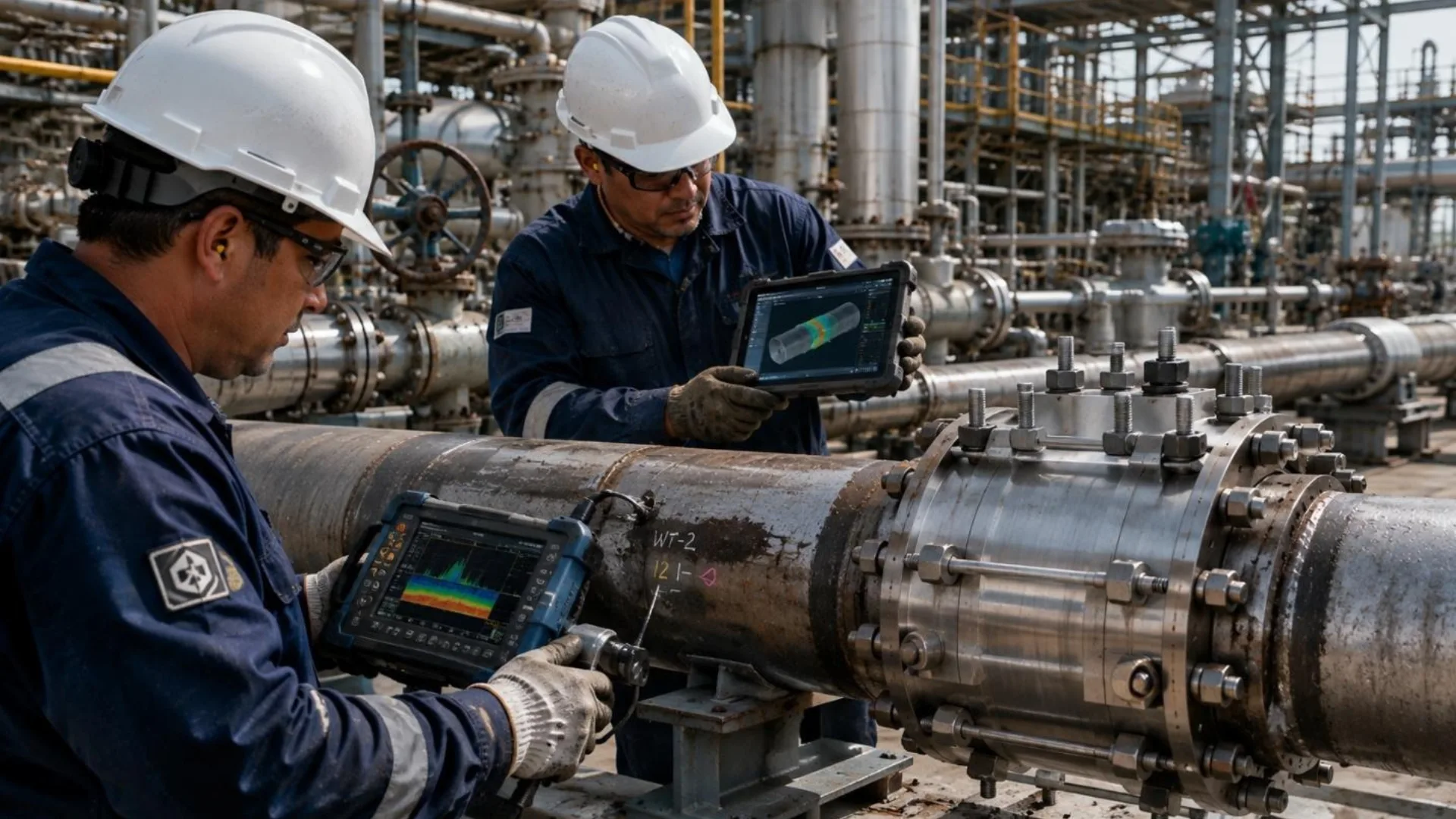
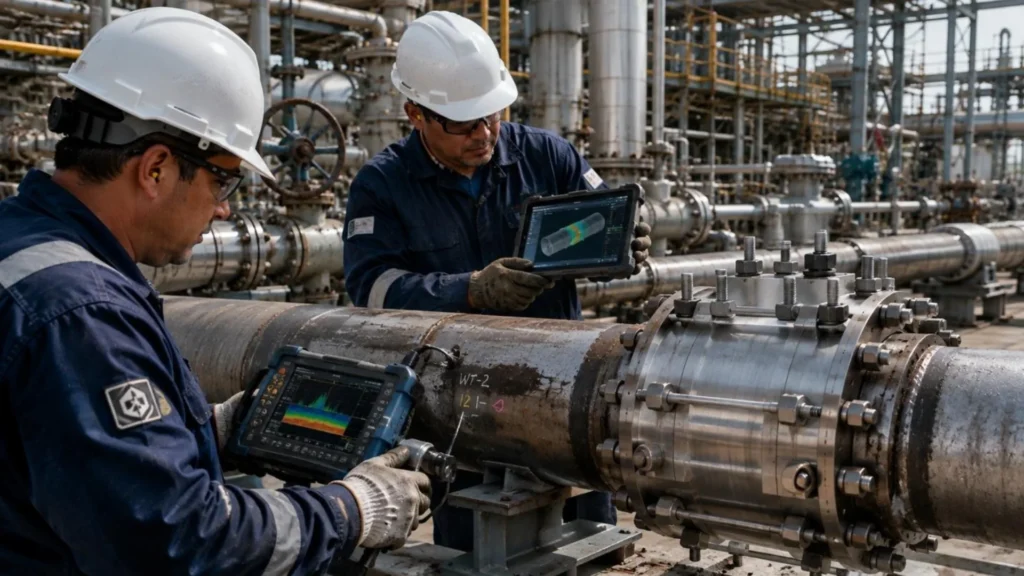
The evaluation begins with equipment inspection, using a targeted visual inspection (VT) and an analysis of the circuit’s history, to identify signs of corrosion, deformation, leaks, mechanical damage, or coating deterioration.
This initial inspection makes it possible to identify the areas that require a more detailed evaluation using nondestructive testing. An inspector certified under ASNT SNT-TC-1A must oversee this inspection process.
Ultrasonic thickness measurement (UT) remains the most widely used technique for quantifying wall thickness loss. When it is necessary to characterize internal discontinuities or evaluate critical welds, advanced technologies such as Phased Array Ultrasonic Testing (PAUT) or industrial radiography (RT) may be used, depending on access conditions and the type of damage expected.
The inspection results must be compared with the minimum wall thicknesses specified in the design and with the criteria defined by API 570 for in-service piping systems.
In cases where a loss of thickness compromises the component’s strength, a Fitness for Service (FFS) assessment in accordance with API 579 helps determine whether the asset can continue to operate, requires additional monitoring, or must be repaired or replaced.
Techniques used to inspect thin-walled pipes
| Technique | Application |
|---|---|
| VT | Identification of surface damage |
| UT | Thickness measurement |
| PAUT | Assessment of internal defects |
| RT | Weld inspection |
| FFS (API 579) | Remaining life assessment and serviceability evaluation |
Maintenance options for thin-walled pipelines
Once the condition of the asset has been assessed, the next step is to determine the most appropriate maintenance strategy. The decision should be based on technical criteria and not solely on the remaining wall thickness of the pipe.
- The damage mechanism, the rate of degradation, the operating conditions, and the criticality of the system are factors that directly influence the selection of the most appropriate alternative.
- When thickness loss is in its early stages and does not affect the integrity of the system, a periodic monitoring program may be sufficient. This strategy makes it possible to track the progression of deterioration and schedule future interventions based on reliable information.
If the damage is localized, there are various methods for repairing pipes while they are in service that allow the component’s capacity to be restored without interrupting production. These solutions help reduce downtime and optimize maintenance costs.
- Available options include composite repairs, mechanical sleeves, repair clamps, and welded liners. Each is designed for specific operating conditions and has advantages and limitations that must be evaluated before implementation.
Options for repairing a thin-walled pipeline
| Solution | Main application |
|---|---|
| Monitoring | Corrosión inicial |
| Composite repair | Corrosión localizada |
| Mechanical enclosure | Pérdida moderada de espesor |
| Repair clamp | Localized leaks |
| Welded sleeve | Structural reinforcement |
| Replacement | Severe damage or critical loss |
Among the various solutions available, the mechanical seal stands out for enabling in-service repairs when engineering conditions support its use.
The infographic in Figure 1 summarizes the main maintenance options for thin-walled pipes. Its purpose is to facilitate a comparison of each method based on the severity of the damage and its most common application in the industry.
Factors to consider when selecting the best option
There is no one-size-fits-all solution. The chosen alternative must address the damage mechanism, operating conditions, and integrity objectives defined by the operator.
A technically sound decision makes it possible to maintain safety, extend the asset’s useful life, and ensure operational continuity with the least possible risk.
Mechanical sleeve for repairing pipelines while in service
A mechanical sleeve is a pipe repair solution designed to reinforce a pipe that has lost wall thickness. Its purpose is to restore the structural integrity of the component without immediately replacing the affected section.
Its application must be supported by an engineering evaluation. Before installing it, it is essential to understand the damage mechanism, the remaining thickness, and the actual operating conditions.
The casing design takes into account variables such as pipe diameter, operating pressure, temperature, mechanical stresses, and material properties. These parameters make it possible to select a solution that is compatible with the condition of the asset.
When installed correctly, the enclosure redistributes the forces acting on the damaged area. This reduces the concentration of loads and helps maintain the integrity of the system while a permanent repair is planned, when necessary.
Advantages of a mechanical enclosure
One of the main advantages of a mechanical enclosure is that it allows repairs to be performed while the system is in operation. This reduces unscheduled downtime and helps maintain the facility’s operational continuity.
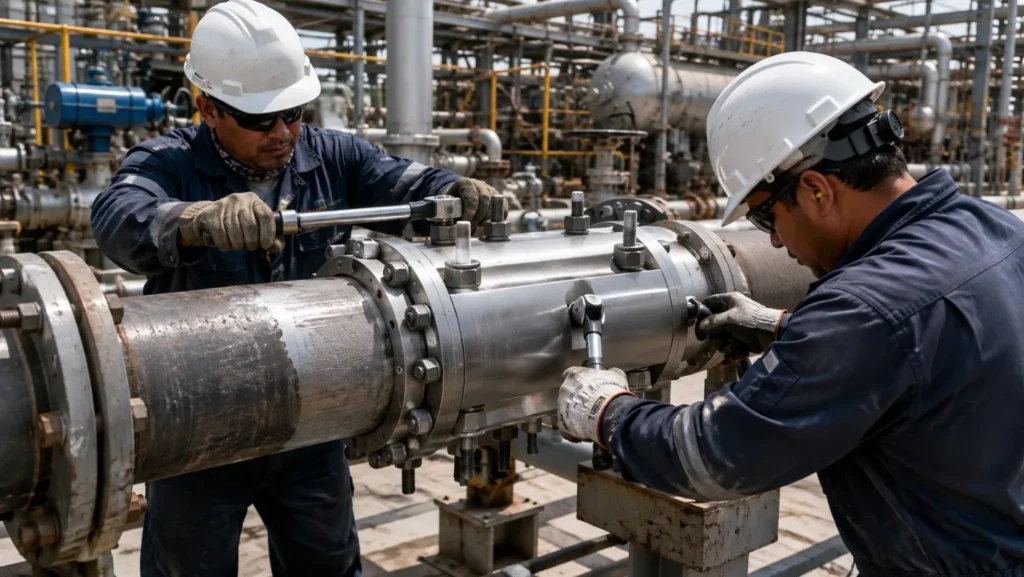
It also reduces service times. In many cases, it eliminates the need for extensive disassembly and minimizes the impact on production.
Another advantage is its adaptability. There are sleeves designed for repairs to straight pipelines, elbows, tees, and other complex geometries found in industrial installations.
The materials used must be compatible with the fluid, the temperature, and the operating environment. Proper selection enhances the effectiveness of the repair and extends the asset’s service life.
Materials used in a mechanical enclosure
The selection of materials is a critical factor in the performance of a mechanical seal. Each repair must be designed with consideration of the operating conditions, the process fluid, the operating temperature, and the damage mechanism identified during the integrity assessment.
The body of the sleeve is typically made of carbon steel or stainless steel, depending on compatibility with the pipe material and the environment to which the repair will be exposed. In highly corrosive applications, special alloys or chemically resistant materials may also be used.
Fasteners, such as studs and nuts, must have sufficient mechanical strength to withstand the forces transmitted during operation. Their selection must ensure uniform tightening and maintain the stability of the system throughout the expected service life of the repair.
When the mechanical seal housing incorporates sealing materials, these must be compatible with the process fluid and maintain their properties under operating pressure and temperature. An inappropriate selection can compromise the assembly’s seal integrity and reduce the reliability of the operation.
Compatibility among all the materials used in the repair is just as important as the structural design of the building envelope. Taking into account phenomena such as galvanic corrosion, thermal expansion, and the mechanical behavior of materials helps ensure safe performance and extend the service life of the repaired system.
Limitations of a mechanical enclosure
Mechanical liners do not replace an engineering analysis or correct the mechanism that caused the loss of thickness. Their performance depends on an accurate diagnosis and proper installation.
Before selecting this type of repair, the extent of the damage, the condition of the base material, and the system’s load conditions must be evaluated. Improper application can reduce the reliability of the repair.
It is also essential to verify the compatibility between the casing materials and the piping. Differences in mechanical behavior or corrosion resistance can affect performance during service.
When should it not be used?
A mechanical sleeve should not be installed when the pipe exhibits severe deformation, active cracks, excessive material loss, or damage that exceeds the limits established by the engineering evaluation.
Nor is it an adequate solution when the deterioration process continues to progress unchecked. In such cases, it is necessary to first eliminate the cause of the damage before determining any repair strategy.
The final decision must be based on an integrity assessment that takes into account operating conditions, the criticality of the asset, and the requirements of applicable standards.
Solutions available for in-service repairs
The selection of a mechanical envelope must be based on an engineering evaluation that takes into account the damage mechanism, thickness loss, operating conditions, and the criteria established in ASME PCC-2.
Currently, specialized companies such as TEAM Inc. develop solutions for repairing in-service pipes using mechanical sleeves, repair clamps, welded liners, and systems designed for complex geometries and service conditions.
These technologies make it possible to restore the integrity of assets and maintain operational continuity when engineering conditions allow for in-service repairs.
Learn about TEAM Inc.’s solutions for asset repair and integrity.
Voices from the Industry
Before selecting a repair strategy, it is essential to understand the actual condition of the asset. Advanced inspection provides the information needed to determine whether a pipeline can remain in service or requires immediate action.

In this interview, experts from TEAM Inc. explain how advanced inspection technologies help assess the integrity of pipelines and equipment before determining the most appropriate repair solution.
ASME PCC-2 for pipeline repair
The ASME PCC-2 standard provides engineering criteria for the repair of pressure equipment and piping. Its purpose is to guide the selection and application of repair methods that restore the integrity of the asset without compromising safety.
Rather than specifying a single procedure, the standard brings together various repair technologies and establishes the requirements that must be evaluated prior to their implementation. These include operating conditions, the mechanism of damage, the materials involved, and the required structural capacity.
ASME PCC-2 recognizes various options for repairing pipes with loss of wall thickness. The choice of method will depend on the nature of the damage and the objectives of the repair, whether it is to contain a leak, structurally reinforce the component, or extend its service life while a permanent repair is planned.
Applying these methodologies in accordance with engineering criteria helps improve asset reliability, reduce operational risks, and ensure that repairs are compatible with actual operating conditions.
Repair methods recognized by ASME PCC-2
| Method | Primary use |
|---|---|
| Mechanical envelope | External reinforcement |
| Repair clamp | Leak containment |
| Welded sleeve | Permanent reinforcement |
| Composite repair | Structural restoration |
Factors to consider when choosing an in-service repair
Not all pipelines with wall thinning require the same solution. The choice of repair method should be based on a technical assessment that takes into account the asset’s performance throughout its entire service life.
Among the most important factors are operating pressure and temperature, as they determine the loads that the repair will have to withstand. The characteristics of the fluid must also be evaluated, especially when it contains corrosive components or is subject to severe process conditions.
The estimated remaining service life of the asset, the geometry of the affected section, and the criticality of the system directly influence the decision. Similarly, it is essential to confirm that the active corrosion mechanism has been brought under control before carrying out any repairs.
A decision supported by inspection data, engineering analysis, and regulatory criteria allows for the selection of the safest, most reliable, and most cost-effective option for maintaining the integrity of the pipeline.
Benefits of repairing a pipeline without interrupting operations
In-service repairs allow operations to continue while the asset’s integrity is restored. When an engineering assessment confirms its feasibility, this strategy reduces the impact of downtime on production.
In addition to ensuring operational continuity, these interventions optimize the use of maintenance resources. They also offer greater flexibility in scheduling permanent repairs during planned outages.
Its implementation must be supported by inspection data, integrity analyses, and technical criteria. A properly designed repair helps extend the system’s service life without compromising safety.
Benefits of an in-service repair
| Benefit | Impact |
|---|---|
| Availability | Reduces unscheduled downtime |
| Security | Reduces the risk of leaks |
| Service life | Preserves the integrity of the assets |
| Costs | Reduces capital expenditures and corrective maintenance |
| Production | Ensures operational continuity |
Conclusions
Today, operators are seeking solutions that allow them to maintain production without compromising safety and mechanical integrity standards. Therefore, in-service repair of thin-walled piping represents a technical alternative when supported by inspection, engineering, and regulatory criteria.
The decision to repair or replace pipes does not depend solely on the remaining wall thickness. It also requires understanding the mechanism of damage, assessing the condition of the asset, and selecting the most appropriate solution for each scenario.
Applying this approach helps optimize costs, increase facility availability, and enhance operational reliability. In an environment where process continuity is a strategic factor, in-service repairs continue to establish themselves as a key tool for modern asset management.
Frequently Asked Questions (FAQs)
What does “thin-walled pipeline” mean?
This means that the pipe wall has lost material due to factors such as corrosion, erosion, or wear. This condition must be evaluated to determine whether the asset can continue to operate safely.
When should you replace a pipe with a thin wall?
When the loss of thickness exceeds acceptable limits, compromises structural integrity, or there is no technically feasible repair alternative according to the engineering assessment.
What is a mechanical envelope?
This is a repair system that externally reinforces a pipe that has lost wall thickness. Its design allows the structural integrity of the component to be restored without immediately replacing the affected section.
What is the difference between a clamp and a welded sleeve?
A clamp is primarily used to control leaks or reinforce specific areas using a mechanical system. A welded sleeve provides permanent reinforcement through welding and requires verification that the component is suitable for this type of repair.
What does ASME PCC-2 specify?
ASME PCC-2 establishes engineering criteria for selecting, designing, and applying various repair methods to pressure vessels and piping, including mechanical enclosures, clamps, welded liners, and composite repairs.
References
- American Petroleum Institute. API 570: Piping Inspection Code: In-service Inspection, Rating, Repair, and Alteration of Piping Systems (5th ed.).
- American Petroleum Institute. API Recommended Practice 571: Damage Mechanisms Affecting Fixed Equipment in the Refining Industry (3rd ed.).
- American Petroleum Institute. API Recommended Practice 574: Inspection Practices for Piping System Components (5th ed.).
- American Petroleum Institute. API Recommended Practice 579-1/ASME FFS-1: Fitness-For-Service (3rd ed.).
- American Petroleum Institute. API Recommended Practice 580: Risk-Based Inspection (3rd ed.).
- American Petroleum Institute. API Recommended Practice 581: Risk-Based Inspection Technology (3rd ed.).
- American Society of Mechanical Engineers. (2022). ASME PCC-2: Repair of Pressure Equipment and Piping.
- American Society of Mechanical Engineers. ASME B31.3: Process Piping.
- American Society for Nondestructive Testing. ASNT SNT-TC-1A: Personnel Qualification and Certification in Nondestructive Testing.