Table of Contents
- What helium is and what makes its properties unique
- Why helium cannot be manufactured
- How helium forms in the subsurface
- Where helium is obtained
- The world helium market and its strategic vulnerability
- How helium is produced: the cryogenic process step by step
- Cryogenic logistics and boil-off losses
- Helium from the subsurface to the processing plant
- Are there any helium derivatives?
- Helium-3: the isotope with a supply chain of its own
- Helium applications in the energy sector
- Helium and the new energies: enabler, not fuel
- Summary: helium function and margin for substitution
- Implications for the energy industry
- Conclusions
- Reerences
- Frequently Asked Questions (FAQs)
Helium in the energy sector occupies a unique position among strategic materials. It does not combust, does not store usable chemical energy, and does not participate in any process reaction. However, there are entire energy technologies that cannot operate without it: high-temperature nuclear reactors, superconducting magnets in fusion devices, and leak testing in cryogenic and process systems.
That condition places helium in the same conceptual category as lithium, cobalt or the rare earths. It is not an energy source; it is an enabler without substitute. And unlike those materials, it carries a further complication that sharpens its criticality: helium is not produced by choice. It is obtained as a by-product of natural gas processing, which means its availability depends on investment and operating decisions taken in another industry, for reasons that have nothing to do with helium.
This article sets out the geological origin of the resource, the cryogenic production route, the distinction between its isotopes and physical states, and its applications across the energy sector, at the level of detail a process, integrity or planning engineer requires.
What helium is and what makes its properties unique
Helium is the second element of the periodic table and the first of the noble gas group. Its 1s² electron configuration corresponds to a closed shell, and every one of its application properties derives from that structure.
The five properties that define its industrial use
- Complete chemical inertness. Helium has the highest first ionisation energy of any element, at 24.59 eV. It forms no stable compounds under process conditions, does not react with hydrocarbons, and neither oxidises nor dissociates. This makes it suitable as a working fluid in circuits where any reactivity would compromise material integrity or system safety.
- The lowest boiling point of any known substance. At normal atmospheric pressure, helium-4 liquefies at 4.22 K (−268.93 °C). It also fails to solidify at atmospheric pressure even close to absolute zero: roughly 25 bar is required to reach the solid phase. It is therefore the only fluid capable of acting as a refrigerant in the kelvin range, a condition without which low-temperature superconductivity is not possible.
- Minimum kinetic diameter. With a kinetic diameter of approximately 2.6 Å, helium passes more readily than any other gas through discontinuities, pores and leak paths. That property, combined with its extremely low atmospheric background concentration of 5.2 ppm, makes it the reference tracer gas for high-sensitivity leak testing.
- High thermal transport capacity. Its specific heat at constant pressure, close to 5.19 kJ/kg·K, is roughly five times that of air, and its thermal conductivity comfortably exceeds that of other inert gases. In a forced-circulation cooling circuit, this allows substantial thermal power to be removed at moderate mass flow rates.
- Neutron transparency. Its thermal neutron absorption cross-section is effectively nil. As a nuclear coolant it does not activate, introduces no parasitic reactivity, and generates no activation products to complicate maintenance of the primary circuit.
Why helium cannot be manufactured
Unlike nitrogen, oxygen or argon, which are obtained by cryogenic distillation of air in practically unlimited quantities, atmospheric helium is present at a concentration so low that recovering it from air is only economically viable as a co-product of neon extraction, and even then in marginal volumes.
Terrestrial helium must be extracted from the subsurface. And once released into the atmosphere, its low molecular mass allows it to reach escape velocities in the exosphere, so that it leaves the planet irreversibly. It is, in the most literal sense of the term, a non-renewable resource on a human timescale: to consume it is to lose it for good.
How helium forms in the subsurface
Understanding where helium comes from is what explains why only a handful of gas fields worldwide contain it at usable concentrations.
Radiogenic helium-4: the alpha particle as origin
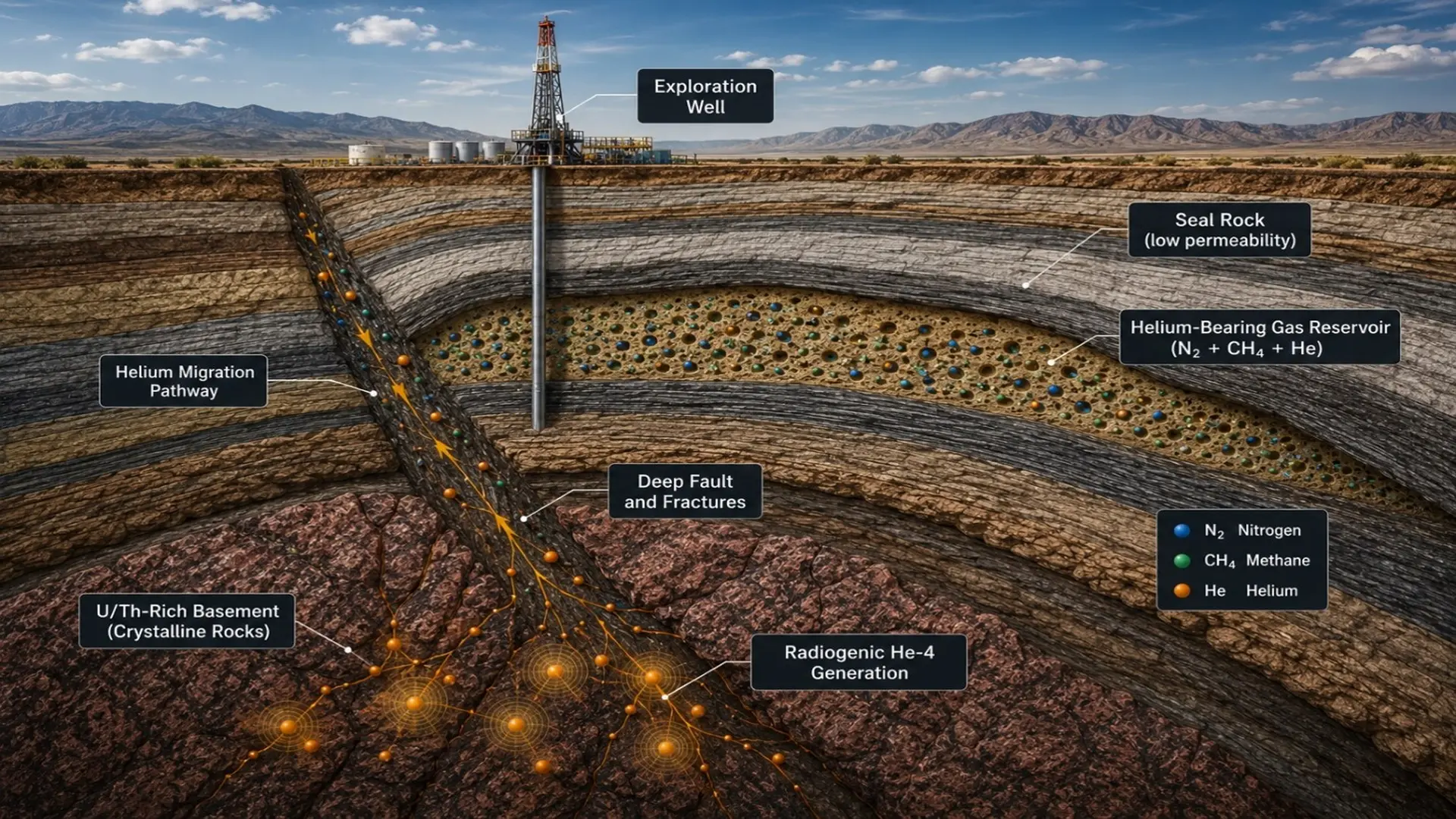
Most of the helium-4 accumulated in commercial reservoirs is radiogenic in origin. A helium-4 nucleus is identically an alpha particle, and alpha particles are the product of decay of the heavy elements present in the crystalline basement of the continental crust.
The three relevant decay series differ quantitatively: the uranium-238 chain to lead-206 emits eight alpha particles; uranium-235 to lead-207 emits seven; and thorium-232 to lead-208 emits six. Each alpha particle captures two electrons from the mineral environment and becomes a helium atom.
Granitic rocks and pegmatites of the Precambrian basement, enriched in uranium and thorium, are the source rocks par excellence. The process is extraordinarily slow — the half-lives involved are on the order of 10⁹ to 10¹⁰ years — which means a commercial helium accumulation represents hundreds of millions of years of atomic production. This is the underlying reason the resource does not regenerate on operational timescales.
Primordial helium-3 and the isotopic ratio as a tracer
Helium-3 has a different origin. A fraction of it is primordial: trapped in the mantle during planetary accretion and not regenerated since. Its presence in a geological fluid is therefore a direct indicator of mantle contribution.
The diagnostic tool is the ³He/⁴He isotopic ratio, normalised against the atmospheric value and expressed as R/Ra, where Ra is approximately 1.39 × 10⁻⁶. Fluids of radiogenic crustal origin show very low values, on the order of 0.02 to 0.05 Ra. Mid-ocean ridge basalts, of mantle origin, sit close to 8 Ra. An intermediate value indicates mixing.
For the explorer, this makes helium an instrument as well as a target: the isotopic signature allows the origin of a fluid to be discriminated, active deep fault systems to be identified and, a point we return to later, natural hydrogen systems to be characterised.
The helium petroleum system
Helium exploration replicates the logic of the conventional petroleum system, with four elements that must coincide in time and space.
- Source rock: the crystalline basement rich in U and Th. Unlike petroleum, generation is not thermal but nuclear, and it is continuous from the moment the rock forms.
- Release and migration mechanism: the helium generated is initially retained within the mineral lattice. Its release requires a thermal, tectonic or fracturing event that opens the crystalline structure. Once free, it migrates dissolved in deep groundwater or as a gas phase through fault systems, and subsequently exsolves on reaching zones of lower pressure.
- Reservoir: a porous, permeable unit where the helium accumulates, almost always associated with a carrier stream of natural gas or nitrogen.
- Seal: this is the most restrictive element and explains why such reservoirs are rare. Given its atomic diameter, helium diffuses through seals that are perfectly effective against methane. Conventional shales do not retain it indefinitely. Only evaporitic seals — halite and anhydrite — offer the impermeability needed to preserve a helium accumulation over geological time. The presence of an evaporitic sequence above the reservoir is, in practice, the single most powerful discriminating criterion in helium exploration.
The association with nitrogen
In most commercial reservoirs, helium appears alongside nitrogen at elevated concentrations. The reason is that both share the same migration vehicle and the same trapping conditions, and both are inert gases that survive processes which would degrade hydrocarbons. This coexistence carries a decisive process consequence: helium separation is executed, in practice, within the nitrogen rejection unit of the gas plant.
Where helium is obtained
The economic concentration threshold
Not every gas field produces helium. In the United States, fields with content above 0.3 % are classified as helium-rich, although most operations extract helium from reservoirs holding less than 1.5 % (Hu & Li, 2025). That value operates as a classification criterion rather than an absolute viability threshold, since project-specific conditions and the value of the other products in the stream can shift it.
Estimated energy costs for conventional processes illustrate the scale of the effect: on the order of 18 kWh/m³ with a feed at 0.35 % helium, around 100 kWh/m³ at 0.05 % and approximately 250 kWh/m³ at 0.02 % (Hu & Li, 2025). The curve is strongly non-linear. It is worth noting, however, that the threshold is not fixed: the same authors point out that large-scale natural gas liquefaction is financially viable at helium concentrations of as little as 0.04 %, and that the industrial minimum shifts as separation technology advances.
Commercially exploitable reservoirs typically contain between 0.3 % and 7 % helium, with exceptional cases above that range. The overwhelming majority of the world’s gas fields sit far below it, and their helium is vented to atmosphere during processing.
The scale paradox
There is an important exception to the concentration criterion, and it explains much of the current structure of world supply: when the volume of gas processed is large enough, concentrations well below the threshold become profitable.
A natural gas liquefaction complex processing tens of millions of tonnes a year generates a cryogenic reject stream of such volume that even a helium fraction on the order of hundredths of a percentage point represents a commercially significant flow. The incremental investment in the recovery unit is amortised against a stream that already exists, not against a standalone project.
From this derives a structural vulnerability worth understanding: world helium production is concentrated in a small number of large-scale processing complexes. If one of them halts LNG production, its helium ceases to exist for the market immediately and completely, regardless of price. No supply elasticity is possible, because helium cannot be produced without producing gas.
Global distribution of production
The United States has historically been the largest producer, with the Hugoton-Panhandle fields across Texas, Oklahoma and Kansas, the LaBarge field in Wyoming and the Cliffside field near Amarillo. To these are added Qatar, Algeria, Russia and Australia as significant producers, along with more recent projects in South Africa and East Africa.
A fundamental institutional change was completed in 2024: the United States Bureau of Land Management finalised the sale of the Federal Helium System — comprising the reserve, the Cliffside field with its wells, a 423-mile helium pipeline and associated operating assets — to Messer, closing a federal programme initiated in 1925. With it, the last public strategic buffer in the world market disappeared, and the entire chain passed into private operation.
Emerging and unconventional sources
Three routes are broadening the resource base beyond conventional natural gas. Recovery from LNG terminal boil-off gas exploits a stream that until now was reprocessed or flared. Extraction from carbon dioxide streams of geological origin, applied commercially in Colorado, demonstrates that the carrier need not be a hydrocarbon. And nitrogen-helium systems without associated hydrocarbons, in cratonic basins, now constitute an exploration category in their own right, with helium as the primary target rather than a by-product.
The world helium market and its strategic vulnerability
The scale of the market is surprisingly small. World production stood at around 180 million cubic metres in 2024, with an estimate close to 190 million for 2025 (USGS, 2025, 2026). United States sales of Grade-A and gaseous helium alone were valued at approximately USD 1.1 billion, at a base price on the order of USD 14 per cubic metre. This is a market of billions, not hundreds of billions: its criticality derives not from economic volume but from the absence of any substitute.
Geographic concentration is the structural fact. In 2024 the United States contributed 81 million cubic metres between natural gas extraction and withdrawals from the Cliffside field, and Qatar 64 million; between them they exceeded 80 % of the world total. They were followed by Russia with 17, Algeria with 11, Canada with 6, and China and Poland with 3 each. For 2025, estimates place the United States at around 42 % and Qatar close to 33 %, preserving the same configuration: two countries account for three-quarters of supply.
Resources follow a different pattern from production. Outside the United States, world resources were estimated at some 31.3 billion cubic metres, distributed chiefly among Qatar (10.1 billion), Algeria (8.2 billion), Russia (6.8 billion), Canada (2.0 billion) and China (1.1 billion). The United States additionally holds a mean recoverable volume estimated at 8.49 billion cubic metres within known gas reservoirs, concentrated in the Midcontinent and Rocky Mountain regions. The resource, therefore, is not scarce: what is scarce is installed processing capacity.
Supply has shown signs of diversification. World production grew by 4 % in 2024, with three new facilities in Canada and four new operations in the United States, and with projects exploring deposits of non-hydrocarbon origin. Even so, the USGS outlook points to stable or moderately growing capacity through 2029, without the step change anticipated for other critical materials.
Geopolitical exposure has already materialised on two fronts. In June 2024 the European Union adopted a sanctions package prohibiting imports of Russian helium from September of that year, removing a significant producer from the European market. And in 2026 the interruption of production at Ras Laffan affected the world’s second-largest producer, with immediate consequences for the Asian semiconductor industry. Both episodes illustrate the same structural vulnerability: when production is subordinated to large-scale gas complexes and concentrated in few jurisdictions, a geopolitical event transmits to supply with no possible buffering.
On the demand side, the 2024 United States consumption profile offers the most detailed reference available: analytical, engineering, laboratory and speciality gases (22 %), lifting gas (18 %), magnetic resonance imaging (17 %), controlled atmospheres, optical fibre and semiconductors (15 %), welding (8 %), aerospace, pressurising and purging (7 %), leak detection (5 %), diving (5 %) and other uses (3 %). The energy and integrity applications analysed here are distributed across several of those categories, and their weight will grow if high-temperature nuclear power and fusion advance towards commercial deployment.
One final figure defines the room for manoeuvre: in the United States, helium used in high-volume applications is rarely recycled, whereas elsewhere in the world the practice is more widespread. Recovery is therefore not a technological frontier but an investment decision still pending across much of the industrial base.
How helium is produced: the cryogenic process step by step
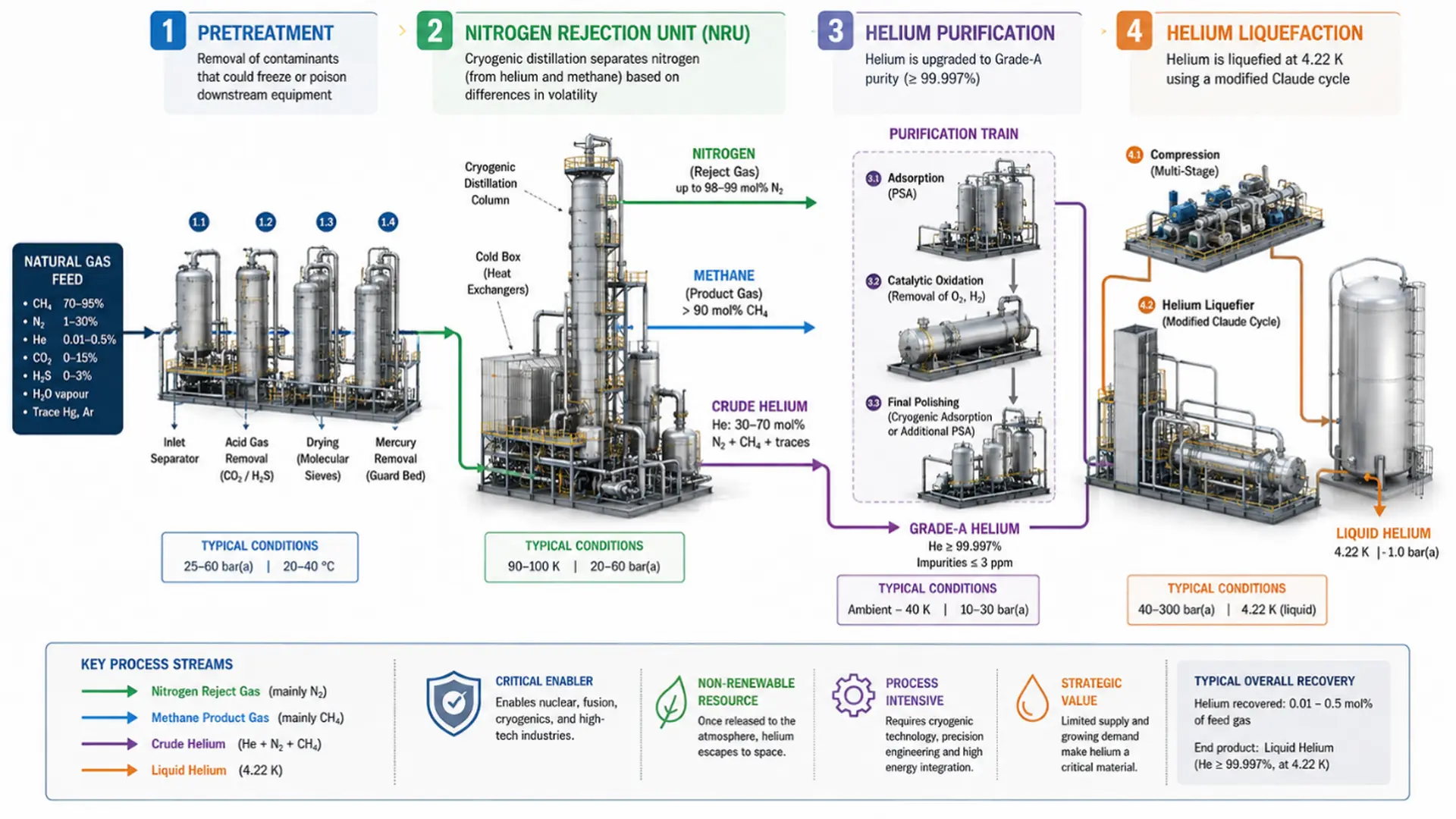
The industrial process for obtaining Grade-A helium comprises four linked stages, each with specific requirements for conditioning the stream.
Stage 1. Pre-treatment and conditioning
Before any cryogenic operation, the stream must be free of every component that would solidify or corrode at low temperature. Dehydration using molecular sieves reduces water content to parts-per-million levels, since ice irreversibly blocks the diffusion-bonded brazed aluminium plate-fin exchangers.
Carbon dioxide removal, by amine sweetening or adsorption, is equally mandatory: CO₂ solidifies at around 216 K and blocks the cold train. Hydrogen sulphide is removed for reasons of corrosion and product specification. Finally, mercury removal is critical and frequently underestimated: elemental mercury causes amalgamation embrittlement in cryogenic aluminium exchangers, with catastrophic and well-documented failure modes in the LNG industry.
Stage 2. Nitrogen rejection and crude helium recovery
The heart of the process is the nitrogen rejection unit. In a cryogenic distillation column operating typically between 90 and 100 K, the stream separates by volatility: methane is recovered at the bottom as sales product or liquefaction feed, nitrogen concentrates in the upper section, and helium — by far the most volatile component of the mixture — accumulates at the column head.
The overhead stream constitutes crude helium, at a purity that, depending on plant configuration, typically sits between 30 % and 70 % molar, the remainder being principally nitrogen with traces of methane and hydrogen. This is the product transported by helium pipeline or fed to the purification unit at the same facility.
Stage 3. Purification to Grade A
Helium of industrial specification, designated Grade A, requires a minimum purity of 99.997 %. Reaching it from crude helium demands a combination of separation technologies.
Pressure swing adsorption over molecular sieves and activated carbon removes nitrogen, methane and hydrocarbon traces, exploiting helium’s practically nil adsorption affinity. Polymeric membrane separation, whose selectivity rests on the difference in molecular size, is employed as a pre-concentration or tail-recovery stage. Catalytic oxidation followed by dehydration eliminates residual hydrogen. And a final cryogenic adsorption stage over activated carbon, operating at around 77 K, captures the last impurities and defines product purity.
One economically relevant aspect: in membrane-based recovery schemes, the compression stage constitutes the principal cost component of the process, in both capital and operating terms, owing to the energy required to raise permeate pressure at each separation stage.
Stage 4. Liquefaction
For long-distance transport, helium is liquefied. The reason is logistical energy density: one cubic metre of liquid helium is equivalent to roughly 750 cubic metres of gaseous helium at normal conditions, a difference that makes international trade in the gaseous phase unworkable.
Liquefaction employs a modified Claude cycle with turboexpanders and multistage regeneration. The helium is compressed, pre-cooled with liquid nitrogen at 77 K, and brought down progressively through successive expansions to the liquefaction temperature of 4.22 K. It is one of the most demanding refrigeration processes in industry, and the number of helium liquefaction plants worldwide is far smaller than the number of plants producing crude helium.
Cryogenic logistics and boil-off losses
Liquid helium is transported in cryogenic ISO containers with multilayer vacuum insulation, maintained below 4.3 K. The enthalpy of vaporisation of helium is extraordinarily low — approximately 20.7 kJ/kg, two orders of magnitude below that of water — so any heat ingress produces immediate evaporation.
This carries a direct commercial consequence: the product evaporates in transit, and the volume delivered depends on journey time. A logistical delay does not make helium more expensive: it evaporates it. And the boil-off gas vented during the journey, with no recovery system on board, leaves the commercial inventory permanently. For that reason, disruptions to maritime routes affect the helium market with a severity that has no equivalent among other industrial gases.
Helium from the subsurface to the processing plant
This tour of the facilities of the former United States National Helium Reserve shows how helium can be stored in geological formations, recovered together with other gases and subsequently enriched prior to commercial purification. Although the video reflects the state of the United States reserve at the time of filming, it offers a visual reference of considerable value regarding the infrastructure and processes associated with the industrial helium chain. Video courtesy of the Tom Scott YouTube channel.
Are there any helium derivatives?
The question comes up often and deserves a precise answer, because the correct one is not the intuitive one.
A noble gas generates no chemical derivatives
Helium has no derivatives in the sense that natural gas or petroleum do. There is no helium petrochemical chain, no conversion products, no commercial compounds. Its closed electron shell prevents the formation of stable bonds under any industrial process condition.
Its true “derivatives” are of a different nature: isotopic variants and physical states, each with distinct applications and separate supply chains.
Physical states as differentiated products
- Gaseous helium. Used in protective welding atmospheres, as a leak-tightness tracer gas, and for purging, pressurising and deep-diving breathing mixtures.
- Liquid helium, He-I. Between 4.22 K and 2.17 K it behaves as a conventional cryogenic fluid, with normal viscosity and surface tension. It is the refrigerant of commercial superconducting magnets.
- Superfluid helium, He-II. Below the lambda point at 2.17 K, helium-4 undergoes a phase transition into a macroscopic quantum state. Its viscosity vanishes, its effective thermal conductivity becomes orders of magnitude greater than that of any metal, and it develops the ability to flow along surface films against gravity. In engineering terms, He-II is a thermal transport medium without equivalent, employed in the most cryogenically demanding systems.
- Supercritical helium. Above the critical point 5.2 K and 2.27 bar, helium is used in forced-flow magnet cooling circuits, where the absence of phase change eliminates two-phase flow instability and guarantees thermal stability under variable load.
Helium-3: the isotope with a supply chain of its own
Helium-3 represents approximately 0.000137 % of terrestrial atmospheric helium. Its extreme scarcity means that its principal practical source of supply is not isotopic separation from natural helium, but recovery of the helium-3 generated by beta decay of tritium, whose half-life is approximately 12.3 years. This process occurs in tritium inventories associated mainly with nuclear programmes and facilities, from which accumulated helium-3 can be recovered, purified and directed to specialised applications.
This particular provenance profoundly conditions its market. Unlike helium-4, whose availability is linked principally to the extraction and processing of certain natural gas streams, helium-3 supply depends on limited tritium inventories and on their accumulation through radioactive decay. That constraint explains its high criticality and an economic value that can sit several orders of magnitude above helium-4.
Its principal applications include neutron detection, exploiting its high capture cross-section, in radioactive material detection systems and scientific neutron scattering facilities. It is also essential in dilution refrigerators used to reach extremely low temperatures in quantum computing and experimental physics. Over the longer term, helium-3 is being studied as a possible fuel for certain aneutronic fusion pathways, although this application remains prospective and faces significant technological and isotope-availability challenges.
An important terminological note for the sector: when a “helium crisis” is discussed, it is essential to specify the isotope. Disruptions related to natural gas production and processing affect principally helium-4. The availability of helium-3 responds to a different supply chain, conditioned mainly by tritium inventories, their decay and the existing capacity to recover and purify the isotope.
Helium applications in the energy sector
Helium as a nuclear coolant
High-temperature gas-cooled reactors employ pressurised helium as the primary coolant and graphite as the moderator. The reason for that choice is thermohydraulic before it is economic. By operating always in the gas phase, the primary circuit eliminates at the root three failure modes characteristic of water-cooled reactors: no boiling crisis can occur, no two-phase flow instabilities arise, and there is no depressurisation accompanied by phase change. To this are added two attributes of the fluid already set out: its chemical inertness, which rules out coolant attack on the graphite and structural alloys, and its neutron transparency, which prevents the formation of activation products in the primary circuit and simplifies maintenance.
Operating parameters allow the scope of the technology to be gauged. The Xe-100 design develops 200 MWt per module and delivers, through a helical coil steam generator, superheated steam at conditions of 565 °C and 16.5 MPa (X-energy, n.d.). That thermal level is what opens up the range of non-electrical applications: process heat supply to refineries and petrochemical plants, industrial cogeneration and, in higher outlet-temperature variants, thermochemical hydrogen production. The commercial operating reference comes from China, where the HTR-PM plant in Shandong province runs two pebble-bed reactors.
Cryogenics of superconducting magnets in fusion
Every magnetic confinement device built with low-temperature superconductors is a structural consumer of helium, and not at an isolated point of the design but across three subsystems simultaneously. The ITER case allows this to be gauged precisely: the superconducting windings operate at 4 K with supercritical helium, a condition without which the field intensities demanded by plasma confinement and stabilisation are unattainable; the thermal shield enveloping the assembly is sustained by forced circulation of helium at 80 K; and the vacuum of the torus and cryostat is maintained by cryoadsorption panels likewise cooled with supercritical helium (ITER Organization, n.d.).
The long-term implication deserves attention in any serious analysis of the energy transition: if magnetic confinement fusion scales commercially, every plant will incorporate a cryogenic helium inventory of considerable magnitude, and demand will grow in step with deployment. It is a dependency little discussed in the energy policy literature.
Leak-tightness verification and asset integrity
In mechanical integrity, helium is the reference tracer gas for high-sensitivity leak testing. Mass spectrometer detection achieves sensitivities on the order of 1 × 10⁻⁹ atm·cc/s in detector-probe and tracer-probe techniques, in accordance with the requirements of ASME Section V, Article 10.
Applications across energy assets are extensive: verification of floating roof compartments and pontoons in storage tanks, double bottoms of atmospheric tanks, heat exchangers, pressure vessels, process lines, drainage systems and LNG cryogenic systems. Helium mass spectrometry is among the most sensitive techniques available industrially for leak detection, and its combination of sensitivity, chemical inertness and low atmospheric background explains why it constitutes the reference method in critical applications. Hence supply restrictions translate directly into rescheduling of plant turnarounds.
Purging, inerting, and pressurising
In cryogenic and hydrogen systems, helium performs functions no other gas can substitute. During start-up and shutdown of LNG trains, nitrogen solidifies at operating temperatures and is unusable as a purge medium; helium remains gaseous across the entire range. In high-purity hydrogen systems, it is used to displace the atmosphere before fuel is introduced, eliminating the risk of a flammable mixture. And in propulsion with cryogenic propellants, it acts as pressurising gas for liquid methane and hydrogen tanks.
Helium and the new energies: enabler, not fuel
Why helium is not an energy source
This is worth stating plainly, because the classification frequently circulates in incorrect form. Helium stores no recoverable chemical energy, does not combust, does not convert and takes part in no exothermic reaction under industrial conditions. In every energy circuit it acts as a medium: it transports heat, maintains temperature, verifies leak-tightness or displaces atmospheres. Its correct taxonomic place is that of a critical enabling material, alongside lithium, cobalt or the rare earths.
And there is a notable symmetry that illustrates its role: helium-4 is, literally, the product of fusion. Every deuterium-tritium reaction generates a helium-4 nucleus as ash. The gas required to cool the magnets is the same one that emerges from the plasma.
Helium-3 and aneutronic fusion
There is a single scenario in which helium would indeed be a fuel. The D-³He reaction fuses a deuterium nucleus with a helium-3 nucleus and produces a helium-4 nucleus and a high-energy proton, releasing 18.3 MeV. Its appeal is that it is aneutronic: by generating charged particles rather than energetic neutrons, it avoids activation of reactor components and opens the possibility of direct conversion to electricity through interaction with the confining electromagnetic field.
The barriers are formidable. The Coulomb barrier of the reaction is substantially higher than that of D-T, demanding far higher plasma temperatures, and terrestrial helium-3 availability falls short by several orders of magnitude. Hence the recurring interest in the lunar regolith, where the solar wind has implanted helium-3 over billions of years. It is a speculative horizon, but a technically legitimate one and worth following.
Convergence with natural hydrogen
The most relevant development for the new energy sector is the exploratory convergence between helium and geological hydrogen. Both are generated in partly shared lithological contexts, ancient cratonic rocks, rift systems, fractured basement, and both require high-integrity seals, which means exploration for one directly informs the other.
The economic logic may prove decisive. Natural hydrogen has a low value per unit volume, whereas helium is priced in the tens of thousands of dollars per tonne. The coexistence of helium may therefore constitute the commercial lever that finances geological hydrogen exploration, in a manner analogous to how natural gas liquids once sustained dry gas developments.
Field evidence supports this reading. Geological hydrogen is documented in ultramafic complexes, sedimentary basins and active fault zones, the same settings where radiogenic helium finds migration pathways, with pilot projects under way in Mali, Oman, Brazil, France and Australia (Zeng et al., 2026). The coexistence of both gases in those systems is what underpins the economic argument, irrespective of the specific proportions of each accumulation, which vary widely between basins.
Summary: helium function and margin for substitution
The table below summarises the central argument of this article. Substitutability depends not on the sector but on the specific function helium performs in each case.
| Application | Function of helium | Is substitution viable? |
| HTGR reactors | Primary circuit coolant | Very limited. No other gas reproduces the combination of inertness, single phase and neutron transparency |
| Magnetic fusion | Cooling of superconducting magnets at 4 K | Very limited. No fluid operates in the kelvin range; high-temperature superconductors could reduce the dependency in future |
| LNG and cryogenics | Purging, inerting and train start-up | Depends on the function. Nitrogen solidifies at operating temperatures and is unusable as a purge medium at that stage |
| Mechanical integrity | Tracer gas for leak testing | Alternatives exist depending on the sensitivity required, such as hydrogen in a 5/95 mixture; helium retains an advantage through inertness and low background |
| Hydrogen | Purging and leak-tightness verification | Depends on the service. In high-purity systems the margin is narrow because of flammable mixture risk |
| Helium-3 in fusion | Prospective fuel (D-³He reaction) | Not applicable. Non-commercial technology and isotope availability short by several orders of magnitude |
Note: in cryogenic applications requiring temperatures below −229 °C, there is no substitute for helium. For uses where temperature is not the determining factor, the USGS recognises partial substitutions: nitrogen in high-temperature superconductors, argon in welding, and hydrogen in lighter-than-air applications and deep diving (USGS, 2025).
Implications for the energy industry
Supply criticality in plant turnarounds
The combination of three factors, production subordinated to another industry, concentration of processing infrastructure, and physical loss of product in transit, makes helium one of the most fragile industrial supply chains in existence. Shortage episodes are recurrent: the industry has passed through several deficit cycles since 2006.
For those responsible for integrity and turnaround planning, the practical consequence is concrete. Helium-based leak-tightness procedures do not admit trivial substitution, and a supply restriction translates into rescheduling risk. The technical recommendation is to incorporate tracer gas availability as an explicit variable in major turnaround planning, at the same level of priority given to scaffolding availability or certified personnel.
Recovery and recycling at high-consumption facilities
Any facility with significant continuous consumption should evaluate boil-off gas recovery systems. Closed systems with recondensation allow substantial reductions in net consumption, and their payback period shortens with every upward price cycle. In cryogenic research facilities and imaging centres this practice is already well established; in the energy industry it remains a widely underexploited opportunity.
Conclusions
Global helium availability does not respond autonomously to the dynamics of its own market; rather, it is directly conditioned by investment and operational decisions within the natural gas industry.
In critical applications, such as extreme cryogenic cooling and next-generation nuclear reactors, the technical substitution of helium is extremely limited or non-existent. In tasks where alternatives exist (such as leak detection), their feasibility depends on the required sensitivity and system conditions. Therefore, rigorous risk management must comprehensively evaluate both supply chain security and the real feasibility of substitution.
ts central function in the development of new energy technologies is not to act as a fuel, but as an indispensable enabler. Understanding it under this premise is key to accurately gauging its true scope, strategic value, and operational limits.
The energy future will depend not only on new sources of energy, but also on materials capable of making them technically possible. Helium belongs precisely to that category: invisible within the energy balance, yet critical to some of the technologies set to transform industry. Understanding its origin, availability and supply chain will therefore be as important as understanding the technologies that depend on it.
Reerences
- Air Liquide Advanced Technologies. (s. f.). Helium-3. https://advancedtech.airliquide.com/solutions/science/helium-3
- American Society of Mechanical Engineers. (2023). ASME Boiler and Pressure Vessel Code, Section V, Article 10: Leak testing. ASME.
- Bureau of Land Management. (2024, 27 de junio). BLM completes sale of Federal Helium System. U.S. Department of the Interior. https://www.blm.gov/press-release/blm-completes-sale-federal-helium-system
- Hu, Z., & Li, J. (2025). A review of helium resources and development. Natural Gas Industry B, 12(3). https://doi.org/10.1016/j.ngib.2025.05.008
- ITER Organization. (s. f.). Cryogenics. https://www.iter.org/machine/supporting-systems/cryogenics
- Messer. (2024, 27 de junio). Messer completes acquisition of Federal Helium System from BLM. https://www.messer-us.com/press-releases/messer-completes-acquisition-of-federal-helium-system-from-blm
- National Research Council. (2000). The impact of selling the Federal Helium Reserve. The National Academies Press. https://doi.org/10.17226/9860
- Scholes, C. A., Gosh, U. K., & Ho, M. T. (2017). The economics of helium separation and purification by gas separation membranes. Industrial & Engineering Chemistry Research, 56(17), 5014-5020. https://doi.org/10.1021/acs.iecr.7b00976
- U.S. Geological Survey. (2025). Mineral commodity summaries 2025: Helium. https://pubs.usgs.gov/periodicals/mcs2025/mcs2025-helium.pdf
- U.S. Geological Survey. (2026). Mineral commodity summaries 2026 (ver. 1.1). https://doi.org/10.3133/mcs2026
- World Economic Forum. (2024). White hydrogen: 5 of the most critical questions answered. https://www.weforum.org/stories/2024/08/white-hydrogen-5-critical-questions-answered/
- X-energy. (s. f.). Xe-100: High-temperature gas-cooled nuclear reactors. https://x-energy.com/xe-100/
- Zeng, L., Sander, R., Salimzadeh, S., Lupton, N., & Musa, M. (2026). Natural hydrogen: Generation mechanisms, occurrence, challenges and future prospects. Gas Science and Engineering, 152, 205928. https://doi.org/10.1016/j.jgsce.2026.205928
Frequently Asked Questions (FAQs)
Where does the helium used in industry come from?
From natural gas processing. Helium is concentrated in the cryogenic reject stream of gas plants and LNG liquefaction facilities, within the nitrogen rejection unit. It is neither manufactured nor recovered from air in commercial quantities, because its atmospheric concentration is only 5.2 ppm. Commercial helium-4 comes principally from geological accumulations dominated by radiogenic helium generated by alpha decay of uranium and thorium.
What is the minimum helium concentration for extraction to be profitable?
The established criterion places the threshold at around 0.3 % molar. Below that, the energy cost of concentration rises non-linearly: from around 18 kWh/m³ at 0.35 % helium to close to 250 kWh/m³ at 0.02 %. There is a relevant exception: at very large-scale LNG complexes, lower concentrations become viable because the incremental investment is amortised against a process stream that already exists.
Is helium an energy source?
No. Helium stores no usable chemical energy and takes part in no industrial exothermic reaction. Its function is that of a critical enabling material: coolant for high-temperature reactors, cryogenic medium for superconducting magnets, and tracer gas for leak testing. The only prospective exception is helium-3 as a fuel for deuterium-helium-3 aneutronic fusion, still at the experimental stage and constrained by isotope availability.
What is the difference between helium-3 and helium-4?
They have entirely separate supply chains. Helium-4 is extracted from natural gas and is the one used in cryogenic refrigeration, welding and leak detection. Helium-3 comes from beta decay of tritium in nuclear programme inventories, represents a minute fraction of natural helium and costs some three orders of magnitude more. It is used in neutron detection, dilution refrigerators for quantum computing and, prospectively, aneutronic fusion.
Why can helium not be substituted in leak testing?
Because of three properties acting simultaneously: it is the gas with the smallest kinetic diameter, allowing it to pass through leak paths other gases do not penetrate; it is chemically inert, so it reacts neither with the material nor with the contained product; and its atmospheric background concentration is only 5.2 ppm, giving a signal-to-noise ratio unattainable with other tracers. That combination allows sensitivities on the order of 1 × 10⁻⁹ atm·cc/s in accordance with ASME Section V, Article 10.