Table of Contents
- How does graphene oxide control corrosion?
- Chemical properties of GO in industrial coatings
- Anticorrosive mechanism of graphene oxide
- Advantages of graphene compared to conventional anticorrosive barriers
- Challenges of anticorrosive nanomaterials
- Potential of graphene oxide in aggressive industrial environments
- Advances in research and the future of the field
- Conclusions
- References
- Frequently Asked Questions (FAQs)
Corrosion is one of the most costly and destructive challenges for global infrastructure, costing billions of dollars annually to sectors such as maritime, aerospace, and petrochemicals.
In the search for more efficient and durable solutions, industrial nanotechnology has emerged as a revolutionary field. Within this discipline, graphene oxide (GO) has consolidated itself as one of the most promising advanced corrosion inhibitors of the 21st century, completely transforming the design of protective coatings.
How does graphene oxide control corrosion?
To understand how graphene oxide helps control corrosion, we must first answer a fundamental question: What is graphene oxide?
It is a two dimensional nanomaterial derived from graphite, characterized by a monolayer structure of carbon atoms arranged in a hexagonal lattice, but with the distinctive feature of being densely functionalized with hydroxyl, epoxide, and carboxyl groups on its surfaces and edges. These groups increase its dispersibility in water and in various polymer matrices, facilitating its incorporation into industrial paints and coatings.

Chemical properties of GO in industrial coatings
The chemical oxidation process used to synthesize graphene oxide from graphite introduces a large number of oxygen-containing functional groups. These hydrophilic groups provide the material with excellent reactivity and chemical compatibility with various polymeric matrices (such as epoxy resins, polyurethanes, and acrylics).
This compatibility favors a homogeneous distribution of the nanomaterial, preventing the formation of agglomerates that could become weak points in the coating. Likewise, the surface modification of GO allows the incorporation of corrosion inhibitor molecules, ceramic nanoparticles, or self-healing compounds, giving rise to a new generation of advanced corrosion inhibitors.
Graphene oxide can covalently bond with the polymer, improving the cross-linking density of the paint and eliminating the micro-voids through which moisture usually filters. In addition, the surface charge of the material can electrostatically repel certain aggressive ions, adding an extra layer of passive protection to the metal.
The high surface-to-volume ratio of the material also increases efficiency with relatively small amounts of additive, which represents an economic advantage compared to other technologies based on higher concentration mineral fillers.
Anticorrosive mechanism of graphene oxide
The hexagonal structure allows it to act through a physical mechanism known as the tortuosity barrier. The following illustration presents a representative image of the mechanism of graphene oxide as a coating against corrosion.
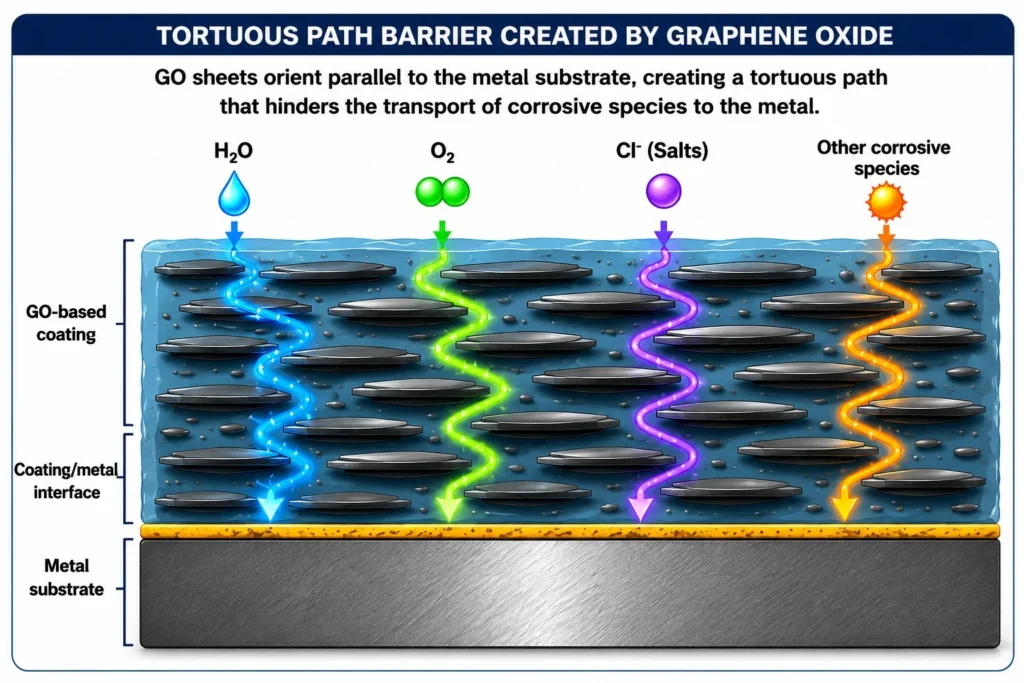
Initially, when graphene oxide is added to a coating, the sheets are distributed forming a laminar structure that hinders the passage of water, oxygen, salts, and other corrosive agents toward the metal surface. This phenomenon is known as a tortuosity barrier, which forces the corrosive species to travel longer trajectories before reaching the substrate.
As a result, the diffusion rate of aggressive agents decreases significantly, delaying the onset of the electrochemical processes responsible for corrosion. This characteristic explains how graphene oxide helps control corrosion in environments where traditional coatings present limitations.
In addition to its barrier effect, various studies indicate that graphene oxide nanoparticles can improve the mechanical stability of the coating, reduce the formation of microcracks, and increase adhesion between the protective film and the metal.
Tortuosity mechanism of GO vs. conventional coating
The efficacy of an anticorrosive coating depends largely on its ability to prevent water, oxygen, chloride ions, and other corrosive species from reaching the metal surface. The difference between a conventional coating and one reinforced with graphene oxide (GO) lies mainly in the trajectory that these agents must travel to diffuse through the coating.
In a conventional coating, the pores, micro-voids, and defects of the film allow corrosive species to advance following short and practically straight paths. As a result, water and oxygen quickly reach the coating-metal interface, where the electrochemical reactions responsible for corrosion begin. This high permeability accelerates the formation of oxides and reduces the useful life of the protection system.
In contrast, a coating with graphene oxide incorporates two-dimensional sheets of GO distributed parallel to the metal substrate. These nanostructures act as impermeable barriers that force corrosive species to move following long, sinuous, and tortuous trajectories, a phenomenon known as the tortuosity mechanism.
The following image shows how both types of coatings work in corrosion control.
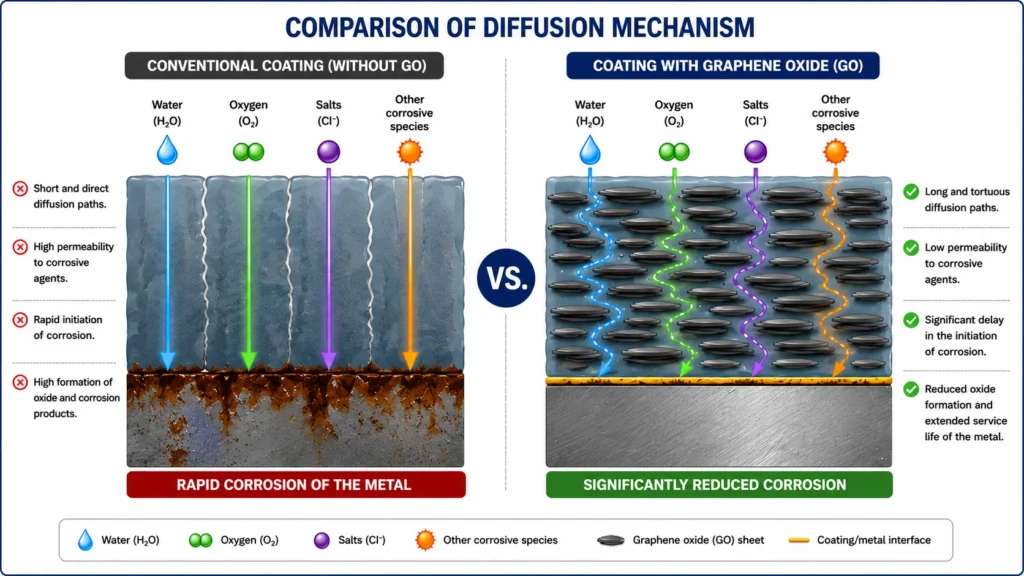
By significantly increasing the length of the diffusion path, the permeability of the coating to water, oxygen, salts, and other aggressive agents decreases. As a consequence, the onset of electrochemical reactions is delayed, the corrosion rate is reduced, and the useful life of both the coating and the protected metal is prolonged.
In addition to the barrier effect, GO sheets increase the mechanical stability of the coating and hinder the formation of microcracks, further reducing the preferential pathways for the penetration of corrosive species. This combination of physical protection and structural reinforcement makes graphene oxide one of the most promising nanomaterials for the development of high-performance anticorrosive coatings.
The following table summarizes the main differences between both protection mechanisms.
Comparison of both mechanisms.
| Conventional coating | Coating with graphene oxide (GO) |
|---|---|
| Short and straight diffusion paths. | Long and tortuous diffusion paths. |
| High permeability to water, oxygen, and chlorides. | Low permeability to corrosive species. |
| Rapid onset of corrosion. | Significant delay of the corrosive process. |
| Higher formation of corrosion products. | Lower oxide formation and greater protection. |
| Limited useful life of the coating. | Greater durability of the coating and the metal substrate. |
Advantages of graphene compared to conventional anticorrosive barriers
Among the main applications of graphene oxide in protective coatings, the protection of pipelines, storage tanks, offshore structures, bridges, marine platforms, aeronautical components, and equipment subjected to highly corrosive environments stand out.
The advantages of graphene compared to conventional anticorrosive barriers include greater impermeability, increased mechanical resistance, reduction of water vapor permeability, and improvement of the chemical stability of the coating. In many cases, these properties make it possible to extend maintenance intervals and reduce costs associated with corrosion failures.
Traditional technologies often rely on heavy pigments or toxic compounds such as chromates, the use of which is severely restricted today. Graphene oxide offers substantial advantages:
- Efficiency at low concentrations: Just a fraction of less than 1% by weight of graphene oxide is enough to multiply the corrosion resistance of a coating.
- Multifunctional properties: In addition to protecting against rust, it improves mechanical scratch resistance, thermal stability, and adhesion of the coating to the metal.
- Sustainability: It allows the formulation of thinner and lighter paints with a significantly longer useful life.
Challenges of anticorrosive nanomaterials
Despite the potential of this compound, there are challenges regarding the use of nanomaterials in corrosion protection. The main technical obstacle is agglomeration; due to strong Van der Waals forces, GO nanosheets tend to stack together in the paint. If the material agglomerates, instead of an efficient barrier, zones of weakness are generated that accelerate the failure of the coating. It is important to achieve a uniform dispersion of GO within the polymer matrix; the accumulation of sheets can generate defects that decrease protective performance.
Another challenge corresponds to the control of electrical conductivity. Depending on the formulation and concentration used, a poorly designed conductive network could favor localized galvanic corrosion phenomena. Therefore, the design of the coating must optimize both the chemical composition and the orientation of the nanoparticles.
Likewise, the cost of production on an industrial scale with high purity and batch-to-batch reproducibility remain complex factors for conventional paint factories. Challenges also persist related to large-scale production, standardization of industrial processes, and evaluation of the environmental impact associated with some nanomaterial resources.
Potential of graphene oxide in aggressive industrial environments
Even with these challenges, the potential of graphene oxide in aggressive industrial environments continues to grow due to advances in chemical functionalization, controlled synthesis, and the development of hybrid coatings capable of combining barrier effect, active inhibition, and self-healing properties. In high-salinity marine environments, offshore platforms, or chemical plants exposed to severe acids, standard technologies fail prematurely.
Graphene oxide, properly dispersed, promises to extend the maintenance cycles of critical infrastructure from 5 to more than 15 years, positioning itself as the key component of the next generation of smart and self-healing coatings.
In the coming years, GO will probably play a relevant role within materials engineering, contributing to the development of more efficient, sustainable, and durable solutions for the protection of critical infrastructure against corrosion, positioning itself as the key component of the next generation of smart and self-healing coatings.
Advances in research and the future of the field
Recent research surrounding graphene oxide is rapidly moving from laboratories to field applications through the use of industrial nanotechnology. One of the most dynamic fronts is the development of “smart” or self-healing coatings. Scientists are using graphene oxide nanoparticles as nanometric capsules that house advanced corrosion inhibitors in the liquid phase. When the coating suffers mechanical damage or a scratch, the localized rupture releases these inhibitors, instantly halting the progress of rust in the affected area.
Another line of research consists of optimizing chemical oxidation processes to obtain materials with a controlled distribution of oxygenated groups, allowing for improved compatibility with different polymer matrices without affecting their mechanical or electrical properties. Likewise, chemical oxidation processes are being optimized through green routes (sustainable chemistry) to reduce the use of strong acids and toxic reducing agents.
Advances in industrial nanotechnology are also driving the manufacture of hybrid coatings that combine graphene oxide with carbon nanotubes, boron nitride, metal oxides, and emerging two-dimensional materials. These combinations seek to increase chemical resistance, improve thermal stability, and offer protection in highly aggressive environments, such as offshore facilities, petrochemical plants, port infrastructure, and hydrogen storage systems.
In parallel, the industry is working on scaling up production processes to reduce costs and guarantee uniform material quality. The standardization of synthesis, characterization, and performance evaluation methods will be a fundamental step to expand the commercial adoption of these nanomaterials in the coming years.
With these advances, GO emerges as one of the most promising components for the next generation of smart coatings destined for corrosion control, combining greater durability, lower environmental impact, and a significant reduction in costs associated with the maintenance of industrial assets.
Conclusions
Graphene oxide represents a paradigm shift in materials science dedicated to the protection of industrial assets. By resolving the permeability limitations inherent in traditional paints through the ingenious tortuosity barrier, graphene oxide manages to mitigate metallic deterioration to levels that previously required highly polluting chemicals.
Although critical technical challenges persist, particularly the tendency of the nanosheets to agglomerate and high standardized production costs, the potential of graphene oxide in aggressive industrial environments far outweighs these initial barriers. The transition toward more sustainable and durable global infrastructures will depend, to a large extent, on our ability to master the incorporation of these nanomaterial elements, making nanotechnology the ultimate pillar of tomorrow’s anti-corrosion resistance.
References
- Cui, M., Ren, S., Zhao, H., Wang, L., & Xue, Q. (2018). Graphene oxide modified with silane coupling agent for reinforcing the anti-corrosion performance of epoxy coating. International Journal of Electrochemical Science, 13(6), 5737-5750. https://doi.org/10.20964/2018.06.49
- Hayat, M. B., Khan, A. A., & Rahman, M. M. (2021). Industrial nanotechnology and advanced corrosion inhibitors: A review on graphene oxide nanoparticles in protective coatings. Journal of Materials Science & Technology, 84, 112-129.
- Ramezanzadeh, B., Niroumandrad, S., Ahmadi, A., Mahdavian, M., & Moghadam, M. H. (2016). Enhancement of barrier and electrochemical properties of an epoxy coating via graphene oxide nanoplatelets. Progress in Organic Coatings, 101, 376-387. https://doi.org/10.1016/j.porgcoat.2016.09.006
- Sheng, X., Ting, J., & Wang, X. (2023). Chemical oxidation methods for high-yield graphene oxide: Overcoming agglomeration challenges in industrial corrosion control. Nano Research Letters, 18(2), 204-218.
Frequently Asked Questions (FAQs)
What does graphene oxide contribute to corrosion control?
It provides an almost impenetrable nanomechanical physical barrier that stops the passage of oxygen and moisture, in addition to improving the structural and chemical resistance of the protective coating itself.
How does it work in anticorrosive coatings?
It is mixed in dispersion within the polymer resin (such as epoxy). As the paint cures, the graphene oxide nanosheets become uniformly distributed, blocking the natural pores of the polymer.
What advantages does it have over other barriers?
It offers superior performance using minimal amounts of material, is an ecological alternative to traditional toxic inhibitors, and adds resistance to mechanical wear without increasing the weight of the coating.
What limits its industrial use today?
The difficulty in ensuring a homogeneous dispersion and preventing the nanoparticles from agglomerating in the paint, combined with the current costs of mass production under uniform quality standards.
What is graphene oxide and how does it prevent corrosion?
It is an oxidized form of graphene rich in functional groups. It prevents corrosion by isolating the metal from environmental electrolytes through its impermeable laminar structure and its optimal chemical integration with the paint.
How does the tortuosity barrier of graphene work?
It works by lengthening and complicating the path of corrosive molecules. Instead of passing through the paint in a straight line, ions must dodge millions of impermeable GO nanosheets, which drastically delays their arrival at the metal surface.