Fouling control in plate heat exchangers is a critical aspect in the operation of industrial thermal systems. In environments where energy efficiency, reliability, and operational continuity are essential, fouling emerges as one of the main causes of performance deterioration. Although its development is often gradual and not easily noticeable in its initial stages, its cumulative effects directly impact heat transfer, hydraulic performance, and operating costs.
In plate heat exchangers, this issue becomes even more relevant due to their compact design and the presence of narrow channels that maximize thermal efficiency but simultaneously increase susceptibility to deposit formation. In this context, fouling control in plate heat exchangers involves not only corrective actions but also an integrated management approach that combines proper design, controlled operation, and strategic maintenance.
This article first provides a description of plate heat exchangers and their main applications. Subsequently, the fouling phenomenon in this type of equipment is addressed, explaining its mechanisms, operational implications, and the reasons why implementing continuous maintenance programs is essential to prevent its development and avoid issues such as blockages and thermal efficiency loss.
What is a plate heat exchanger?
There are many types of heat exchangers; however, this article focuses specifically on the plate heat exchanger, as it is one of the most widely used in refrigeration systems. It consists of a set of plates arranged with small gaps between them, through which the hot and cold fluids flow. Heat transfer occurs through these plates, whose efficiency depends on factors such as surface area, thickness, geometry, roughness, and the material they are made of. The following image shows a representative example of this type of heat exchanger.
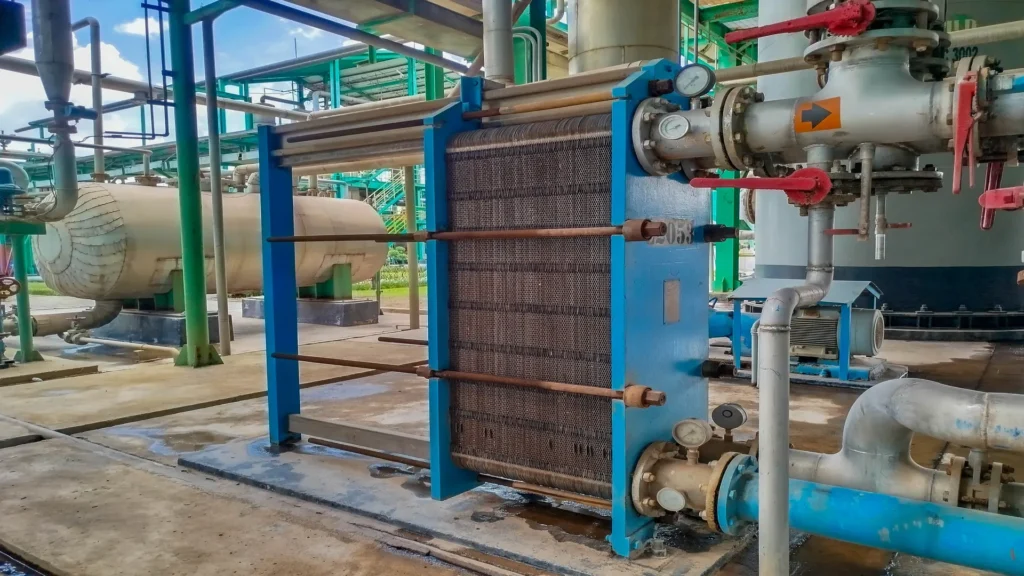
A plate heat exchanger is a device designed to transfer thermal energy between two fluids through a series of thin metal plates arranged in parallel. These plates create channels through which the fluids flow, allowing heat exchange without mixing. Like other types of heat exchangers, its main function is to facilitate thermal transfer, but its compact and efficient design makes it especially attractive for a wide range of industrial applications.
Operation and main applications
The heat transfer process occurs through corrugated or embossed plates assembled in layers that form alternating chambers. The fluids flow through these channels following flow configurations that can be counter-current, co-current, or cross-flow. Among these, the counter-current arrangement is the most efficient, as it maximizes the thermal gradient between fluids and therefore enhances heat transfer.
The following video shows the Mechanim 3D animation, which presents how a plate heat exchanger operates. In this video, the internal design and operating principle of these highly efficient devices are explored. Throughout the content, a step-by-step explanation is provided of how they work and the key aspects of their performance.

Among its main applications are the following:
One of the main characteristics of plate heat exchangers is their versatility, which allows them to be used in various industrial sectors. In heating and cooling systems, they are commonly used to preheat or cool fluids, optimizing energy consumption and improving system efficiency.
In the chemical and petrochemical industries, these devices play a key role in process stream cooling and phase separation operations, such as water removal from oil streams. Likewise, in the food and beverage industry, they are widely used due to their thermal efficiency and ease of cleaning, both critical aspects in sanitary processes.
In power generation, plate heat exchangers are used for fluid conditioning, such as preheating water or steam before it enters equipment like boilers, thereby contributing to improved overall system performance.
Overall, their compact design, high thermal efficiency, and operational adaptability make plate heat exchangers a key solution for a wide range of industrial applications.
What is fouling in heat exchangers?
Fouling is defined as the accumulation of unwanted materials on heat transfer surfaces, generating additional resistance to heat flow. This phenomenon can originate from multiple mechanisms that, in practice, rarely act in isolation.
Among the most relevant are mineral scaling due to salt precipitation, biofouling associated with microbiological growth, organic deposits present in industrial processes, corrosion products, and suspended particle accumulation. The interaction between these mechanisms leads to complex deposits that are more adherent and difficult to remove, increasing the need for effective fouling control strategies in plate heat exchangers.
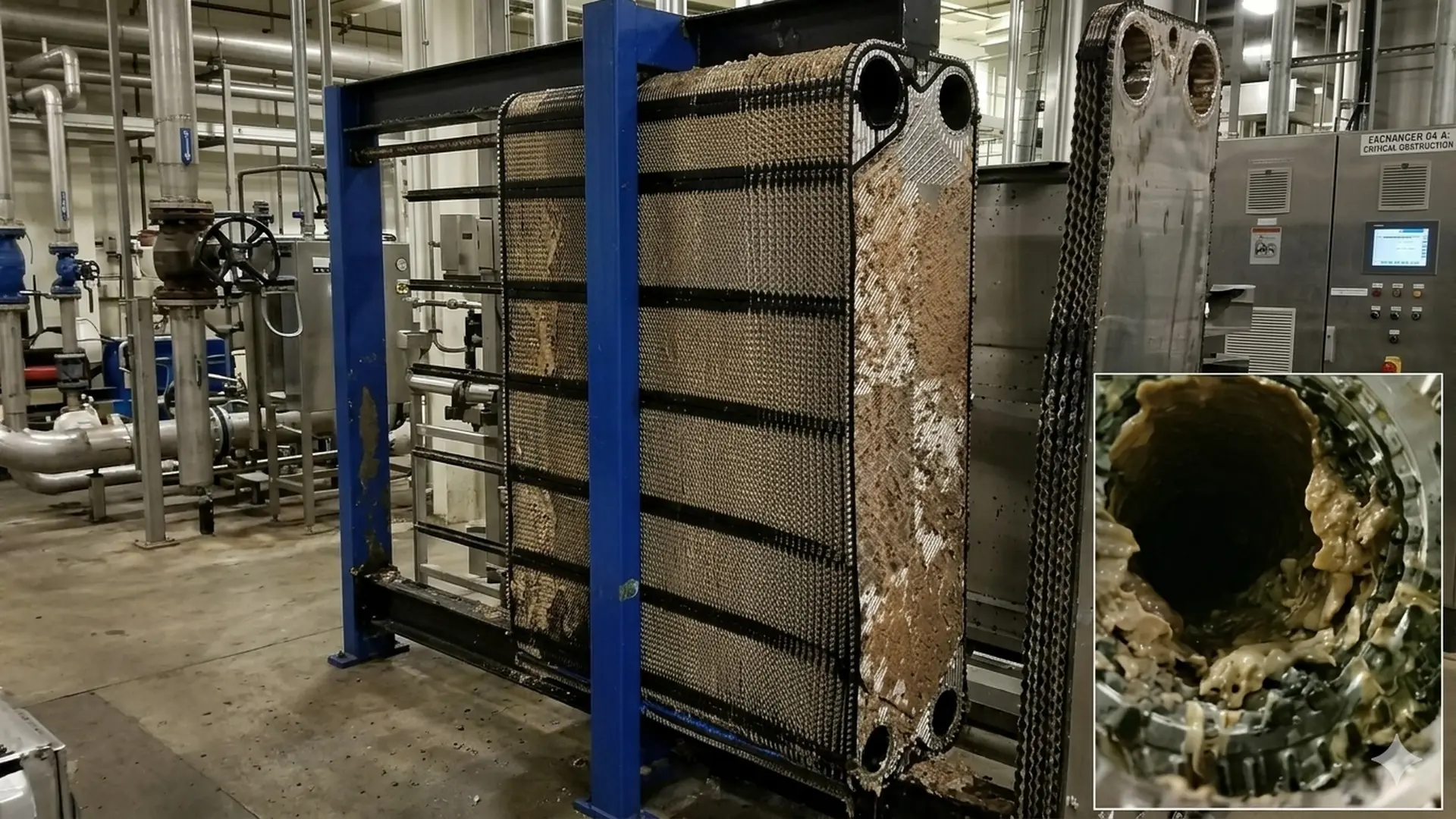
In the case of plate heat exchangers, this phenomenon is especially important due to their compact design and the presence of narrow channels with high turbulence. Although these characteristics improve the heat transfer coefficient, they also make the system more sensitive to deposit formation, since even small amounts of fouling can significantly reduce thermal performance and operational capacity, as shown in the following figure.
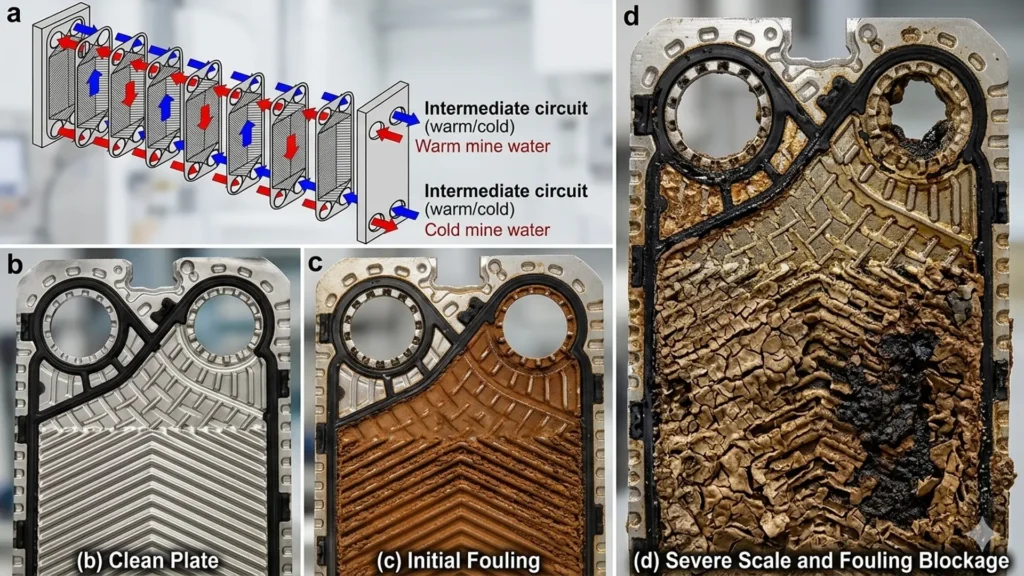
Fouling can originate from several mechanisms, including:
- Mineral scaling: formation of insoluble salts such as calcium carbonate or sulfates, generally associated with changes in temperature, pressure, or pH.
- Biofouling: growth of microorganisms (bacteria, algae, fungi) forming adhesive biofilms, especially in cooling water systems.
- Organic deposits: accumulation of hydrocarbons, oils, or organic residues present in process fluids.
- Corrosion products: metal oxides detached from internal surfaces and deposited in low-velocity zones.
- Solid particles: sediments, sand, or suspended matter that adhere to or become trapped on surfaces.
In practice, these mechanisms do not usually occur in isolation but interact with each other, resulting in more complex and difficult-to-control fouling processes. As a consequence, the overall heat transfer coefficient decreases, operating costs increase due to energy consumption and maintenance, and equipment service life is reduced.
Therefore, understanding fouling and its associated mechanisms is essential for the design, operation, and maintenance of heat exchangers, enabling the implementation of mitigation strategies such as fluid treatment, material selection, and optimization of operating conditions.
Impact on thermal efficiency and operation
The impact of fouling on thermal performance is direct and significant. Deposit formation introduces additional thermal resistance that reduces the overall heat transfer coefficient, forcing the system to operate with higher energy demands to maintain process conditions.
At the same time, pressure drop across the heat exchanger increases, affecting hydraulic behavior and requiring greater pumping effort. This combined effect not only reduces system efficiency but also shortens operating cycles between cleanings, decreases equipment availability, and increases maintenance costs. In critical applications, insufficient fouling control in plate heat exchangers can lead to production losses or failure to meet operational specifications.
Influence of design on deposit formation
Design plays a decisive role in fouling formation and development. Variables such as flow velocity, operating temperature, and fluid quality directly influence deposition tendency. Low velocities favor particle settling, while high temperatures may induce precipitation of dissolved compounds or accelerate unwanted chemical reactions.
From a geometric perspective, the plate corrugation angle is a key factor, as it defines the level of turbulence within the channels. Higher turbulence increases shear stress on surfaces, making deposit adhesion more difficult, although at the cost of higher pressure drop. Likewise, non-uniform flow distribution can create low-velocity zones where fouling develops more easily.
Plate spacing also represents a critical trade-off. While narrow channels enhance thermal efficiency, they increase blockage risk; conversely, wider channels reduce fouling susceptibility but decrease thermal performance. In this sense, fouling control in plate heat exchangers begins at the design stage, where each decision involves balancing efficiency and operability.
Fouling control strategies
One of the most effective strategies to mitigate this phenomenon is the modification of the surface properties of the metal plates. In this context, functional coatings emerge as an innovative solution. For a coating to be viable in plate heat exchangers, it must meet strict technical requirements: first, it must exhibit excellent adhesion to the metal substrate, ensuring stability during operation. Second, it must not significantly affect heat transfer, which requires minimal thickness and relatively high thermal conductivity.
Additionally, operating conditions impose important mechanical challenges. The plates are in direct contact, generating wear due to friction at contact points. Therefore, the coating must have high mechanical strength and structural stability to withstand these stresses without premature degradation.
In this framework, the development of multilayer coatings based on materials such as Teflon™ has shown promising results. These solutions combine anti-adhesive properties with reduced thickness, promoting fouling release without significantly affecting thermal efficiency. Furthermore, their multilayer design improves both adhesion and wear resistance, meeting the operational requirements of plate heat exchangers.
The implementation of these technologies, supported by industrial experience in sectors such as the paper and biofuel industries, demonstrates that fouling control should not only be addressed through corrective cleaning but also through preventive strategies based on surface engineering. This approach makes it possible to extend operating intervals, reduce maintenance costs, and optimize overall thermal system performance.
Fouling control in plate heat exchangers requires an integrated approach combining prevention, monitoring, and maintenance. Acting on the root cause is one of the most effective strategies, which involves improving fluid quality through proper filtration systems and applying chemical treatments to reduce scaling formation and biological growth.
From an operational perspective, it is essential to maintain conditions within design ranges, avoiding low velocities that promote sedimentation or extreme temperatures that accelerate fouling mechanisms. Process stability also helps reduce variability in deposit formation.
Continuous monitoring of heat exchanger performance is a key tool for early fouling detection. Tracking the overall heat transfer coefficient and pressure drop allows deviations to be identified and timely decisions to be made before the problem worsens.
When fouling is unavoidable, cleaning strategies play a fundamental role. In-place chemical cleaning reduces downtime by eliminating the need for disassembly, while mechanical cleaning enables more thorough deposit removal. In severe cases, a combination of both methods provides the best results, ensuring recovery of thermal performance.
Conclusions
Fouling control in plate heat exchangers must be addressed as a multidimensional phenomenon that integrates design, operation, and maintenance aspects. Understanding fouling mechanisms enables the development of more effective strategies to minimize its impact and extend equipment service life.
Furthermore, the influence of design and operating conditions shows that prevention is more efficient than correction, especially in systems where process continuity is critical. The implementation of continuous monitoring and proper maintenance practices not only improves energy efficiency but also reduces costs and operational risks.
In an increasingly demanding industrial environment, fouling control in plate heat exchangers is established as a key element to ensure reliability, sustainability, and optimal performance of thermal systems.
References
Bott, T. R. (1995). Fouling of heat exchangers. Elsevier.
Müller-Steinhagen, H. (2011). Heat exchanger fouling: Mitigation and cleaning technologies. IChemE.
Kakac, S., Liu, H., & Pramuanjaroenkij, A. (2012). Heat exchangers: Selection, rating, and thermal design. CRC Press.
Wang, L. K., Hung, Y. T., & Shammas, N. K. (2009). Handbook of environmental engineering. Humana Press.