Table of Contents
- What electrical problem exists in classified areas
- PCRH: DC decoupling and AC continuity
- OVP: protection against lightning and AC faults
- When induced AC changes the selection
- The role of DC decouplers in cathodic protection systems
- How to decide without affecting cathodic protection
- Conclusions
- References
- Frequently asked questions (FAQs)
Electrical protection in classified areas is a fundamental element to ensure operational safety, preserve the integrity of metallic assets, and maintain the efficiency of cathodic protection systems. Buried or exposed structures associated with hydrocarbon transportation, industrial facilities, and pipelines require solutions capable of controlling electrical risks such as overvoltages, AC faults, lightning discharges, and induced AC voltages.
In this context, the proper selection between PCRH (Polarization Cell Replacement) and OVP (Overvoltage Protector) devices allows establishing an effective protection strategy, avoiding interference with cathodic protection and ensuring the required electrical continuity in classified environments. The decision between one or the other depends mainly on whether the system requires alternating current (AC) continuity with direct current (DC) isolation or only protection against transient events such as lightning and electrical faults.
What electrical problem exists in classified areas
Facilities with metallic structures protected by cathodic protection face different electrical phenomena that can compromise system safety and performance:
- Steady-state induced AC voltages due to proximity to high-voltage power lines.
- Transient overvoltages generated by lightning discharges or electrical switching operations.
- AC faults that can introduce dangerous currents into pipelines, tanks, or other metallic structures.
- Electrical isolation interruptions due to damage in insulating joints.
- DC stray currents that can affect polarization and the performance of the cathodic protection system.
In these cases, the challenge is to provide a safe path for hazardous currents without compromising the direct current required to protect the asset against corrosion.
PCRH: DC decoupling and AC continuity
The PCRH (Polarization Cell Replacement) is primarily designed for applications where a cathodic protection system requires maintaining electrical separation in direct current while allowing a safe connection in alternating current.
Its main functions are:
- Blocking direct current (DC) flow during normal operation.
- Allowing controlled alternating current flow to ground.
- Providing a discharge path for AC fault events and lightning strikes.
- Maintaining the effectiveness of the cathodic protection system.
Unlike a conventional permanent electrical bonding device, the PCRH allows the cathodic polarization of the structure to be maintained while providing protection against external electrical conditions.
A common application occurs in buried pipelines installed parallel to electrical transmission lines, where electromagnetic induction can generate steady-state induced AC voltages. In these cases, the PCRH can be used as part of an AC mitigation strategy, reducing risks associated with electrical shock, AC corrosion, and damage to insulating components.
It is also used in:
- Protection of insulating joints.
- Structures with cathodic protection.
- Systems requiring DC decoupling and AC continuity.
- Installations exposed to electrical faults and lightning discharges.
OVP: protection against lightning and AC faults
The OVP (Overvoltage Protector) is designed to limit transient overvoltages that can affect sensitive electrical components or isolated elements within the system.
Its main functions are:
- Diverting voltage spikes generated by lightning.
- Reducing overvoltages caused by electrical switching operations.
- Protecting insulating joints and connected equipment.
- Limiting the maximum voltage applied to electrical components.
However, the OVP is not designed to continuously conduct steady-state AC voltages. If a permanent induced AC voltage exists, the device may operate outside its normal conditions, reducing its protection capability and compromising its service life.
For this reason, its application is more suitable when:
- No permanent AC component exists.
- The main risk corresponds to transient events.
- Strict voltage limitation is required on isolated components.
When induced AC changes the selection
The presence of steady-state induced AC is one of the most important factors when deciding between PCRH and OVP.
When a pipeline is located near high-voltage power lines, it may experience continuous alternating voltage due to electromagnetic coupling. This condition can produce:
- Accelerated AC corrosion.
- Electrical contact risks for operating personnel.
- Coating damage.
- Insulating joint failures.
- Interference with monitoring systems.
In these scenarios, a conventional OVP may not be the appropriate solution because it is not designed to continuously discharge AC current.
The PCRH, on the other hand, provides a permanent path for alternating current while maintaining the DC isolation required for cathodic protection.
The correct selection must consider:
- Induced AC voltage level.
- Available fault current.
- Characteristics of the cathodic protection system.
- Asset location relative to external electrical sources.
- Electrical classification requirements of the area.
The role of DC decouplers in cathodic protection systems
Cathodic protection (CP) is a highly effective technique for minimizing corrosion in buried steel structures, but it requires the pipeline to be perfectly isolated from the ground using coatings and isolation joints. However, these structures also need an indispensable electrical grounding system to mitigate lightning, faults, and alternating current (AC) induction from nearby power grids. This dual requirement creates a technical conflict, as traditional grounding introduces unwanted escape paths that drain the direct current (DC) from the CP system.
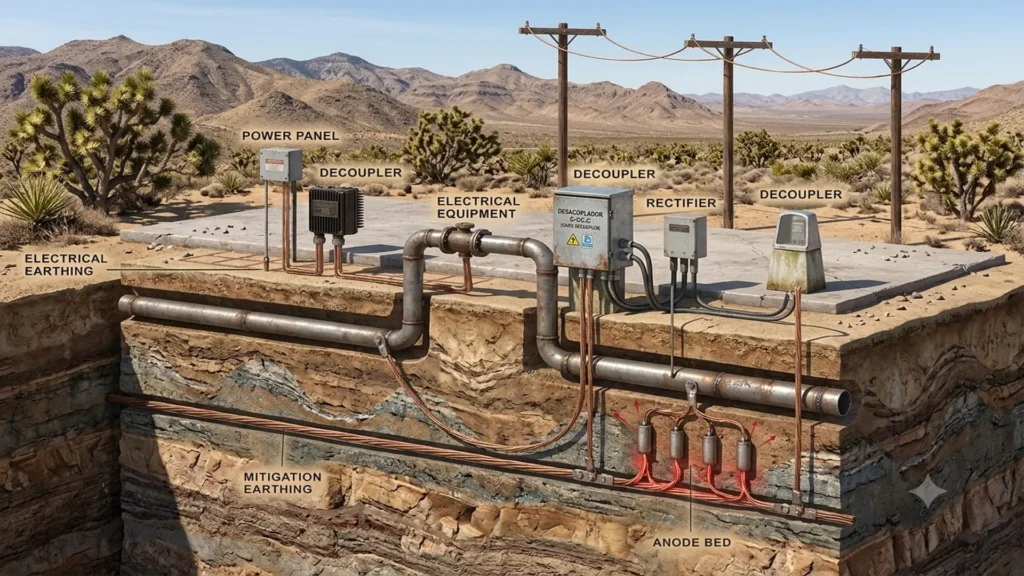
When the cathodic protection current leaks through traditional grounding systems, the rectifier is forced to protect a significantly larger material surface area than it was designed for. As a direct consequence of this diversion, it becomes extremely difficult to maintain adequate CP potentials on the specific pipeline section intended for protection. It is in this critical scenario where DC decouplers become essential to successfully balance isolation needs and system safety.
DC decouplers solve this problem by providing effective DC isolation of the cathodically protected structures from other buried objects, blocking the protection current from leaking. Simultaneously, they act as a continuous bridge that bonds the structure to ground to safely drain AC and lightning surges. Their correct implementation prevents grounding systems from interfering with CP, ensuring both personnel safety and the infrastructure’s service life.
How to decide without affecting cathodic protection
The device selection must be performed considering the interaction between electrical safety, asset integrity, and corrosion control performance.
A general guideline is:
Select PCRH when:
- An active cathodic protection system exists.
- DC decoupling is required.
- Induced AC is present.
- AC continuity to ground is needed.
- Protection against AC faults and lightning is required.
Select OVP when:
- The main objective is protection against transient overvoltages.
- No permanent AC voltage exists.
- Protection of insulating joints or sensitive equipment is required.
- Rapid limitation of voltage spikes is needed.
In classified areas, both devices may be available with certifications for hazardous environments, such as Class I Division 1 and Division 2; however, the selection must be based on the actual electrical conditions of the system and not only on the device classification.
Incorrect application can affect cathodic protection, create unwanted electrical paths, or reduce the reliability of the protection system.
Conclusions
Electrical protection in classified areas requires understanding the nature of the electrical risk present in order to correctly select between PCRH and OVP. While PCRH is intended for systems requiring AC continuity with DC isolation, mitigation of induced AC voltages, and protection of structures with cathodic protection, OVP is primarily designed to control transient overvoltages generated by lightning or electrical faults.
A proper evaluation of operating conditions allows the implementation of an effective electrical protection strategy, protecting insulating joints, preserving the efficiency of the cathodic protection system, and ensuring safe and reliable operation of metallic assets in classified environments.
References
- Dairyland Electrical Industries. (2023). Electrical isolation and overvoltage protection solutions for cathodic protection systems. Dairyland Electrical Industries.
- NACE International. (2014). SP0177-2014: Mitigation of alternating current and lightning effects on metallic structures and corrosion control systems. NACE International.
- AMPP. (2021). Cathodic protection criteria and electrical isolation practices for underground metallic structures. Association for Materials Protection and Performance.
- DNV. (2017). RP-F103: Cathodic protection of submarine pipelines by galvanic anodes. Det Norske Veritas.
Frequently asked questions (FAQs)
When is it preferable to use PCRH instead of OVP?
PCRH is preferred when a cathodic protection system exists and it is necessary to block direct current while allowing controlled passage of alternating current or currents associated with electrical faults and lightning events.
What risk does PCRH cover in pipelines?
PCRH helps control risks associated with induced AC voltages, electrical faults, and lightning discharges by providing a safe path to ground without affecting the pipeline’s cathodic polarization.
What limits the use of OVP with induced AC?
OVP is not designed to continuously conduct steady-state AC voltages. Permanent exposure to alternating current can reduce its performance and result in inadequate protection.
Add Image
How does the decision change in classified areas?
In classified areas, in addition to evaluating the electrical function of the device, certification requirements, protection against explosive atmospheres, and compatibility with the existing cathodic protection system must be considered.