Table of Contents
- 3D printed parts under pressure
- Uncertainty of 3D printed metal
- What API 20s covers in additive manufacturing
- Pbf, ded and binder jetting processes
- Metal additive manufacturing and amsl
- Pressure vessels and applicable codes
- Qualification of the 3D printing process
- NDT for 3D printed parts
- Typical defects of printed metal
- Traceability and API certification
- In-process monitoring and critical variables
- Selection of parts for pressure equipment
- Future of 3D printed components
- Conclusions
- References
- Frequently Asked Questions (FAQs)
- Conclusions
- References
API 20S responds to a specific operational problem: a critical metal part can halt production, increase operational risk, and depend on a slow supply chain. In pressure equipment, manufacturing quickly loses value when the component lacks traceability, testing, inspection, process control, and technical acceptance.
Uncertainty appears in the microstructure, porosity, build orientation, and acceptance under design codes. Metal additive manufacturing can resolve lead times and complex geometries, provided that the 3D printed part reaches service with verifiable technical evidence from candidate selection to documentary release.
3D printed parts under pressure
Pressurized equipment depends on components with demonstrable geometry, material, and mechanical properties. A special nozzle, a manifold, a spool, a valve body, or a separation internal can fall outside conventional inventory and require casting, forging, welding, or machining with extended lead times.
Metal additive manufacturing reduces that time when the part has a low volume, high complexity, or difficult fabrication through traditional routes. The risk appears when the delivery speed exceeds the maturity of the technical file. In critical service, a quick decision without qualification shifts the failure from procurement to mechanical integrity.
API 20S manages this tension through qualification, production, and inspection requirements: it allows qualifying manufacturing close to the asset, reducing supply times, and preserving verifiable evidence for engineering, inspection, and operation.
The standard connects design, procurement, manufacturing, and quality control, preventing a maintenance emergency from ending up as a weakly documented installation.
Uncertainty of 3D printed metal
A 3D printed component is marked by its thermal history. Power, speed, layer thickness, atmosphere, feed, toolpath, and orientation modify porosity, anisotropy, residual stresses, and fatigue response. Two parts with the same nominal alloy can behave differently if the manufacturing window changes.
This variability explains why dimensional acceptance is insufficient. 3D printed parts intended for pressure require demonstrating strength, ductility, toughness when applicable, hardness, microstructure, internal soundness, finish, and fluid compatibility. Uncertainty is controlled with qualification, testing, and process limits.
What API 20s covers in additive manufacturing
The first edition of API 20S was published under the title Additively Manufactured Metallic Components for Use in the Petroleum and Natural Gas Industries, which defines its main focus: additively manufactured metallic components for oil and gas.
This standard establishes requirements to qualify metal additive manufacturing processes and control the production of components used in oil and gas. Its scope focuses on metallic materials, manufacturing, marking, documentation, and verification, with application to technologies such as Powder Bed Fusion (PBF), Directed Energy Deposition (DED), and Binder Jetting (BJT).
Pbf, ded and binder jetting processes
Powder Bed Fusion uses a metal powder bed and an energy source to consolidate successive layers. It is useful for high-precision parts, internal channels, compact geometries, and designs where conventional machining limits the final shape.
Directed Energy Deposition deposits metal powder or wire using a concentrated energy source. In DED-Arc, the process behavior approaches that of layered welded deposition, making the qualification of variables critically important.
Binder Jetting binds metal particles with a binder and requires subsequent steps such as curing, binder removal, and sintering. Its use demands strict control of shrinkage, final density, porosity, and dimensional stability before releasing a part for industrial service.
Metal additive manufacturing and amsl
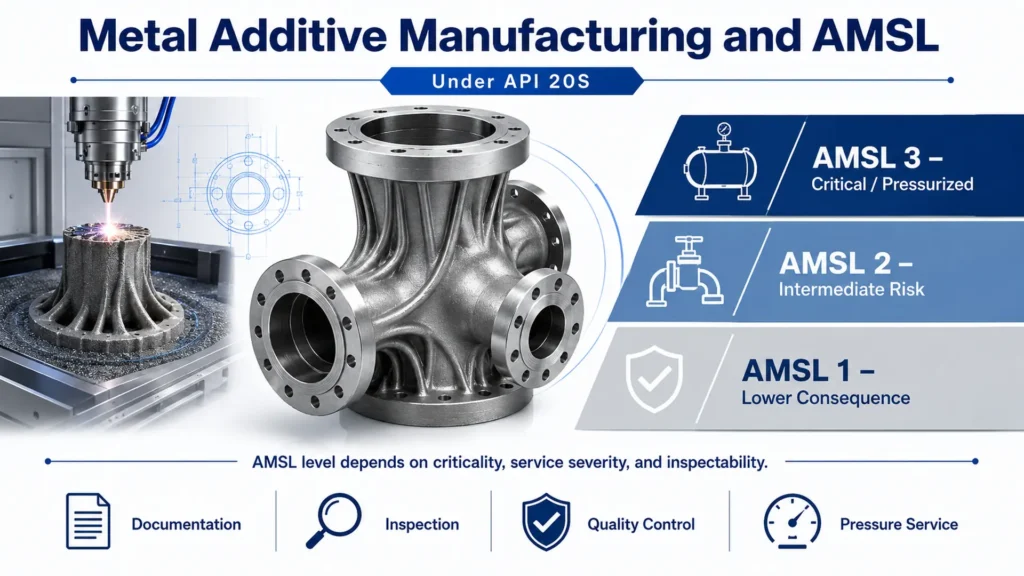
AMSL stands for Additive Manufacturing Specification Level. These levels grade the technical, quality, and qualification requirements according to the criticality of the component. AMSL 1 corresponds to lower consequence, AMSL 2 to intermediate-risk operational components, and AMSL 3 to higher-consequence parts, including critical or pressurized applications.
This classification allows adjusting the file to the real risk. A secondary support, an accessory without internal pressure, and a part subjected to pressure, cycles, or hazardous fluids require different levels of evidence. For pressurized equipment, the AMSL must be selected based on the consequence of failure, severity of service, and actual possibility of inspection.
Pressure vessels and applicable codes
API 20S qualifies the additive manufacturing route; the equipment design must remain aligned with the applicable code. For this equipment, the analysis of pressure, temperature, external load, thickness, joints, testing, permitted materials, and final acceptance remains tied to documents such as ASME BPVC Section VIII when the project requires it.
In pressure vessels, the most realistic application consists of qualifying integrable metallic components: nozzles, adapters, manifolds, spools, internals, or replacement parts subjected to pressure, temperature, corrosion, cycles, or critical fluids. The standard provides production discipline, traceability, and inspection; final acceptance depends on the code, the service, and the buyer.
Qualification of the 3D printing process
Qualification must begin before manufacturing the final part. The manufacturer needs to demonstrate that the machine, parameters, feedstock, and post-processing generate repeatable properties. Additive manufacturing demands representative coupons, mechanical testing, metallographic review, and traceability of every variable that could alter the result.
In arc-directed energy deposition, alignment with criteria such as ASME Section IX QW-600 is relevant because the process behaves closely to layered welded deposition. In powder bed fusion, control focuses on powder, atmosphere, energy, scanning strategy, and removal of unconsolidated material.
NDT for 3D printed parts
Additive manufacturing defects can be volumetric, surface, internal, and dependent on the build orientation. Therefore, the NDT plan must be designed according to the geometry, process, material, inspection access, and criticality of the component.
Radiography, ultrasound, liquid penetrants, magnetic particles, dimensional measurement, and tomography can be combined depending on size, material, and access. In pressure-associated components, inspection must confirm internal integrity, geometric continuity, machined surfaces, and areas where roughness could affect leak tightness, fatigue, or corrosion.
Typical defects of printed metal
Lack of fusion appears when the energy, overlap between paths, or bonding between layers is insufficient to consolidate the material. Porosity can originate from trapped gas, moisture, contamination, unstable parameters, poor feeding, or collapse of the melt pool in keyhole mode.
Cracks, inclusions, and residual stresses require special attention in sensitive alloys, parts with variable thickness, or geometries with stress concentrators. In pressurized service, these defects can reduce strength, fatigue life, toughness, leak tightness, and performance against thermal cycles or corrosion.
The design must facilitate volumetric inspection, machining of critical areas, and evaluation of internal surfaces. Closed channels, abrupt transitions, or high roughness can complicate NDT and accelerate erosion, deposit accumulation, or the initiation of localized damage.
Traceability and API certification
API certification linked to this standard requires a quality system, approved procedures, competent personnel, controlled equipment, and auditable records. For the end user, the value lies in receiving a component with a complete technical history, not a metal part disconnected from the process that produced it.
The file must contain design review, powder or wire batch, material certificate, qualified parameters, orientation, build map, heat treatments, machining, repair, non-destructive testing, dimensional testing, and a certificate of conformity.
This traceability allows investigating deviations, repeating manufacturing, and defending acceptance during an audit, inspection, or integrity management.
In-process monitoring and critical variables
Control must occur during the construction of the part, before relying on final inspection. In components for pressure equipment, monitoring the melt pool, interpass temperature, build atmosphere, applied energy, powder or wire feed, and layer-by-layer recording allows detecting deviations that can generate porosity, lack of fusion, distortion, or residual stresses.
Process data adds value when integrated into the manufacturing file. A thermal map, a power curve, or a deposition record must be linked to qualified parameters, mechanical testing, NDT, dimensional control, and acceptance criteria. Thus, the process is traced from construction to component release.
Selection of parts for pressure equipment
Technical selection begins with a candidate matrix. Priority should be given to components with low availability, complex geometry, high inventory cost, obsolescence history, or urgent need, provided there is inspection capability and regulatory acceptance. The matrix must include pressure, temperature, fluid, corrosion, criticality, and consequence of failure.
Next, a phased sequence is defined: candidate evaluation, review of the applicable code, definition of AMSL, process qualification, manufacture of a representative part, testing, NDT, functional test, and documentary release. This sequence turns additive manufacturing into an engineering decision, far removed from an accelerated purchase.
Future of 3D printed components
The growth of 3D printed metallic components will depend on their ability to demonstrate repeatable properties, verifiable inspection, and compatibility with applicable codes for pressurized equipment. In pressurized equipment, advancement will be selective: obsolete spare parts, optimized internals, special adapters, manifolds, spools, and low-volume parts with complex geometry.
Expansion into higher criticality services will require mechanical property databases, robust supplier qualification, in situ monitoring, and greater integration between additive manufacturing, NDT, and acceptance criteria. Approved digital libraries will also grow, where each model retains revisions, limits of use, qualified parameters, and manufacturing evidence.
Conclusions
API 20S does not render a 3D printed part fit for service simply by virtue of being made of metal; it demands demonstrating that the process can repeat material, geometry, mechanical properties, and inspection under controlled conditions. In pressure equipment, that difference is critical: the component’s acceptance depends on its traceability, NDT, dimensional control, thermal history, and compatibility with the applicable design code.
Its greatest value lies in transitioning metal additive manufacturing from a rapid supply solution into a verifiable engineering methodology.
When the AMSL, testing, inspection, and manufacturing file are selected according to real risk, 3D printed parts can enter services with high pressure, corrosive environments, severe thermal regimes, or operational cycles. That advancement must occur without weakening mechanical integrity, material traceability, or acceptance under the applicable code.
References
- API Standard 20S, Additively Manufactured Metallic Components for Use in the Petroleum and Natural Gas Industries. American Petroleum Institute, 2021.
- API Enhances 3D Printing Guidelines with Updated Additive Manufacturing Standard. American Petroleum Institute, 2025.
- ASME BPVC Section VIII, Rules for Construction of Pressure Vessels. American Society of Mechanical Engineers.
Frequently Asked Questions (FAQs)
AMSL classification applied to metallic components for pressure equipment
It defines qualification, production, marking, and documentation requirements for metallic components manufactured by additive manufacturing, with control of repeatability, traceability, and inspection.
How does it apply to pressure equipment?
It applies to integrable metallic components in pressurized equipment. The design code governs the vessel; API 20S controls the manufacturing, inspection, and traceability of the additive part.
What challenges exist in certifying additive manufacturing?
Controlling process variables, validating mechanical properties, detecting internal defects, inspecting complex geometries, and demonstrating consistency among batches manufactured under qualified parameters.
What advantages do these parts offer in service?
They reduce supply times, allow for complex geometries, eliminate assemblies, and enable localized manufacturing, provided there is qualification, inspection, evaluated criticality, and complete documentation.
Which parts are better candidates for 3D printing?
Obsolete spare parts, low-volume parts, special adapters, optimized internals, manifolds, and spools with complex geometry, viable inspection, and criticality compatible with gradual validation.
Conclusions
API 20S does not render a 3D printed part fit for service simply by virtue of being made of metal; it demands demonstrating that the process can repeat material, geometry, mechanical properties, and inspection under controlled conditions. In pressure equipment, that difference is critical: the component’s acceptance depends on its traceability, NDT, dimensional control, thermal history, and compatibility with the applicable design code.
Its greatest value lies in transitioning metal additive manufacturing from a rapid supply solution into a verifiable engineering methodology.
When the AMSL, testing, inspection, and manufacturing file are selected according to real risk, 3D printed parts can enter services with high pressure, corrosive environments, severe thermal regimes, or operational cycles. That advancement must occur without weakening mechanical integrity, material traceability, or acceptance under the applicable code.
References
- API Standard 20S, Additively Manufactured Metallic Components for Use in the Petroleum and Natural Gas Industries. American Petroleum Institute, 2021.
- API Enhances 3D Printing Guidelines with Updated Additive Manufacturing Standard. American Petroleum Institute, 2025.
- ASME BPVC Section VIII, Rules for Construction of Pressure Vessels. American Society of Mechanical Engineers.