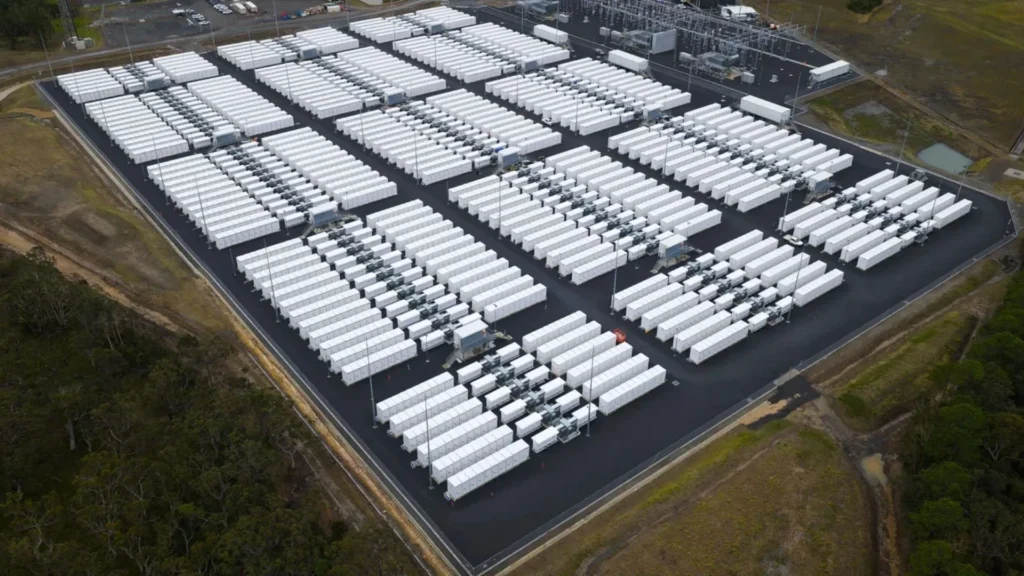
The Waratah Super Battery, considered one of the most powerful grid-connected batteries in the world, has begun operating at full capacity in New South Wales after overcoming a prolonged testing phase and several technical delays.
The system features 850 megawatts (MW) of power and 1,680 megawatt-hours (MWh) of storage. The final authorization allows the facility to fully fulfill its role within the Australian power grid after having operated partially since 2025.
The New South Wales Government confirmed that the Australian Energy Market Operator (AEMO) authorized its full operation. The facility was built by Akaysha Energy on the site of the former Munmorah coal-fired power station.
Waratah Super Battery reaches its 850 MW capacity
Specifically, the Waratah Super Battery can deliver up to 850 MW and store 1,680 MWh, which is equivalent to approximately two hours of discharge at maximum power.
However, its primary function is not to supply electricity for extended periods. The system was designed to respond rapidly when major disturbances occur in the transmission network.
According to EnergyCo, at maximum power, the facility could supply electricity to around 340,000 homes in New South Wales during peak demand moments.
The project had begun operating partially in August 2025 with approximately half of its capacity available. Since then, testing and commissioning work necessary to reach full operation continued.
During its development, the facility faced various technical setbacks that delayed its entry into full operation. These included issues related to transformers during the final testing stage.
In February 2026, New South Wales Parliament documents indicated that the battery was operating at about 350 MW while issues associated with one of those units were being resolved.
A massive buffer for the Australian power grid
One of the most important features of the project is its integration with the System Integrity Protection Scheme (SIPS).
This system monitors the transmission infrastructure and can command the battery to rapidly inject electricity when it detects a potential overload.
In this way, the Waratah Super Battery functions as a large electrical buffer against events that can affect transmission lines. These include wildfires, fallen trees, lightning storms, and other sudden interruptions.
Transgrid explains that the system allows more electricity to be transported through existing lines and reacts automatically when a condition appears that could compromise grid stability.
To achieve this, modifications were also made to 22 substations and four existing transmission lines in New South Wales.
Transgrid coordinates the SIPS protection system
For its part, Transgrid plays the role of the project’s network operator and connects the battery through the existing Munmorah substation.
The SIPS system monitors dozens of high-voltage transmission lines and can coordinate the battery’s response with other generators connected to the electrical system.
When it detects an overload, the system can request Waratah to discharge energy and simultaneously request production adjustments from certain hydroelectric, solar, or wind facilities.
Furthermore, this scheme allows for more intensive use of existing transmission capacity without relying exclusively on the immediate construction of new power lines.
The battery will support the coal phase-out
The commissioning occurs as New South Wales prepares its grid for a greater presence of renewable generation and the progressive retirement of coal-fired power plants.
The Waratah facility was initially proposed as critical infrastructure to reinforce electrical security during this process.
Penny Sharpe, NSW Minister for Energy, noted that the battery will help maintain supply reliability as renewable resources connected to the system increase.
The project also allows more electricity to be transported from generation areas located outside major consumption centers to regions such as Sydney, Newcastle, and Illawarra.
With its entry into full operation, the Waratah Super Battery moves from a prolonged construction and testing stage to become an active part of the New South Wales power grid protection system.
Source and photo: Akaysha Energy