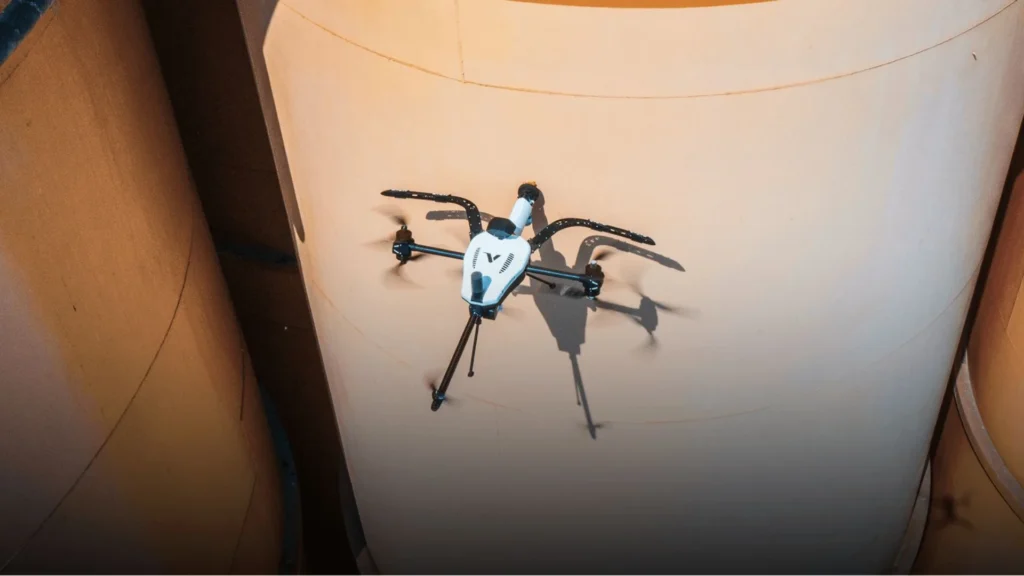
The Swiss company Voliro has unveiled a new generation of intelligent batteries designed specifically for its Voliro T aerial inspection platform, marking a turning point in industrial drone operations.
These power units incorporate self-management capabilities, real-time monitoring and, above all, hot-swapping (hot-swap), eliminating the need to shut down the system during replacement. This advancement directly transforms the operating logic of technical inspections.
Optimized energy efficiency means the system can resume operations in under 20 seconds after a battery change, virtually eliminating downtime and redefining field productivity indicators.
Hot-swapping (Hot-swap): unprecedented operational continuity
The hot-swap concept represents a qualitative leap in industrial inspections. While one battery is replaced, the second keeps the system active, avoiding restarts, recalibrations, or loss of positioning.
This approach directly impacts the efficiency of inspection campaigns on highly technically complex assets such as tanks, offshore structures, or wind turbines, where access windows are limited and costly. Operational continuity ceases to be an aspiration and becomes a standard condition.
In addition, this technology makes it possible to plan inspections based on the asset’s actual availability rather than the drone’s energy limitations, completely changing the planning paradigm in industrial maintenance.
Autonomous energy management and global operation
Voliro’s intelligent batteries integrate advanced energy management systems capable of monitoring essential parameters such as state of charge (SOC), state of health (SOH), and voltage in real time, accessible from the system application.
Another differentiating aspect is their self-heating capability, enabling safe operation down to -10°C. This technical detail is crucial in offshore environments, extreme climates, or winter campaigns, where conventional batteries exhibit unpredictable failures.
They also comply with International Air Transport Association (IATA) regulations, allowing them to be carried in the cabin on commercial flights. This seemingly logistical factor becomes a strategic advantage for global operations.
Impact on NDT and the economics of industrial inspections
Beyond the hardware, the real impact is reflected in the economics of drone-based inspections. Eliminating downtime and improving data continuity significantly increases the amount of effective inspection per hour.
Applications such as ultrasonic testing (UT), pulsed eddy currents (PEC), or inspection of lightning protection systems (LPS) benefit directly from this continuity, avoiding interruptions and loss of quality in the collected data.
In this context, the key criterion is no longer maximum flight time or sensor capability, but rather real productivity per inspection session. Voliro thus introduces a paradigm shift: energy is no longer a limitation, but an enabler of continuous industrial value.
Source: https://voliro.com/
Photo: Shutterstock