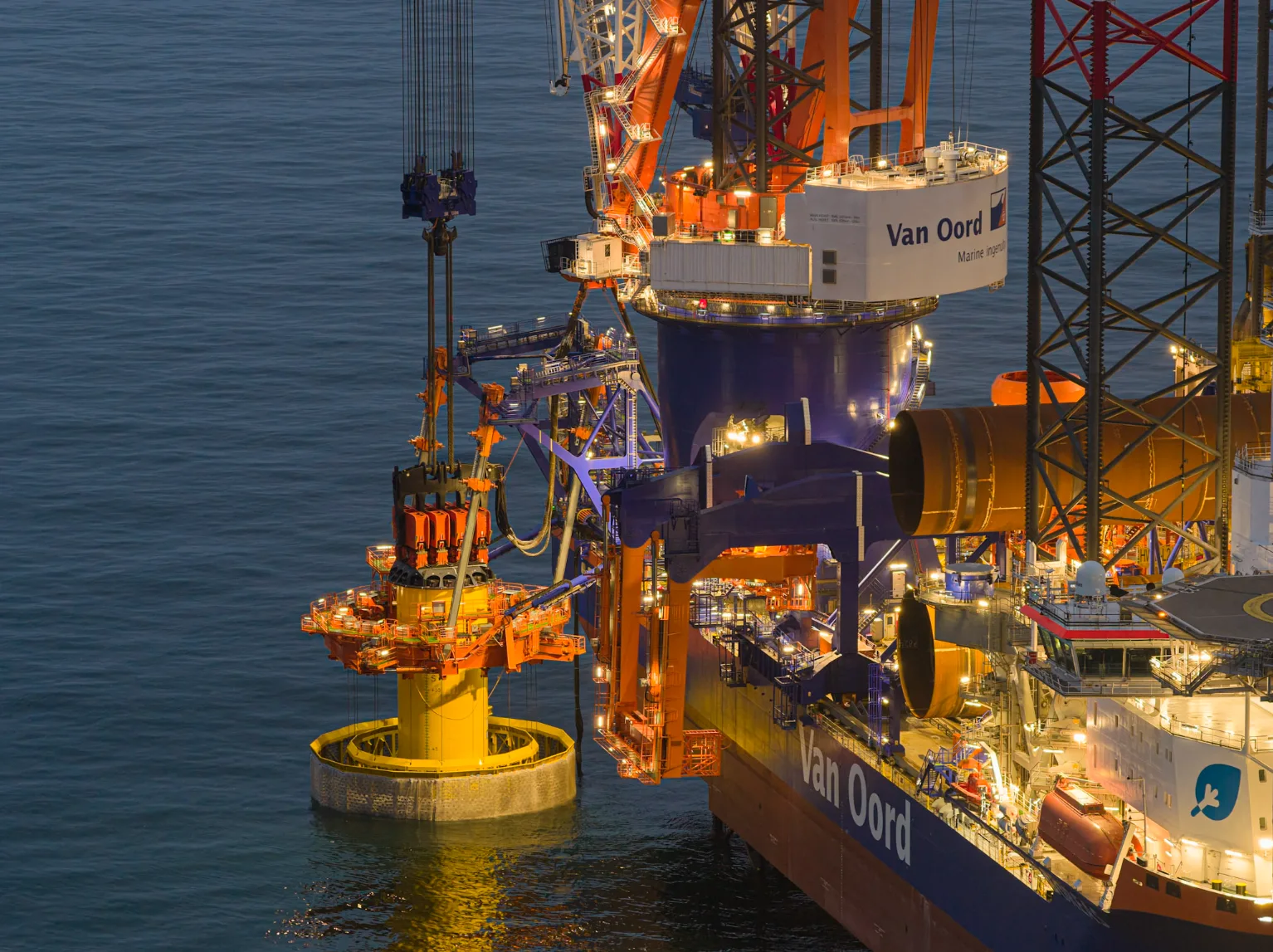
VibroJet®: impact-free driving in dense North Sea sand
Van Oord has completed the installation of three monopiles at the Hollandse Kust West Site VI wind farm using GBM Works’ VibroJet® technology in combination with CAPE Holland’s vibratory lifting tool, marking the first commercial-scale application of a silent monopile installation method in the global offshore wind industry.
Unlike the conventional percussive method, which generates acoustic impacts of up to 200 dB re 1 µPa at 750 m, disorienting marine mammals and fish, VibroJet® fluidizes the soil through the simultaneous combination of vertical mechanical vibrations and controlled water jets injected inside the monopile, allowing the structure to penetrate under its own weight without the need for a hydraulic hammer.
The deployment was carried out at Block VI of Hollandse Kust West, a field located approximately 53 kilometers off the Dutch coast near IJmuiden, where the dense sand layers of the Dutch North Sea represent one of the most demanding geotechnical environments in the European offshore wind sector.
Fluidflow® and CAPE Holland: dual control of the seabed
The differentiating element of VibroJet® compared to other low-noise installation proposals is the proprietary prediction model Fluidflow®, developed specifically by GBM Works to simulate and control the interaction between water jets and different soil conditions in real time during operation.
Fluidflow® enables dynamic adjustment of jet pressure and flow rate based on stratigraphic variations detected during penetration, ensuring precise operational control that prevents both under-penetration and excessive scour of the seabed around the monopile.
In parallel, CAPE Holland’s Vibro technology acts as a kinetic complement: it applies high-frequency vertical vibrations to temporarily reduce the resistance of the surrounding sand, allowing the monopile to reach design depth under its own weight once the soil has been fluidized by VibroJet® jets.
Boreas: the jack-up vessel as a validation platform
The silent installation campaign was executed aboard the Boreas, Van Oord’s next-generation jack-up vessel designed specifically for foundation installation at next-generation wind farms.
The Boreas installed the project’s first monopile in December 2025, completing all 52 elements of the wind farm in the first quarter of 2026.
The use of the Boreas as an industrial validation platform is not incidental: its dynamic positioning system and load capacity enable operation with the combined VibroJet®/Vibro equipment without penalties in installation cycle times, demonstrating that silent technology can compete in productivity with conventional percussive methods.
Hollandse Kust West VI: the most environmentally friendly wind farm to date
The 52 monopiles installed at Hollandse Kust West Site VI will support 52 Vestas V236-15.0 MW wind turbines, reaching a total installed capacity of approximately 760 MW capable of covering around 3% of the current electricity demand in the Netherlands.
The steel structures were manufactured by Sif and Smulders, with Van Oord acting as the main contractor for foundations, inter-array cables, and turbine installation.
The project is promoted by Ecowende, a joint venture between Shell, Eneco, and Chubu Electric Power, with the stated ambition of building the most environmentally friendly offshore wind farm to date.
With full operation expected by the end of 2026, Hollandse Kust West Site VI is positioned as a design and execution reference for the next generation of offshore wind projects in Europe.
Source and photos: https://www.vanoord.com/