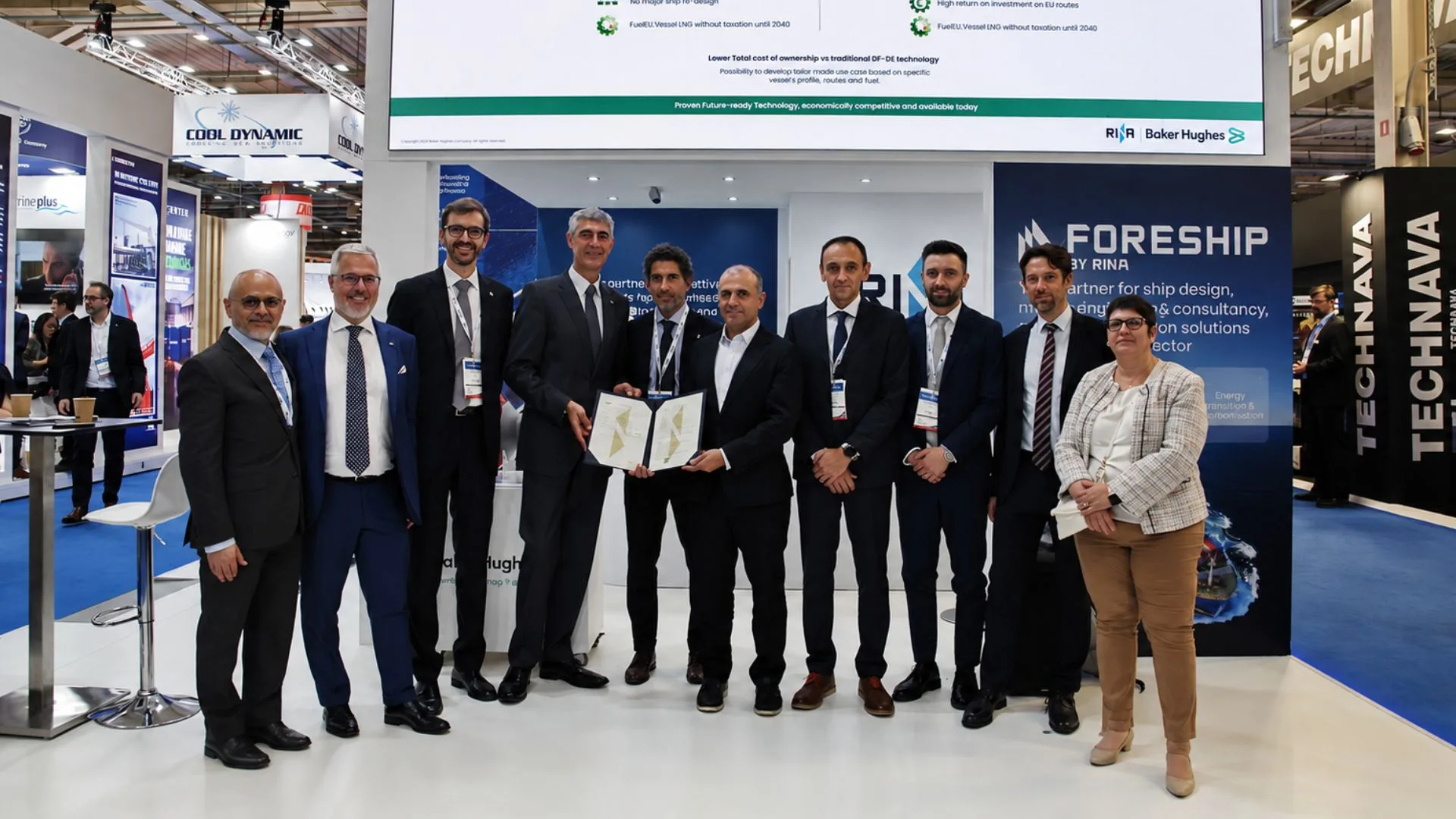
Energy technology company Baker Hughes has received RINA type approval for its NovaLT™ 16 gas turbine designed for marine propulsion applications. The approval validates the technology’s operation with natural gas and up to 100% hydrogen, expanding the options available for the marine energy transition.
The announcement was made during Posidonia 2026 in Athens, Greece, one of the most important events in the international shipbuilding industry. The certification marks a step forward in the collaboration between the two companies to incorporate lower-emission propulsion technologies in a context of increasing regulatory pressure on maritime transport.
A turbine designed for the maritime energy transition
Originally developed for industrial power generation, the NovaLT™ turbine family was adapted to meet the specific installation and operating requirements on board vessels.
The NovaLT™ 16 offers a power output of between 12 and 17 MW in simple cycle mode and can reach up to 22 MW in combined cycle mode. Its compact design, high operating efficiency, and long maintenance intervals of up to 35,000 hours are attributes especially valued in marine applications where system availability is critical.
Likewise, the maritime validation process made it possible to verify compliance with the safety, performance and regulatory standards required for propulsion systems installed on ships.
Hydrogen is gaining ground in the decarbonization strategy
The ability to operate on up to 100% hydrogen places the NovaLT™ 16 among the technologies seeking to meet the emissions reduction goals of international shipping.
Currently, shipowners and operators are exploring various alternatives to reduce their carbon footprint; in this scenario, gas turbines have begun to attract greater interest due to their high power density and their compatibility with hybrid and electric architectures.
Furthermore, the flexibility to use different fuels allows for a reduction in the uncertainty associated with the future evolution of the maritime energy market, where several solutions will coexist during the coming years.
RINA highlights early collaboration in certification
During the announcement, Giosuè Vezzuto, RINA’s Executive Vice President of Marine, noted that cooperation between technology developers and classification societies is fundamental to accelerating the incorporation of innovations in the maritime sector.
He explained that the evaluation carried out ensured that the technology meets the safety, performance and regulatory compliance requirements demanded by the naval industry.
For his part, Ahmed Eldemerdash, Vice President of Climate Technology Solutions at Baker Hughes, emphasized that maritime decarbonization requires technologies capable of delivering immediate performance and future adaptability without affecting operational reliability.
Interest in new propulsion architectures is growing
The maritime industry continues to evaluate alternatives to reduce CO₂ emissions compared to conventional two-stroke and four-stroke diesel engines.
In this context, gas turbines are emerging as an option for vessels requiring high power in confined spaces and compatibility with low-emission fuels. The certification granted by RINA represents a further step towards the integration of these technologies into commercial maritime projects seeking to balance operational efficiency, sustainability, and energy security.
Source and photo: Bakerhughes