Table of Contents
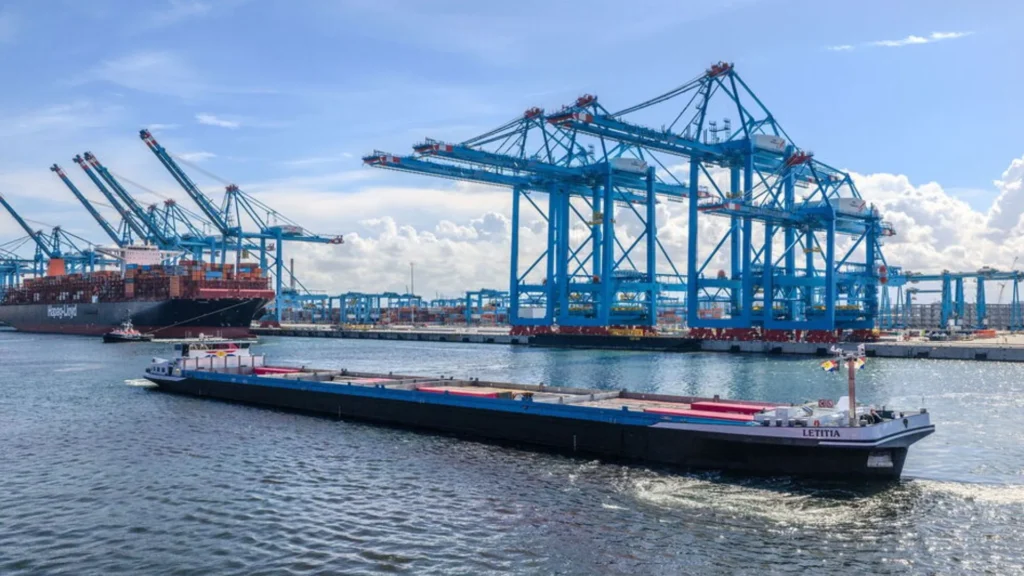
The Port of Rotterdam Authority coordinated a practical demonstration of automated navigation in one of Europe’s highest-density commercial traffic zones. During the tests, the river vessel MS Letitia, owned by HTS Group, successfully traveled independently from Amaliahaven, on the Maasvlakte river, crossing Europoort and the Nieuwe Waterweg, to reach Waalhaven. The vessel executed critical maneuvers including undocking, river transit, and automated docking without requiring direct manual assistance at the controls.
Operations of the Automated River Vessel
In this regard, the digital system maintained continuous monitoring of the port environment to identify other vessels and execute evasion maneuvers safely. Although the software managed navigation and dynamic decision-making, a captain remained on board at all times with the ability to intervene in the operation in the event of any contingency. Likewise, the applied technology integrated environmental variables to optimize the energy performance of the commercial route.
Regarding logistical benefits, Oscar van Veen, Innovation Director of the Port of Rotterdam Authority, noted that the automation of river transport introduces new schemes that increase the flexibility, efficiency, and reliability of supply chains. The use of river channels for transporting containers, bulk cargo, and liquids reduces congestion on the land road network. This projected increase in cargo volumes requires the river sector to maintain and expand its participation in the global logistics market.
The initiative is part of the 10 pilot projects promoted by MAGPIE (sMArt Green Ports as Integrated Efficient multimodal hubs), a European consortium that brings together 45 international partners. This innovation program, co-financed by the European Union, seeks to accelerate the transition toward climate-neutral terminals through the digitalization of transport infrastructure.
Finally, the technology developers involved in the trial, among which Alphatron Marine, Argonics, and Argonav stand out, confirmed that the results obtained will be immediately integrated into their commercial assistance systems. The guidance tools argoPositionPilot and argoRadarPilot will add advanced collision detection and navigation intention projection capabilities to fixed-propeller vessels.
Source and photo: Port of Rotterdam