Strohm completed the qualification and field testing program for its Thermoplastic Composite Pipe (TCP) technology, developed alongside Petrobras and Shell for subsea applications in Brazil.
The next step will be the installation and operation of a pilot flowline in a Brazilian pre-salt field, scheduled for early 2027. The project seeks to transition the technology from the validation phase to real offshore production conditions.
The qualified 6-inch line is manufactured with carbon fiber and PA12 polyamide for Water-Alternating-Gas (WAG) injection services used in enhanced oil recovery.
The system was qualified according to DNV-ST-F119, a standard establishing design, load analysis, safety, and documentation requirements for thermoplastic composite pipes intended for offshore applications.
The campaign accumulated over 50,000 testing hours, including materials, sealing, and full-scale trials. Strohm also reported more than 40 individual tests conducted across seven laboratories and certification centers in Europe and Brazil.
The problem the material change aims to solve
Interest in the technology stems from integrity issues associated with certain metallic systems used in CO₂ environments. In the Brazilian pre-salt, pressure, temperature, and fluid composition conditions make material selection a variable directly linked to the service life of subsea facilities.
TCP utilizes a carbon fiber-reinforced thermoplastic matrix, meaning it does not rely on a metallic wall exposed to the fluid to provide structural strength.
Strohm specifically developed this architecture for applications where corrosion and CO₂-related mechanisms represent an integrity concern. The company notes the solution is designed for a 30-year service life.
This does not mean all system deterioration mechanisms disappear. Integrity remains dependent on the interaction between material, structure, connections, seals, cyclic loads, pressure, temperature, and installation procedures.
For this reason, qualification was not limited to the material: the combined behavior of the pipe and its interfaces was evaluated.
The true innovation lies in system-level installation
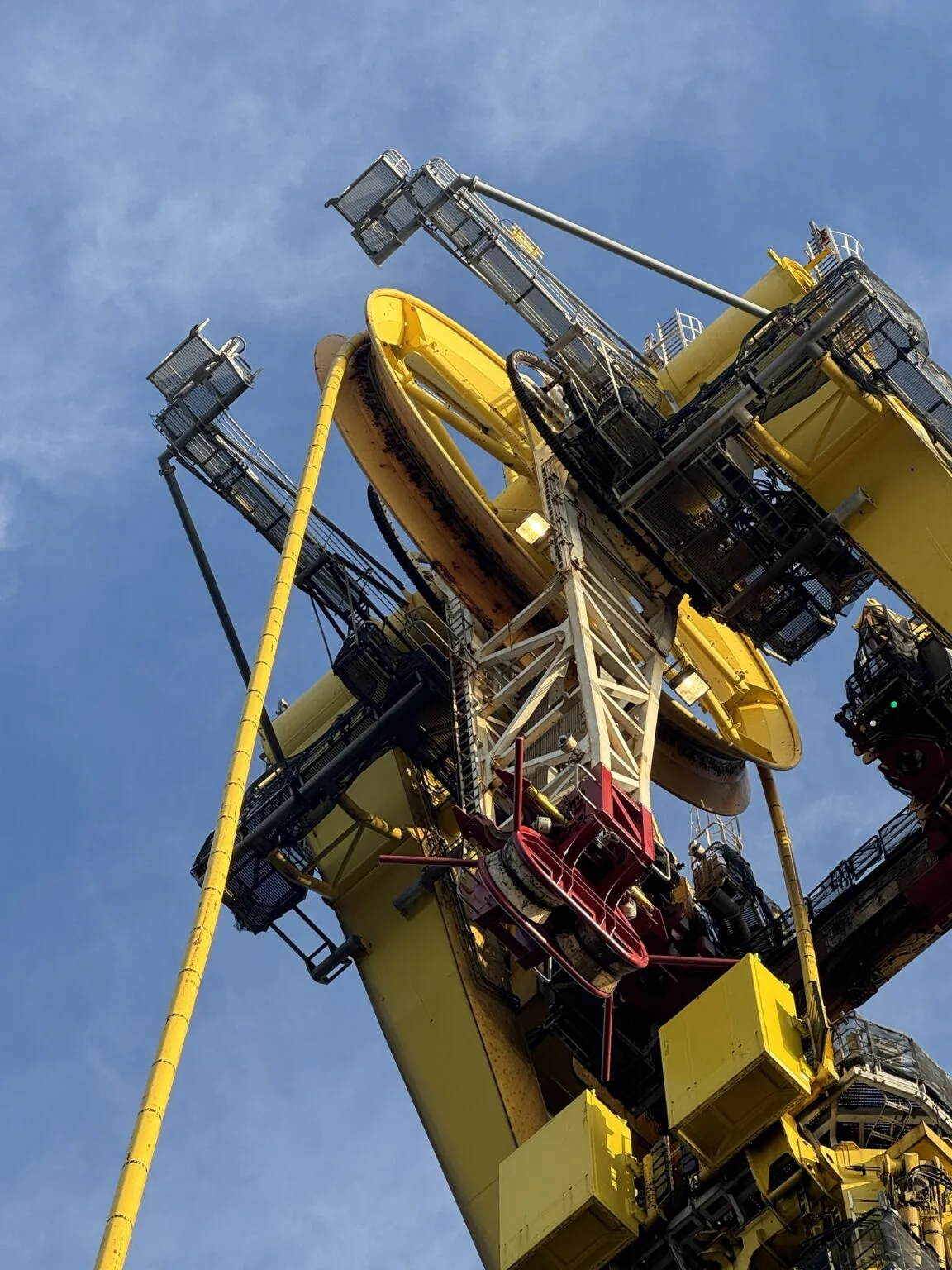
A technically relevant aspect is that Strohm plans to use existing installation vessels without significant modifications to their procedures. The behavior of the pipe during laying and subsequently underwater was included in the validation process.
This is important because subsea technology may be technically viable yet impractical if it requires a new installation logistics chain.
The low-weight characteristic of TCP also modifies operations. DNV has noted that thermoplastic composite pipes offer advantages such as lower weight compared to metallic solutions, flexibility, and corrosion resistance—factors that can expand offshore installation alternatives.
The Brazilian project therefore represents a transition from material qualification to the qualification of the production and installation system. This difference is fundamental in ultra-deepwater, where subsequent intervention on a flowline can involve complex and costly subsea operations.
The pre-salt could become an industrial validation field
Brazil has already served as a development stage for this technology. Strohm and its partners initiated testing programs years ago specifically targeting conditions in Brazilian fields, and the company subsequently obtained DNV qualifications for deepwater TCP applications.
The installation planned for 2027 will hold a different significance: it will allow for the observation of the technology’s behavior within a real operation during its service cycle. The experience gained can be used to expand the use of TCP in flowlines, jumpers, and other subsea applications where weight, corrosion, and fatigue dictate design.
SOURCE and PHOTO: https://www.offshore-energy.biz/