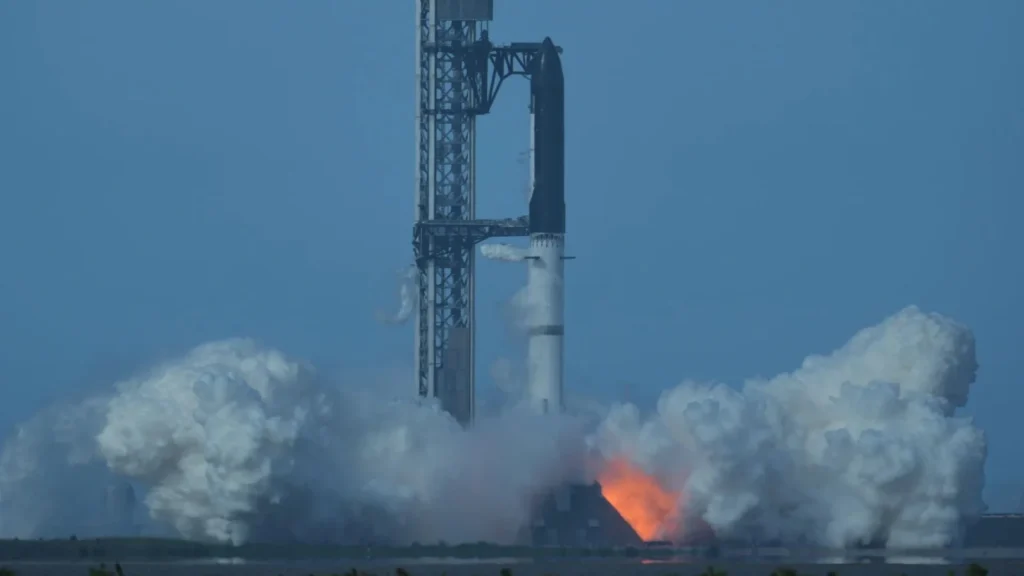
The thirteenth test flight of Starship, the launch system developed by SpaceX, was canceled just seconds before liftoff from Starbase, Texas, after several engines failed to complete the ignition sequence correctly. The automated system detected the anomaly and halted the operation, preventing a potential incident during vehicle departure.
Safety System Halted the Countdown
During the official launch broadcast, the ignition sequence could be observed starting just three seconds before the scheduled liftoff. However, four of the 33 main engines did not achieve the expected performance. As a protective measure, the automated system commanded the shutdown of the remaining engines and kept the rocket secured to the launch pad.
Likewise, ground teams immediately began tasks to drain the fuel tanks and secure the vehicle before initiating a complete technical inspection.
This marks the first time a full-scale Starship has experienced a cancellation this close to the moment of launch.
SpaceX Will Replace Two Engines Before Next Attempt
SpaceX founder and CEO Elon Musk reported that the company will replace two engines before scheduling a new flight attempt.
According to his explanation via the social network X, the objective is to ensure reliable performance before launching the vehicle again. The entrepreneur indicated that the next attempt could take place early next week, provided technical reviews are completed satisfactorily.
At 124 meters tall with 33 main engines, Starship remains the largest and most powerful rocket built to date.
Starlink Was Part of the Mission
The mission included the deployment of twenty next-generation Starlink satellites during an approximately one-hour flight.
In addition to expanding SpaceX’s satellite internet constellation, the satellites were to conduct communication tests with other units in orbit and capture images of Starship’s heat shield during different phases of the trajectory.
This test did not include plans for recovery of either the Super Heavy booster or the upper stage, as both vehicles would end their trajectory over the ocean.
Starship Maintains a Key Role for Future Lunar Missions
Although the launch was suspended, the incident does not alter the importance Starship holds within NASA’s space exploration plans.
The U.S. agency selected SpaceX to develop the landing system that will be used for the Artemis III mission, intended to return astronauts to the lunar surface. In parallel, Blue Origin is developing the Blue Moon module as part of the same program.
Over the coming years, both companies must demonstrate that their vehicles can operate safely in Earth orbit before participating in future expeditions to the Moon’s south pole region.
The new postponement represents a setback for the SpaceX test schedule. However, it also demonstrates the functioning of automated safety systems, designed to cancel a launch when technical conditions do not guarantee a safe flight.
Source: AP News
Photo: Eric Gay