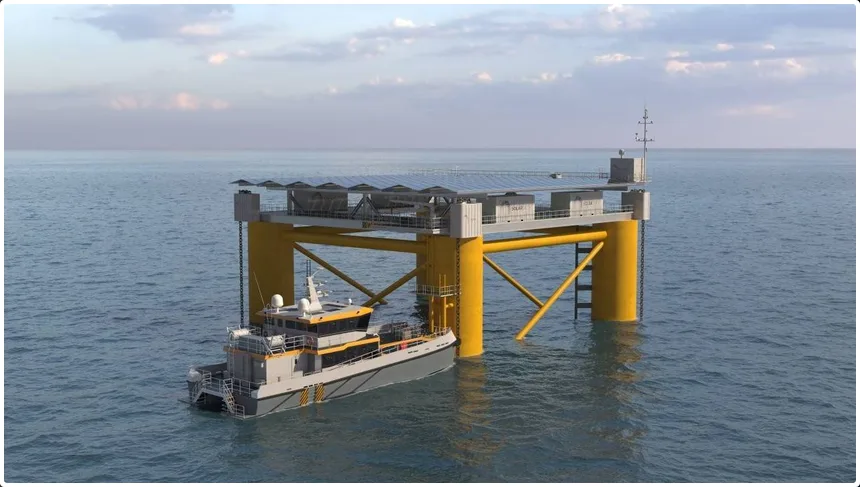
SolarDuck and the Maritime Research Institute Netherlands (MARIN) received a grant of 3.2 million euros from the Netherlands Enterprise Agency (RVO) to develop the Steady Seas program, an initiative aimed at accelerating the design of the Offshore Floating Power & Utility Hub (OFPH), a floating platform that will supply renewable energy and essential services to remote offshore assets.
The initiative seeks to offer an alternative to traditional systems used to power subsea installations, through a solution capable of generating electricity directly at the point of need.
An Alternative for Subsea Infrastructure
As energy operations extend further offshore, the need for reliable power sources for platforms, monitoring systems, subsea oil and gas infrastructure, and Carbon Capture and Storage (CCS) projects increases.
Currently, many of these facilities rely on long subsea cables, umbilicals, or diesel generators, technologies that increase installation and maintenance costs, in addition to generating higher emissions.
The Offshore Floating Power & Utility Hub aims to address this challenge with a reusable floating platform that integrates solar generation, energy storage, and auxiliary systems to ensure continuous operations in offshore conditions.
Research to Validate Offshore Performance
Within the Steady Seas program, SolarDuck will lead the comprehensive platform design and system integration, while MARIN will develop hydrodynamic analyses, numerical simulations, and tank tests to validate structural behavior, wave response, and system reliability under real operating conditions.
Likewise, the research will evaluate aspects related to dynamic behavior, mooring systems, communication and power integration, and interaction with subsea infrastructure.
The results will serve as a basis for future demonstration projects with companies in the offshore sector.
Technology to Support the Energy Transition
The project leverages the experience gained during DEI+ Merganser, SolarDuck’s first pilot initiative in the Dutch North Sea, transforming the operational data collected into a larger-scale design aimed at industrial applications.
In addition to supporting offshore oil and gas operations, the platform will also be able to supply power to carbon capture and storage projects and other remote assets, helping to reduce the lifecycle costs of these facilities and fostering new investment opportunities.
With this advancement, SolarDuck and MARIN seek to accelerate the development of marine energy solutions that combine renewable generation, storage, and smart infrastructure to meet the needs of an increasingly digitized offshore industry focused on emissions reduction.
Source and photo: https://solarduck.tech/