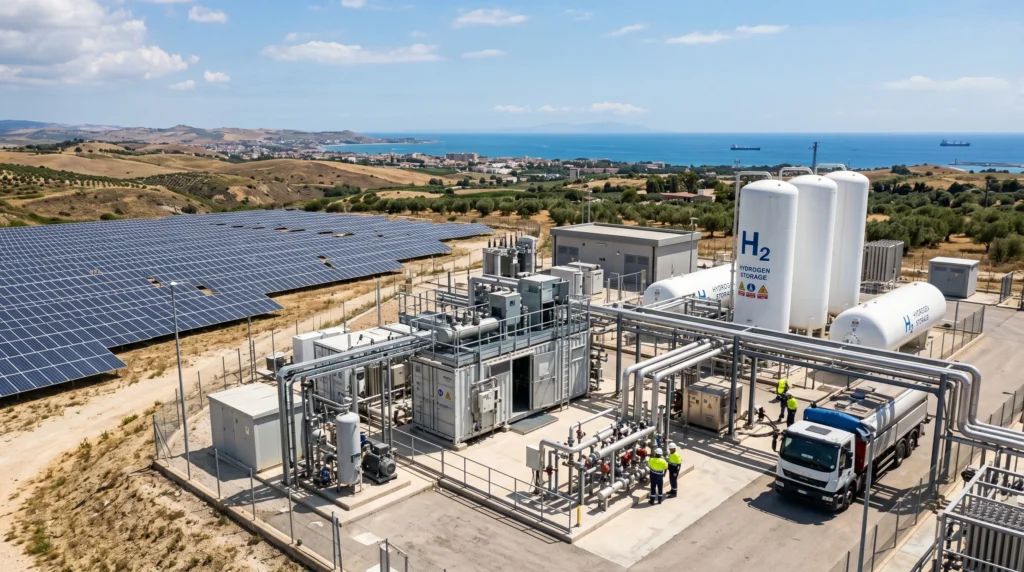
The Sicily green hydrogen plant reflects Europe’s growing commitment to accelerating the production of renewable fuels capable of reducing industrial emissions and strengthening regional energy security. In a context of expanding hydrogen projects in the Mediterranean, the Italian island seeks to position itself as a new center for technological and industrial development for one of the energy sources expected to play a key role in the transition toward a low-emission economy.
Giammoro to Host Sicily’s First Green Hydrogen Plant
The Sicily green hydrogen plant represents a decisive step in Italy’s decarbonization strategy, following formal approval by the Regione Siciliana for the construction of the first facility dedicated exclusively to green hydrogen production on the island. Located in the Giammoro industrial hub in the province of Messina, the project is being developed by Duferco Energia in partnership with Ansaldo Green Tech, within the framework of the Hydrogen Valley Giammoro initiative. Regional authorities in Palermo have defined this initiative as a reference model for other Italian regions seeking to drive hydrogen-based industrial transformation.
The project has attracted an estimated investment of approximately €10 million, primarily allocated to the deployment of electrolysis infrastructure and photovoltaic solar generation that will constitute the core of the facility. According to Duferco Energia, the plant is expected to supply hydrogen to both local industrial consumers and regional logistics operators once it enters operation. For its part, the Regione Siciliana confirmed that the project is aligned with national and European Union roadmaps for the development of the hydrogen economy.
Green Hydrogen Plant to Produce 100 Tons per Year
The Giammoro facility will be equipped with a 1 MW electrolyzer, capable of separating water into hydrogen and oxygen using electricity generated on-site by a dedicated 4 MW photovoltaic solar plant. This configuration ensures that the hydrogen produced meets the European Union’s definition of renewable hydrogen, an essential requirement to access EU hydrogen infrastructure funding programs and comply with the Renewable Energy Directive.
The estimated annual production will reach approximately 100 tons of hydrogen per year, a figure aligned with small- and medium-scale industrial hydrogen hubs currently being developed in various European countries.
According to Offshore Energy, the initial 1 MW electrolyzer capacity represents a first phase of the project, with possibilities for expansion as regional demand for green hydrogen increases. The 4 MW photovoltaic solar installation will be located adjacent to the electrolysis plant within the Giammoro industrial park, which will minimize transmission losses and ensure a direct supply of renewable energy.
This integrated design—in which solar generation directly powers the electrolysis process within a single industrial complex—is increasingly considered one of the most efficient and cost-effective architectures for green hydrogen production at this scale.
The construction of the plant in Giammoro positions Sicily within the growing group of southern European regions that are developing their own hydrogen production capacity. In this way, the island joins similar initiatives being promoted in Spain, Portugal, and southern France, territories seeking to accelerate the energy transition through the deployment of renewable hydrogen-based infrastructure.
Furthermore, the project’s location within an already established industrial zone reduces potential conflicts related to land use and allows for the utilization of existing transportation infrastructure, utilities, and industrial connections, facilitating a more efficient and competitive project implementation.
Industrial Decarbonization, Logistics, and Energy Transition in Europe
The primary application of the hydrogen produced in Giammoro will be oriented toward industrial decarbonization, with the steel sector being one of the main potential consumers due to the existing metallurgical activity in Sicily and the commitments made by the steel industry in Italy to reduce Scope 1 and Scope 2 emissions. The substitution of fossil-based hydrogen or natural gas in steel manufacturing processes can reduce CO₂ emissions by up to 90% per ton of steel produced.
Logistics and transportation represent a second demand axis. Trucks powered by hydrogen fuel cells and port equipment fueled by this fuel are being incorporated with increasing frequency in Mediterranean logistics corridors. Additionally, Sicily’s strategic position as a transshipment hub between Europe and North Africa creates a natural market for green hydrogen as fuel for vessels and heavy-duty vehicles.
The storage of renewable energy constitutes a third relevant application. In this context, hydrogen can act as a seasonal storage medium, absorbing surplus solar generation during peak production periods and subsequently releasing that energy through fuel cells or co-combustion systems when solar irradiation levels decrease. This function is particularly valuable in island electrical systems such as Sicily’s, where limitations in utilizing all available renewable generation during high solar production periods remain a structural challenge.
The project’s inclusion within the European Hydrogen Valley framework positions Giammoro to access specialized technical assistance and potential co-financing mechanisms from European Union instruments, including the Innovation Fund and the Connecting Europe Facility program.
For Sicily as a whole, the Giammoro plant is part of a broader energy transition strategy that includes the expansion of photovoltaic solar capacity and the modernization of the electrical grid on the island’s southern and eastern coasts. Regional energy security increasingly depends on the capacity to produce, store, and manage clean energy locally, reducing dependence on imported fossil fuels. In this context, the Giammoro project joins other comparable initiatives being developed in southern European regions, such as Andalusia, where the growth of renewable energy and green hydrogen has become a strategic component of regional energy transformation.
Sources: