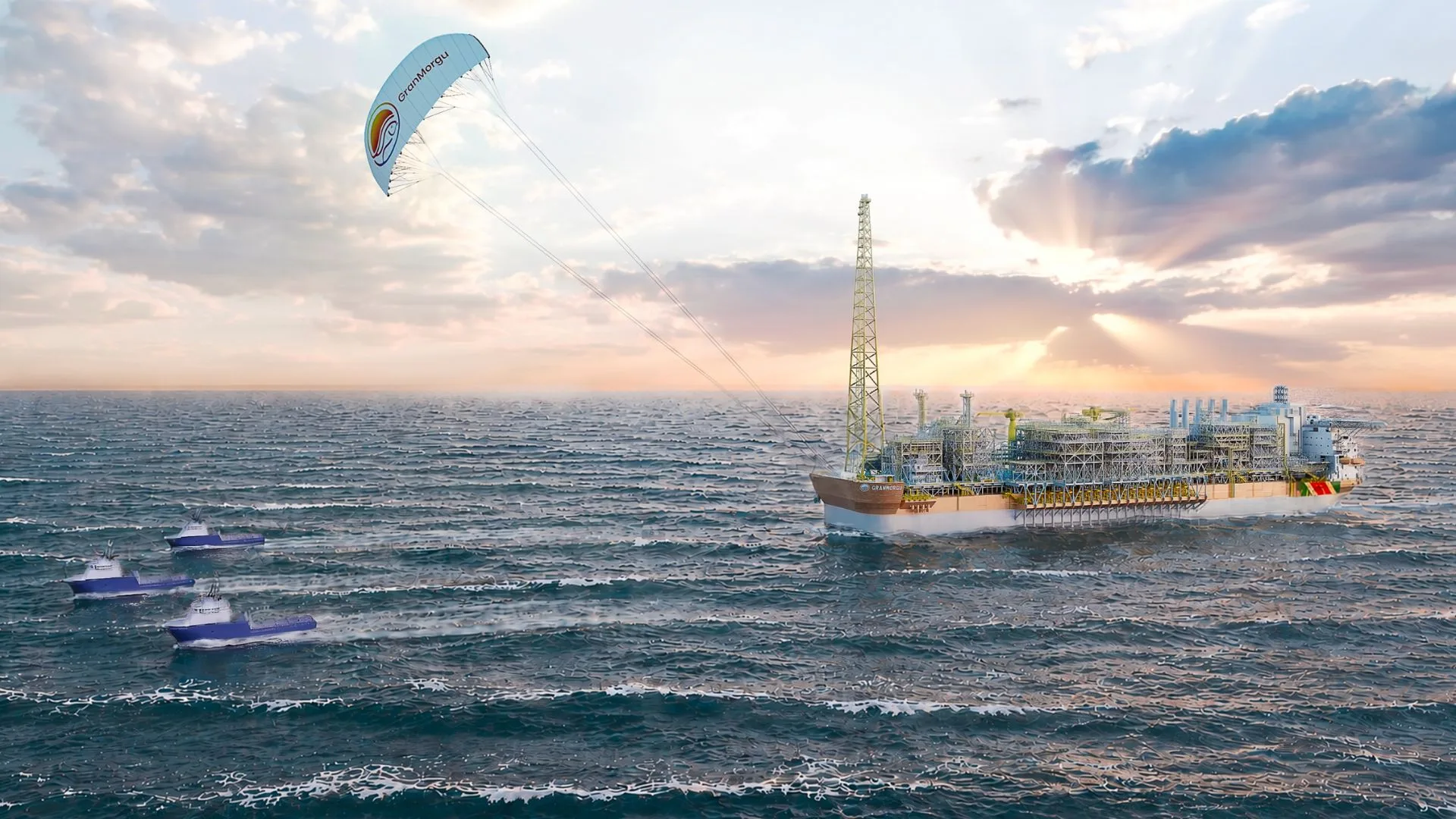
Companies SBM Offshore and TotalEnergies signed an agreement to study the feasibility of a wind-assisted traction towing system for the GranMorgu FPSO. This initiative will be developed in collaboration with the French firm Beyond the Sea, a specialist in kite technology applied to commercial navigation. The main purpose is to reduce travel time and minimize fuel consumption during the unit’s transit from the construction shipyard in China to the deep waters of Suriname.
The Implementation of Wind Propulsion for the GranMorgu FPSO
Consequently, the technical development will utilize the SeaKite 2400 model, an automated mechanism designed to provide constant propulsive force according to the weather conditions of the journey. The process will be executed through a staged research and development strategy, which includes technological qualification, operational cost estimation, and land-based testing before final assembly on the naval structure. Likewise, the transition to subsequent operational periods will depend on strict validation of safety protocols and the kite recovery system.
Additionally, the collection of digital data will allow for the refinement of simulation models to optimize equipment design for large vessels. Laurent Le Touze, Director of Technology and Product Development at SBM Offshore, noted that this cooperation seeks to contribute to marine logistics with lower carbon emissions and greater energy efficiency. For his part, Yves Parlier, founder of Beyond the Sea, mentioned the relevance of this trial in a complex maritime environment to consolidate kite traction as a reliable and effective alternative.
Technical Feasibility and Phases of the SeaKite 2400 Project
Regarding the energy context, the GranMorgu project represents a total financial investment that could reach $12.2 billion, exceeding the initial estimate of $10.5 billion set by the operating consortium. The Sapakara South and Krabdagu fields, located 150 kilometers off the Surinamese coast, hold recoverable crude oil reserves estimated at over 750 million barrels.
Finally, the FPSO’s commissioning is projected for 2028, with a daily operational processing capacity set at 220,000 barrels of oil. Frédéric Beys, project director for TotalEnergies, ratified the corporate commitment to energy optimization and technical support for the expansion of clean propulsion systems in complex offshore operations.
Source and photo: SBM Offshore