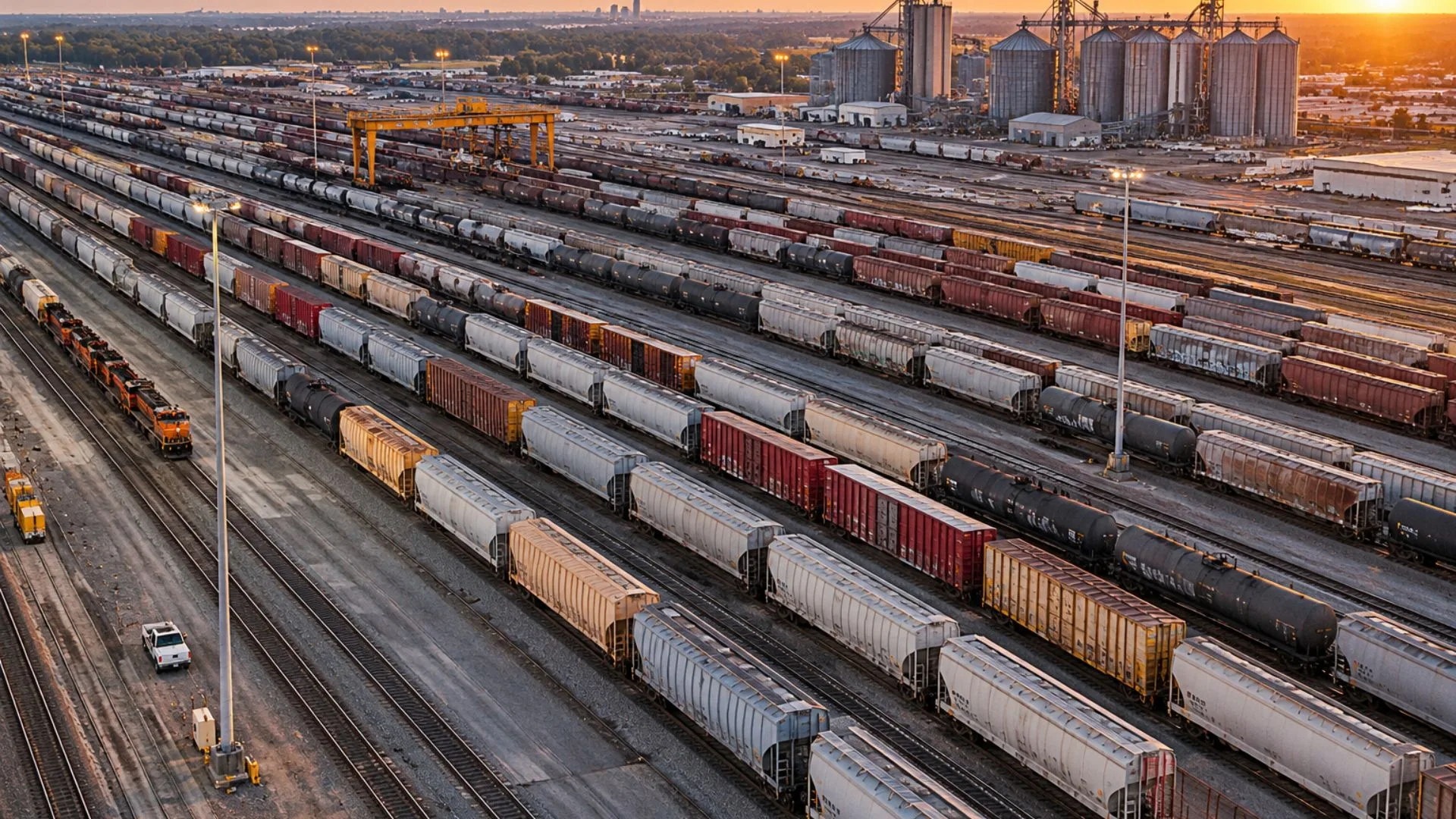
The rail fuel surcharges rail freight surcharges in the United States reached record levels in September, coinciding with the start of the corn and soybean harvest. This increase adds pressure to an agricultural supply chain already facing higher production and transportation costs. According to data from the U.S. Department of Agriculture (USDA), the average surcharge reached 48 cents per mile per railcar during the second week of September, representing a 153 % year-over-year increase, these charges now account for approximately 11 % of the total cost of rail freight for corn and soybeans, a year ago, their share was around 5 %.
Rail fuel surcharges increase with the price of diesel
Railway companies use these surcharges to compensate for variations in the fuel price the surcharge, which is added to the regular rates for long-distance freight transport, is tied to the US diesel price index for trucking. The surcharges are triggered when the fuel price exceeds certain benchmark values, typically between $2.30 and $3.25 per gallon.
The recent surge in energy prices has rapidly increased that bill. Diesel prices have surpassed $6 per gallon, while Brent crude futures have exceeded $104 per barrel. For the agricultural sector, the speed of these price movements poses an additional challenge due to the tight margins on which many producers operate, Frayne Olson, an agricultural economist at North Dakota State University, explained that variations of just a few cents per bushel can have a significant impact on profitability.
Farmers feel the impact on the price of grain
The increase in rail costs can also ultimately be reflected in the price farmers receive for their crops. Silos and collection centers buy grain from producers and then must transport it to processors, export terminals, or livestock facilities. When moving this merchandise becomes more expensive, part of the increase can be passed on to the local price offered to the producer.
This can widen the gap between the spot price available in a given producing region and the futures contracts used as a benchmark by the market. Gary Millershaski, a Kansas wheat and sorghum farmer and president of U.S. Wheat Associates, noted that the gap in his local silo was about 70 cents per bushel below Kansas City durum wheat futures; typically, the gap is closer to 40 cents.
The problem is especially sensitive for producers located far from inland waterways, many corn, soybean, and wheat farmers rely on the railway to move large volumes over long distances.
Railroads collected $2.93 billion in surcharges
Data from the Surface Transportation Board illustrates the economic impact of these charges: rail companies collected $2.93 billion in fuel surcharges during the second quarter. This figure was more than 90% higher than that recorded in the same period of the previous year and covered approximately 90 % of their diesel costs.
Companies such as BNSF, CSX, Norfolk Southern, Canadian National, Canadian Pacific Kansas City, and Union Pacific apply these types of charges to their long-distance freight rates. For the railroads, the mechanism allows them to adjust fares to fuel price fluctuations and reduce their financial exposure to sharp movements in the energy market, Canadian National maintains that this system helps keep fares aligned with current operating costs.
Rail costs also affect the export chain
The impact is not limited to farms. Marketing companies and silo operators must also incorporate transportation and fuel costs into their operations. Large companies like ADM have a greater capacity to distribute some of these expenses along the supply chain, for individual farmers, the possibilities of passing on the cost are much smaller.
During periods of high international demand, some of the increased logistics costs may also end up reaching buyers in export markets such as China; thus, the price of fuel creates a direct link between the energy market and the international competitiveness of corn, soybeans, and wheat produced in the United States.
Railway consolidation is causing concern among producers
The rate increase comes as the agricultural sector closely monitors a potential acquisition of Norfolk Southern by Union Pacific. Railroad companies argue that such a deal could facilitate the movement of goods and improve service. Agricultural organizations, however, have expressed concern about its potential effects on competition and freight prices.
This issue is especially important for producers located in regions with few alternatives for transporting large quantities of grain. With the U.S. harvest underway and fuel prices high, rail surcharges have become an increasingly significant factor in the logistics costs faced by the agricultural sector.
Source: Reuters
Photo: Shutterstock