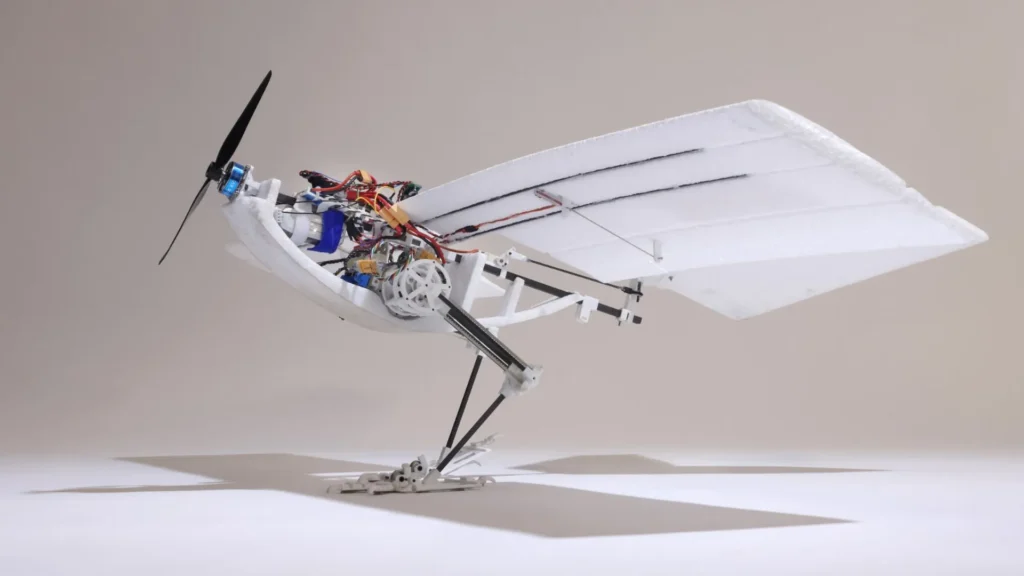
An international team of researchers has developed an innovative robot bird , called RAVEN (Robotic Avian-inspired Vehicle for multiple ENvironments), that challenges the limitations of traditional flying machines. This robot has the ability to walk, jump and fly, thanks to bird-inspired legs , making it one of the most promising proposals for future aerial robots and flying vehicles.
The robot bird that walks, jumps and flies in complex terrain
The development of RAVEN, led by researchers at the École Polytechnique Fédérale de Lausanne (Switzerland), represents a significant advance in the integration of multiple forms of locomotion into a single system. The robot’s legs, built to mimic the structure of birds’ hind limbs, allow it to leap into flight, walk across rough terrain, and even navigate around obstacles in its path . This versatility could be key to the development of more efficient and versatile flying vehicles in the future.
According to experts, RAVEN’s leg system facilitates a faster and more energy-efficient takeoff , and opens the door to applications in complex terrain, where traditional vehicles would have difficulty operating. Although the design still requires further adjustments, the potential of this robot is remarkable, especially in situations that demand adaptability on the ground , such as rescue missions or exploration of hard-to-reach areas.

Watch how RAVEN can jump and fly. Source: Nature
Implications for the future of robotics and aeronautics
The concept of flying machines that can move with the same agility as birds could completely transform the capabilities of aerial vehicles , allowing them to land, take off and move with greater flexibility. This type of innovation could be used in robotics for high-precision tasks and in the aeronautical industry, offering more efficient and adaptive solutions for air transport in the future.
Ultimately, the research behind RAVEN opens up new possibilities in the design of intelligent flying vehicles, highlighting the importance of biomechanics in modern robotics.
Follow us on social networks and don’t miss any of our publications!
YouTube LinkedIn Facebook Instagram X TikTok
Source and photo: Scimex