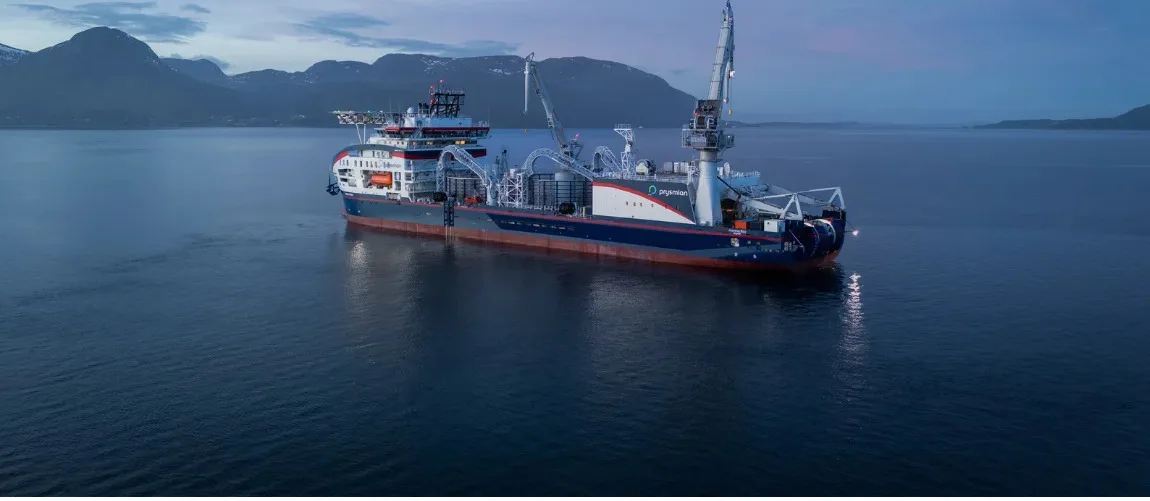
Prysmian commissioned a new heavy-duty subsea plough developed together with SMD to strengthen the protection of subsea power cables used in interconnections and offshore wind farms. The tool will enable cables to be installed up to five meters below the seabed, increasing their protection against mechanical and environmental risks.
The new equipment will be incorporated into the cable-laying vessels Prysmian Monna Lisa and Prysmian Alessandro Volta, strengthening the company’s operational capability to execute large-scale subsea power transmission projects.
The adoption of this technology responds to the accelerated growth of offshore electrical infrastructure, where the reliability of subsea links is as important as their transmission capacity.
Burial improves the protection of subsea cables
Subsea cables are the backbone of numerous modern electrical interconnections and of the connection between offshore wind farms and national transmission grids.
Although they are designed to operate for several decades, they can be affected by anchors, fishing gear, ocean currents, seabed erosion, and even geological movements. Burying them significantly reduces the likelihood of damage and lowers the costs associated with repairs and service interruptions.
The new tool developed by Prysmian increases the maximum installation depth to five meters, making it possible to adapt the level of protection to the geotechnical characteristics of each section of the route.
Seabed engineering determines the success of the installation
Burying a subsea cable is a highly specialized operation that requires prior analysis of the seabed composition, soil strength, the presence of rock, sediments or slopes, and the site’s oceanographic conditions.
The precision with which the plough operates directly influences the depth achieved, cable stability, and installation speed—factors that determine both the safety and profitability of the project.
The collaboration between Prysmian and SMD made it possible to develop a tool capable of maintaining high levels of precision even under complex seabed conditions.
Subsea infrastructure demands more specialized solutions
The growth of international interconnections and offshore wind energy is driving the development of new technologies for the installation and protection of subsea cables.
The adoption of more powerful burial tools responds to the need to build infrastructure capable of operating for decades with high levels of availability, minimizing maintenance interventions and increasing the resilience of power grids.
In addition to improving operational safety, this type of development strengthens the specialized supply chain and consolidates industrial capabilities that will be decisive for the future expansion of offshore power transmission.
Source and photo: https://www.prysmian.com/