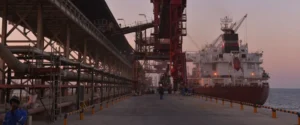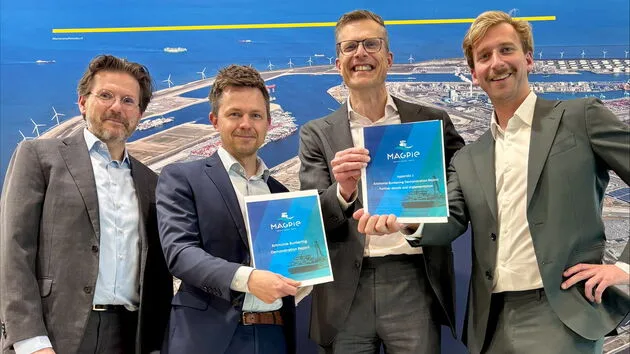
The Port of Rotterdam demonstrated that ship-to-ship ammonia bunkering can be performed safely within an operational port, as part of the European MAGPIE project.
The simulation was conducted on April 12, 2025, and its results were published in May 2026 in an open technical report for the industry.
The project was developed within the framework of MAGPIE, a European Union-funded initiative to promote green, smart, and multimodal ports. Participants included the Port of Rotterdam, the Mærsk Mc-Kinney Møller Center for Zero Carbon Shipping, and industrial partners involved in ammonia bunkering.
Green, smart, and multimodal ports
Ammonia is considered one of the options with the greatest potential to reduce maritime transport emissions. However, its use as a fuel requires specialized safety procedures, appropriate equipment, and clear regulatory frameworks due to its specific risks.
The large-scale simulation confirmed that this type of operation can be executed safely if rigorous planning and a solid operational framework are in place.
The exercise also validated the Port of Rotterdam’s safety framework for the use of ammonia as a marine fuel, in addition to port readiness tools applicable to other ports.
Maritime energy transition and operational safety
Bo Cerup-Simonsen, CEO of the Mærsk Mc-Kinney Møller Center for Zero Carbon Shipping, noted that the project provides practical insights, validation sheets, and recommendations to support future permitting and regulatory processes.
For his part, Boudewijn Siemons, CEO of the Port of Rotterdam, highlighted that the energy transition requires new integrated value chains and that this pilot represents an important step in developing alternative fuels from import to their application in maritime transport.
With the open publication of the results, the MAGPIE partners aim to accelerate the safe adoption of ammonia as a marine fuel and support the development of more sustainable, smart, and integrated ports.
Source and photo: https://www.portofrotterdam.com/