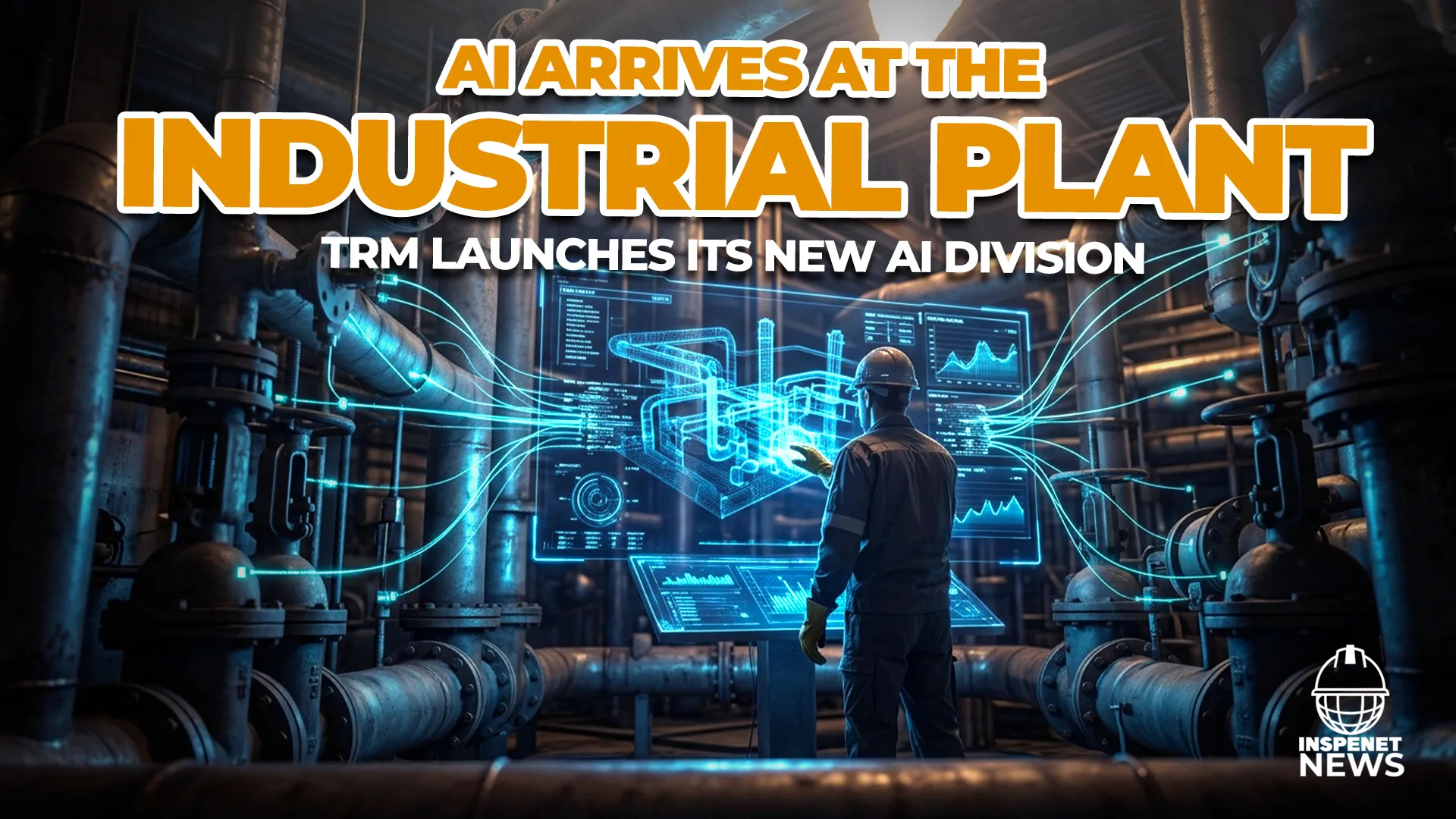
TRM brings asset management to AI with OMNI AI Studio
TRM launched a new artificial intelligence division focused on asset management in partnership with OMNI AI Studio. The company aims to help industrial businesses integrate these tools into their operations and achieve measurable results in asset maintenance, performance, and availability.
Furthermore, the proposal aims to address one of the main challenges companies face when adopting AI: moving from isolated tests to applications connected to the systems they use daily. TRM proposes integrating these capabilities into existing processes without forcing organizations to abandon their technological infrastructure.
TRM creates an AI division focused on asset management
Specifically, the new division brings together advisory services, architectural guidance, development of industrial AI solutions , enterprise integration, and software that incorporates artificial intelligence .
In this way, TRM aims to help organizations identify use cases with operational value and prepare their data to work with intelligent applications . The company also envisions connecting these tools with platforms dedicated to asset management and performance.
On the other hand, the company can work within an organization's existing approved AI infrastructure. When a company does not yet have this environment, TRM can assess its current systems, operational needs, security requirements, and growth plans to define a suitable architecture.
What does TRM seek to solve with its AI strategy?
Currently, many organizations are allocating resources to artificial intelligence; however, transferring that investment to operations related to physical assets presents additional difficulties.
Therefore, TRM focuses its proposal on connecting enterprise AI with the tools and processes used by maintenance and operations teams. The goal is for the information generated by these systems to inform daily decisions and have quantifiable effects on costs, performance, and uptime.
Likewise, Jordan Ortiz, director of AI Strategy, Research and Development at TRM, explained that many companies already have a strategy for this technology, although they are still studying how to convert it into measurable business value.
The company also maintains that this integration should allow each organization to retain control of its data, models, security, and governance policies.
OMNI AI Studio connects AI with EAM systems
In this scenario , OMNI AI Studio appears , the solution presented by TRM to facilitate the use of artificial intelligence within enterprise asset management or EAM environments.
Thus, the platform aims to bring AI capabilities closer to the systems and workflows that organizations already use. This approach reduces the gap between an experimental application and a tool integrated into industrial operations.
Furthermore, TRM's prior experience includes working with artificial intelligence and machine learning within EAM environments . The company also highlights its experience in regulated sectors where enterprise architecture, security, and governance influence the adoption of new technologies.
AI for predictive maintenance and workflow automation
In practice, one of the anticipated fields is predictive maintenance ; artificial intelligence can use available data on equipment and operations to support early detection of problems and facilitate intervention planning.
Furthermore, workflow automation plays a key role in the proposal. TRM offers applications capable of streamlining repetitive processes and helping specific information reach the people responsible for acting on an asset more quickly.
Intelligent work management is also being considered; the combination of operational data, EAM systems, and industrial AI can facilitate task planning and provide more context before making a decision related to maintenance or performance.
Thus, the approach goes beyond simply incorporating an artificial intelligence assistant . The intention is to connect models and applications with processes that are already part of the daily operations of organizations.
Industrial AI enters asset planning and diagnostics
At the same time, industrial AI opens up possibilities for analyzing information from physical assets and turning it into recommendations that operations teams can use.
For example, these capabilities can support problem diagnosis, maintenance planning, and the identification of follow-up actions. Their usefulness will depend on the quality of the available data and the integration with enterprise systems.
Consequently, asset management becomes one of the areas where organizations can seek concrete results from their investments in artificial intelligence. Factors such as availability, costs, and performance allow for a more precise measurement of the impact of these applications.
Security and governance condition the deployment of industrial AI
On the other hand, deploying artificial intelligence within industrial operations requires considering aspects that go beyond the model's functionality. Permissions, infrastructure, data protection, and internal policies determine what information each application can use and how it should do so.
Given these demands, TRM proposes adapting the AI architecture to the specific conditions of each organization. This allows them to work on previously approved infrastructure or design an environment for companies that do not yet have systems ready for these applications.
Furthermore, this approach becomes especially important when asset management takes place in industries subject to strict security and governance requirements. In these cases, integrating AI means maintaining control over the data and systems involved in operations.
TRM uses AI to support workers' decisions
Finally, the strategy presented by TRM also defines the role that artificial intelligence would play within teams. Don Omura, the company's CEO, maintains that the goal should be to provide people with tools to act more quickly and confidently based on operational intelligence.
Therefore, the proposal does not focus on replacing those who manage the assets. Its aim is to incorporate information, recommendations, and automation into the processes these professionals use.
With this launch, TRM aims to move artificial intelligence from the experimental phase to daily operations. OMNI AI Studio and the new division offer the company a way to integrate industrial AI, workflow automation, and EAM systems into a single asset management strategy.

News of additional interest
Azerbaijan wants technology to gain ground
Azerbaijan aims to reduce its heavy reliance on oil and gas by strengthening its technology sector. This industry accounted for 2.1% of its GDP last year, down from 1.9% in 2024. To accelerate its growth, the country is seeking to attract foreign companies, venture capital funds, and new projects that will help transform Baku into a technology hub on the Caspian Sea.
A law passed in July will make it easier for startups to receive investment and close deals within the country without having to establish companies in other jurisdictions. The government is also preparing a fund with local and foreign capital, while the Central Bank develops regulations for financing projects through crowdfunding. The challenge is considerable: in 2025, only 22 startups raised $2.62 million, and the three venture capital funds operating in the country reported a combined total of around $11 million.
Canada sets a date for the future of Pathways
Canada's major oil producers expect to decide between late 2027 and early 2028 whether to move forward with Pathways , a multi-billion-dollar carbon capture and storage project. The initiative would have the capacity to manage 6 million tons of CO₂ and aims to reduce emissions from the oil sands. Before making a decision, the companies hope to reach an agreement with Alberta and the federal government on the project's fiscal terms by mid-November.
Pathways is also linked to Canada's plans to increase its oil exports. Prime Minister Mark Carney supports Alberta's proposal to build a pipeline to the Pacific coast with a capacity of one million barrels per day, but his support is contingent on the progress of the carbon capture system. The original project aimed to reduce emissions by 22 million tons by 2030. The current target is 6 million tons by the mid-2030s and another 10 million tons by 2045.
NRG Energy is considering entering a coal-fired power plant project
NRG Energy is considering buying Pleasants Power Station , a West Virginia coal-fired power plant currently undergoing bankruptcy proceedings, or acquiring a stake in it. The potential deal comes as Omnis Energy, the plant's owner, seeks to have a federal court close its reorganization process. The company maintains that the plant could generate at least $466 million in revenue and approximately $286 million in operating profit over the next four years.
The conflict pits Omnis against a management team installed by the lenders. The new administrators claim the plant suffered losses, a lack of capital, maintenance problems, and operational failures. Omnis rejects these accusations and states that there are purchase offers between $350 million and $400 million. These figures would far exceed the price paid for the facility in 2023 and would cover the estimated debts associated with the asset.
SLB accelerates reservoir reading with QI-FWI
QI-FWI solution , a tool that seeks to obtain information about reservoir rocks and fluids directly from seismic data. The system analyzes the behavior of underground waves and adjusts digital models to closely match observed conditions. This allows it to generate data on properties such as velocity, density, and formation stiffness.
The solution integrates tasks that traditionally require multiple stages of processing and analysis. QI-FWI uses pressure and shear waves to calculate properties such as impedance P and the Vp/Vs ratio, data that help identify changes in rocks and potential fluids. The results can also be compared with logs obtained from wells. Its applications range from exploration and drilling planning to monitoring existing producing reservoirs.