Researchers at the Oak Ridge National Laboratory (ORNL), part of the U.S. Department of Energy, have successfully combined the SAMMY nuclear analysis code with high-resolution neutron transmission measurements.
These were obtained using the VENUS instrument, with the goal of identifying and verifying nuclear materials without dismantling or destroying the samples.
The integration of both technologies offers a new approach to nuclear non-destructive analysis, known as NDA.
SAMMY analyzes complex nuclear data
SAMMY is a code developed by ORNL for the analysis of nuclear data, specifically resonance parameters and neutron cross sections.
These sections represent the probability of a neutron interacting with a given nucleus and producing a nuclear reaction.
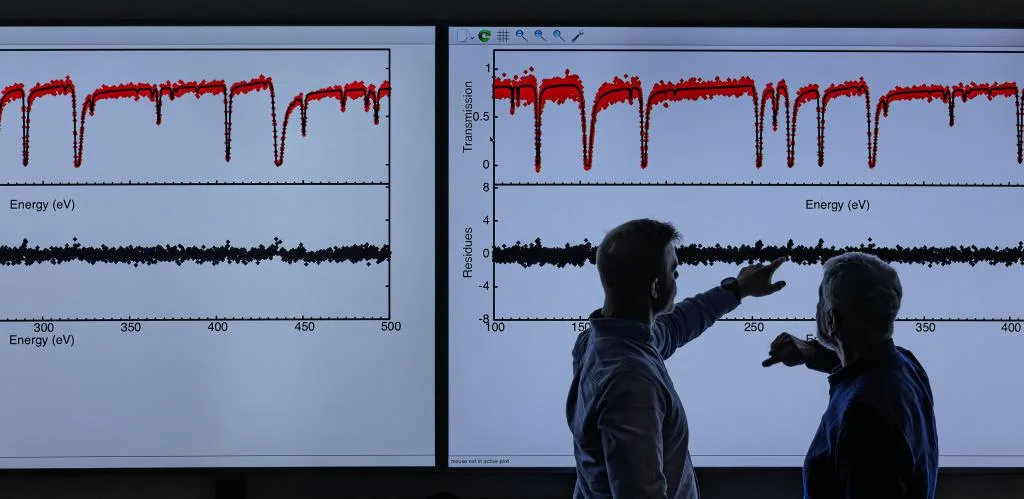
Each isotope possesses a distinctive cross-section profile, comparable to a nuclear fingerprint. From this signature, researchers can identify materials by analyzing how they respond to a neutron beam across different energy ranges.
Luiz Leal, lead author of the report and a member of the ORNL Nuclear Data Group, explained that SAMMY has been a key tool for nearly three decades in linking nuclear theory with experimental measurements.
VENUS provides precise neutron imaging
VENUS, which stands for Versatile Neutron Imaging Instrument, is a neutron imaging instrument located at ORNL’s Spallation Neutron Source. Its design allows it to work with a wide range of neutron energies, facilitating the detection of subtle differences between isotopes.
For this study, researchers employed neutron resonance transmission analysis, known as NRTA. The method involves directing a neutron beam through a sample and measuring how they are transmitted at different energies.
According to Hassina Bilheux, senior neutron imaging scientist at ORNL, VENUS was designed with meticulous shielding to allow for precise measurements of resonance cross sections.
Natural hafnium put the method to the test
To demonstrate the combined capability of SAMMY and VENUS, the team selected three samples: gold, tantalum, and natural hafnium. Gold and tantalum were used as reference materials due to their relative isotopic simplicity.
Natural hafnium represented the greatest challenge, as it contains six isotopes whose neutron signatures can overlap. This material is also relevant to the nuclear industry due to its use in reactor control rods.
After collecting the transmission measurements with VENUS, the ORNL nuclear data team used SAMMY in its traditional format and in a modified version to optimize hypothesis testing within a library of possible isotopes.
Applications in nuclear security
The combination of VENUS and SAMMY represents a complementary capability: VENUS generates precise experimental neutron transmission data, while SAMMY processes that information to draw conclusions about the composition of the samples.
According to the researchers, this approach can be applied in nuclear safeguards, forensics, post-irradiation examinations, and the verification of unknown materials.
Furthermore, the team highlighted that measurements could be obtained in acquisition times of minutes, rather than processes that could extend for days.
The work was funded by the U.S. Department of Energy’s Nuclear Criticality Safety Program. For ORNL, the collaboration demonstrates the value of integrating advanced experimental facilities with nuclear data expertise to solve real-world challenges in energy and national security.
Source and photo: https://www.ornl.gov/