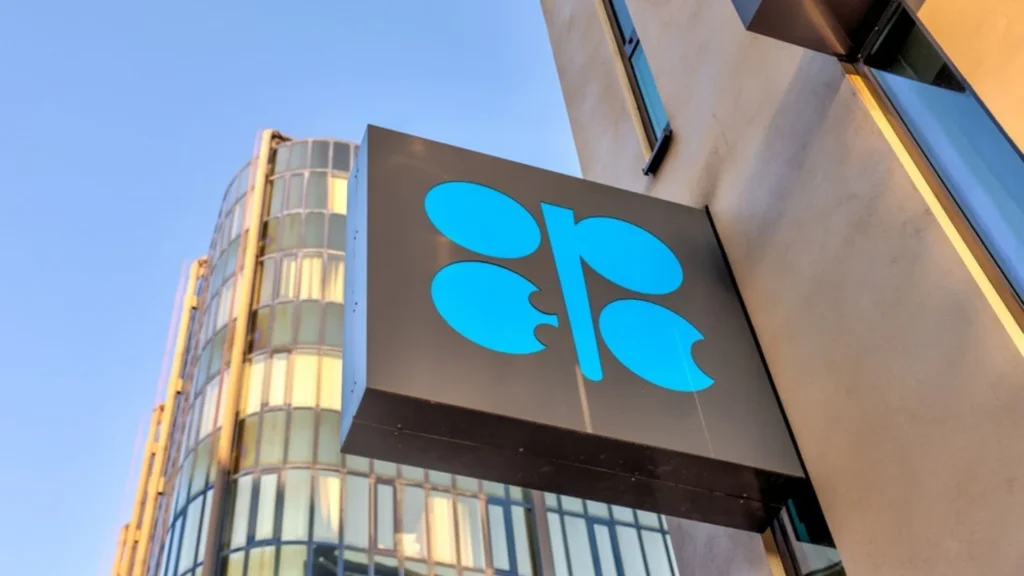
On June 11, the Organization of the Petroleum Exporting Countries cut its forecast for 2026 growth in global crude demand to 970,000 barrels per day (bpd), the second consecutive downward revision in the cartel’s monthly report. The adjustment—down 200,000 bpd from the previous month—comes as seven nations in the bloc simultaneously approve a production increase of 188,000 bpd for July, the fourth monthly increase since April. Cumulative increases since April have already exceeded 600,000 bpd, according to data from Reuters.
The combination of rising supply and falling demand defines the bloc’s strategic signal: OPEC+ is prioritizing regaining market share over non-member producers. In May, the group’s combined production reached 33.13 million bpd, 190,000 bpd below April, partly due to disruptions in the Strait of Hormuz that affected Iran’s exports. For upstream programs and asset management planning, the message is clear: drilling margins face structural pressure.
OPEC+ increases production despite lower projected demand
The U.S. Energy Information Administration (EIA) projects a net decline in global demand of approximately 1.1 million bpd in 2026 versus previous scenarios, according to its Short-Term Energy Outlook. The International Energy Agency (IEA) goes further, estimating an absolute year-over-year contraction in demand of around 80,000 bpd, with declines in the petrochemical and aviation sectors as the main drivers. Both agencies point to Asia as the epicenter of the slowdown.
While OPEC+ manages its cuts, non-member producers continue to expand. The U.S. is keeping Permian output near 13.7 million bpd; Brazil is adding FPSOs in the Santos Basin; Guyana exceeds 900,000 bpd with ExxonMobil’s Yellowtail project; and Canada is expanding export capacity via the Trans Mountain pipeline. The result is a structurally more competitive market, where the non-OPEC cost curve pushes the breakeven price downward.
Upstream adjusts investments for 2026–2027
OPEC’s monthly report (MOMR) acknowledged that “global performance in the first half of 2026 has remained robust despite persistent geopolitical tensions,” but the demand revision contradicts that operational optimism. For independent operators and integrated companies exposed to high-cost projects, the signal is one of caution: profitability models that assumed demand growth above 1 million bpd need to be recalibrated. Energy security as a political argument continues to underpin state investment, but the free market faces a tighter equation.
For 2027, OPEC projects a rebound in demand to 1.73 million bpd, an upward revision of 190,000 bpd versus previous estimates. The EIA also anticipates a recovery toward 1.5 million bpd. The cartel’s base case assumes the current disruption in the Strait of Hormuz is temporary and that Asian demand normalizes in the second half. If that normalization does not materialize, July’s production commitments could be subject to another review before year-end.
The full OPEC Monthly Oil Market Report is available on the organization’s official website. Reservoir engineering and CAPEX planning teams should incorporate both scenarios—flat demand and a moderate rebound—into their sensitivity models for the 2026–2027 investment cycle.
Source: OPEC
Photo: Shutterstock