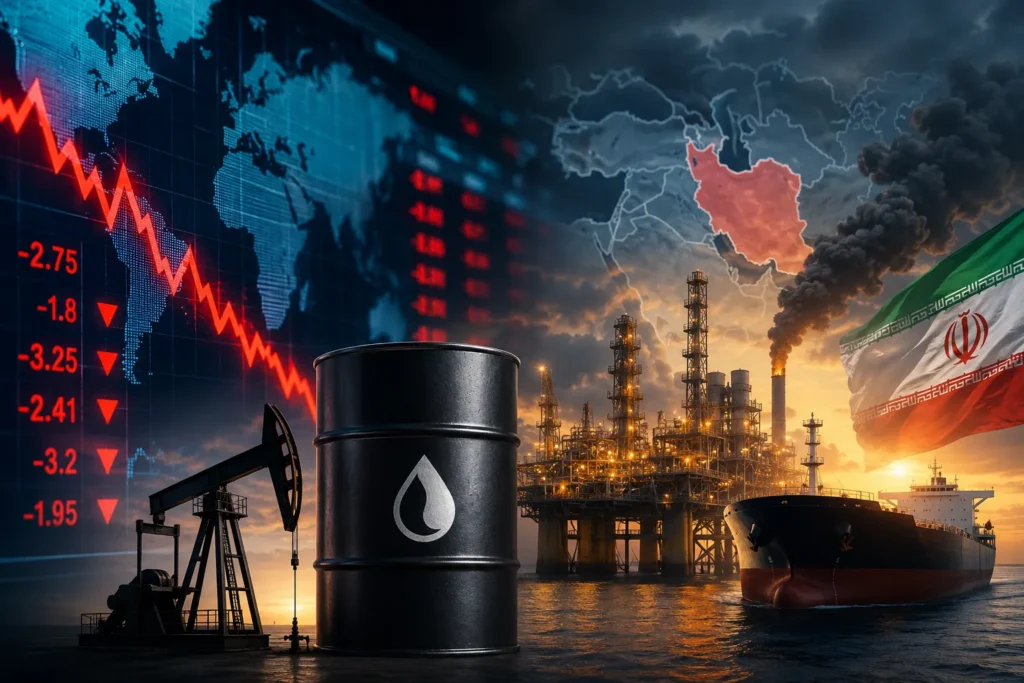
La volatilidad del petróleo volvió a intensificarse como consecuencia de la convergencia de factores tecnológicos, geopolíticos y financieros. Mientras las acciones del sector de semiconductores registran fuertes correcciones en las principales bolsas internacionales, el crudo acumula su mayor avance semanal desde abril debido al recrudecimiento del conflicto en Medio Oriente.
Este escenario refleja cómo la incertidumbre sobre el crecimiento económico y la seguridad del suministro energético vuelve a condicionar las decisiones de inversión a escala global.
Oil Volatility Responds to Global Risk
The day was marked by increased caution among investors, who simultaneously reacted to deteriorating sentiment in stock markets and rising geopolitical tensions in the Middle East. The combination of both factors heightened financial volatility and reinforced the perception of risk to the global economy.
For the energy industry, this context represents much more than a cyclical price movement. The evolution of international conflicts, inflation expectations, and the stability of supply chains continue to directly influence the oil market outlook and the strategic decisions of producers, refiners, and logistics operators.
As uncertainty increases, market participants tend to review their investment strategies, prioritizing sectors considered more resilient in a changing international environment.
Technological Volatility Impacts Energy Markets
The adjustment recorded in companies linked to semiconductor manufacturing once again exerted strong pressure on major international stock exchanges. Asian technology indices led losses, while Europe and Wall Street futures also reflected a deterioration in risk appetite.
La corrección se produjo incluso después de que algunas empresas del sector publicaran resultados financieros superiores a las expectativas y mantuvieran perspectivas positivas para el negocio asociado a la inteligencia artificial.
Although the energy industry does not directly participate in this technological segment, financial volatility often impacts capital flows, project financing, and economic growth expectations, elements that ultimately influence future energy demand.
Oil Records Its Largest Weekly Advance Since April
While technology stocks ceded ground, the oil market moved in the opposite direction. International Brent and West Texas Intermediate (WTI) contracts accumulated gains exceeding 10% during the week, driven by rising tensions between the United States and Iran and concerns about supply stability from the Gulf.
Investors incorporated a higher risk premium given the possibility that the conflict could affect strategic infrastructure or increase difficulties for hydrocarbon transportation in one of the most relevant regions for global oil trade.
Although global supply has not experienced significant disruptions, geopolitical uncertainty continues to be sufficient to sustain upward pressure on international crude prices.
Geopolitics Again Influences Global Investment
Recent events show that international markets continue to react quickly to changes in the geopolitical environment. The possibility of a prolonged conflict in the Middle East has reinforced a more conservative strategy among investors, who are simultaneously evaluating risks to inflation, economic growth, and energy costs.
Una persistencia de los elevados precios del petróleo podría dificultar los esfuerzos para contener la inflación, condicionando el calendario de futuras decisiones sobre tasas de interés y modificando las perspectivas para distintos sectores económicos.
The interaction between geopolitics, energy, and monetary policy once again becomes a determining factor for the evolution of international markets.
Energy Markets Face an Uncertain Scenario
The combination of technological volatility, geopolitical risks, and increased pressure on oil poses new challenges for the entire energy value chain. Producers, refiners, marketers, port operators, and transportation companies continue to evaluate the impact that a more complex international environment could have on investment planning and global operations.
At the same time, companies are intensifying their risk management strategies, logistical strengthening, and operational diversification with the aim of preserving supply continuity in the face of possible disruptions arising from international conflicts or abrupt changes in market conditions.
In this context, operational resilience plays an increasingly relevant role in sustaining the competitiveness of the energy industry.
Uncertainty Will Continue to Shape Market Direction
The simultaneous evolution of technology and oil markets confirms that the global economy is going through a stage where multiple factors interact ever more closely. Geopolitical uncertainty, financial volatility, and economic expectations continue to redefine the behavior of investors and companies, while the energy sector remains at the center of this balance.
Para la industria, la capacidad de adaptarse a escenarios de alta volatilidad, garantizar la seguridad del suministro y mantener la confianza de los mercados será determinante durante los próximos meses.
En un entorno donde la tecnología, la energía y la geopolítica avanzan de manera interconectada, la anticipación y la resiliencia seguirán siendo ventajas competitivas clave para afrontar los desafíos del mercado internacional.
Source: Reuters