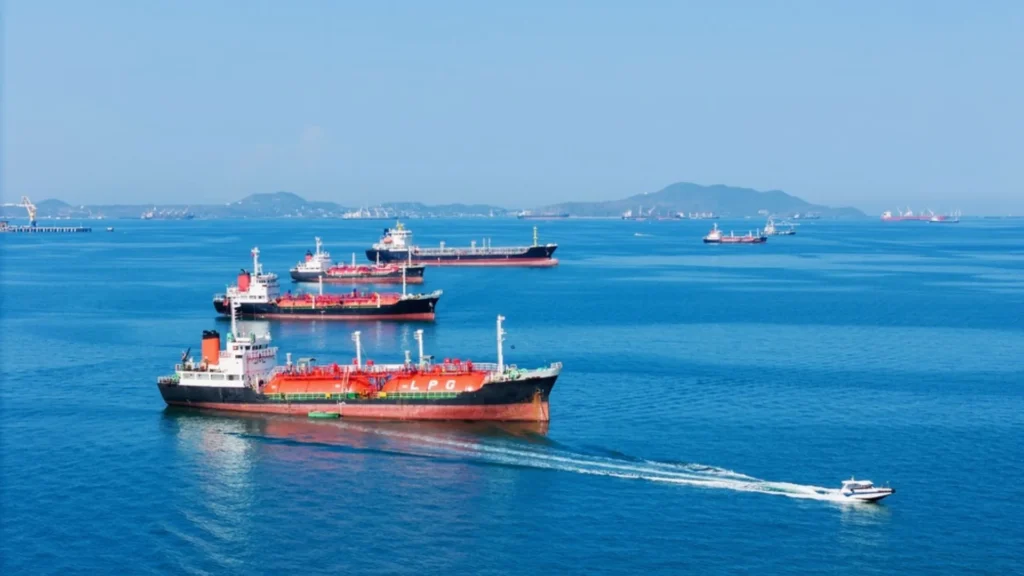
Three supertankers began crossing the Strait of Hormuz with approximately 6 million barrels of crude oil on board, after remaining inside the Gulf for over two months. The cargoes are destined for Asian markets and are part of a still-reduced transit through a key area for global energy supply.
According to maritime tracking data cited by LSEG and Kpler, the vessels were proceeding along a route ordered by Iran for ships seeking to exit the Gulf. The movement signals activity in the corridor, although the flow of tankers remains well below usual levels.
The Strait of Hormuz Reactivates Supertanker Transit
Among the identified vessels is the South Korean-flagged VLCC Universal Winner, carrying approximately 2 million barrels of Kuwaiti crude oil loaded on March 4. The vessel is bound for Ulsan, home to SK Energy’s refinery, with an estimated discharge on June 9.
Additionally, two Chinese tankers crossed the strait with cargoes of Iraqi Basrah crude. One of them, the Yuan Gui Yang, had loaded around 2 million barrels on February 27, just before the start of the conflict between the United States and Israel against Iran.
The Strait of Hormuz is one of the most closely monitored energy routes in the world. Approximately one-fifth of globally traded oil and energy normally passes through it. Therefore, every transit is closely watched by the maritime sector, Asian refineries, and crude oil markets.
Maritime Traffic Remains Far Below Normal Levels
Before the conflict, traffic through the strait averaged between 125 and 140 daily passages. In recent days, movement has decreased to about 10 vessels entering and exiting, including cargo ships, chemical tankers, liquefied gas tankers, and some crude oil tankers.
Furthermore, hundreds of vessels remain within the Gulf awaiting safer navigation conditions. The accumulation of ships could become an additional problem if transit suddenly normalizes, as it would increase congestion in a narrow and sensitive passage.
The situation also leaves thousands of seafarers stranded. According to available information, some 20,000 crew members remain aboard hundreds of vessels within the Gulf, exposed to operational delays, route changes, and security risks.
Navigation Risks in Every Journey
The Joint Maritime Information Center, led by the U.S. Navy, warned that the operational environment remains high-risk due to recent attacks on ships in the area. The entity also reported aggressive actions and assertive maneuvers by Iranian units over the past 48 hours.
For their part, maritime industry associations issued new guidance for vessels planning to cross the Strait of Hormuz. The document highlights threats of attacks, drones, mines, unpredictable congestion, and reduced military oversight.
In this context, each oil tanker departure requires constant route evaluation, coordination with maritime authorities, and satellite monitoring. For operators, the priority is to reduce exposure without completely interrupting crude oil flows to refineries.
Asia Monitors Middle East Crude Oil Supply
Asian markets are heavily dependent on Middle Eastern crude oil. Therefore, the departure of these supertankers offers partial relief for buyers and refiners, although it does not eliminate uncertainty about future shipments.
Meanwhile, oil prices have reacted to diplomatic and operational signals in the Gulf. Brent fell to $110.16 per barrel before recovering some of its losses, amid doubts about a possible sustained reduction in tensions.
However, the departure of three VLCCs does not imply a full reopening of the corridor. Tanker transit remains small compared to historical volumes, and security warnings keep shipping companies in cautious mode.
The Strait of Hormuz Remains at the Center of the Energy Market
Uncertainty about conditions in the Gulf keeps the Strait of Hormuz a critical point for oil trade. Any prolonged interruption can affect crude oil supply, transportation costs, marine insurance, and refinery planning in Asia.
For now, the passage of supertankers shows that some operations are possible under strict navigation conditions. Even so, the balance remains fragile: vessels are moving, but the Gulf’s most sensitive energy corridor continues under geopolitical and operational pressure.
Source: Reuters
Photo: Shutterstock