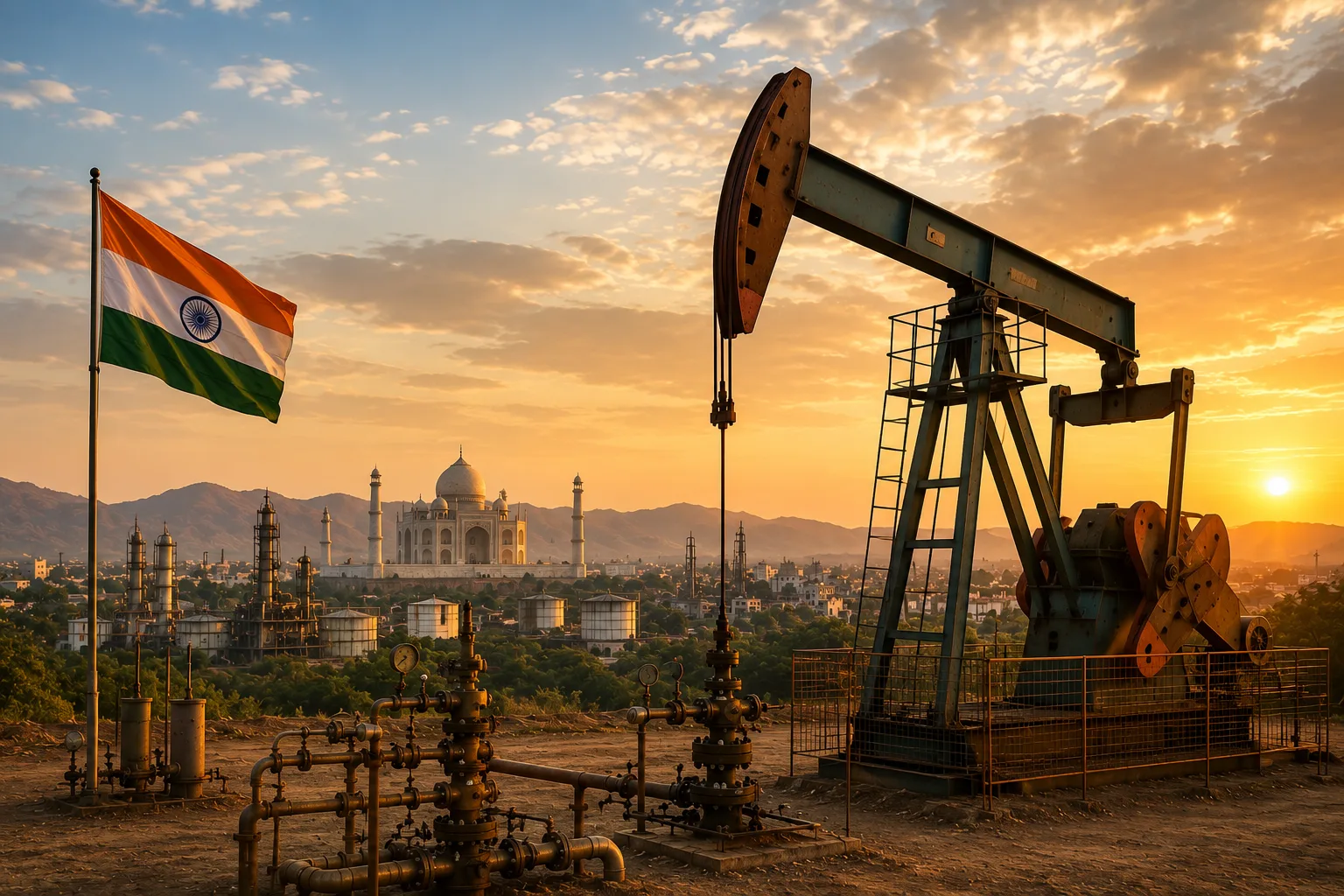
Oil production in India is entering a new phase of transformation, driven by investments aimed at revitalizing so-called mature fields—reservoirs that have been in operation for decades and whose output naturally declines over time. Faced with sustained growth in energy demand and a high dependence on crude imports, the country is seeking to increase hydrocarbon recovery through advanced technologies, infrastructure modernization, and new upstream developments.
This strategic shift reflects an increasingly visible trend in the global industry: rather than relying exclusively on new discoveries, operators are focusing on maximizing the value of existing assets by using engineering solutions that extend their productive life and improve recovery factors.
Oil production in India drives new upstream investments
Strengthening domestic production has become a strategic priority for India, one of the world’s largest energy consumers. In this context, companies in the sector are increasing their investments to develop new projects while also optimizing the performance of reservoirs that still hold significant recoverable reserves.
The strategy aims to increase the contribution of domestic production to the national energy supply and reduce the country’s exposure to volatility in international oil markets.
Among the most recent initiatives is Vedanta Oil & Gas’s plan to invest around US$5 billion over the next five years, with the goal of significantly increasing its production through the development of new assets and the optimization of existing fields, especially in the Rajasthan Basin.
Mature fields require new recovery strategies
Mature fields account for a significant share of global oil production. Although their performance declines over time due to the natural drop in reservoir pressure and the progressive depletion of the most easily recoverable hydrocarbons, many still contain substantial volumes of oil that can be extracted using specialized technologies.
To capitalize on this potential, companies are implementing well workover programs, drilling new development wells, optimizing production systems, and running intervention campaigns that increase operational efficiency and extend asset life.
This approach not only reduces the cost associated with new discoveries, but also leverages existing infrastructure, reducing development timelines and operational risks.
Enhanced recovery gains prominence in the upstream
Enhanced Oil Recovery (EOR) is becoming established as one of the main tools for increasing production in mature reservoirs.
Technologies such as water, gas, or chemical injection, along with digital reservoir models, real-time monitoring, and advanced data analytics, make it possible to increase the recovery factor and improve the performance of fields that were previously considered close to the end of their productive life.
Integrating these solutions with maintenance programs, well integrity management, and surface facility optimization is redefining how companies develop their upstream assets.
India seeks to strengthen its energy security
Growth in liquid fuel consumption remains one of the main challenges for the Indian economy. The high dependence on imports makes domestic production a strategic element to ensure supply and reduce vulnerability to fluctuations in the international market.
In this scenario, increasing production from existing fields represents a faster and more efficient alternative than developing new discoveries alone, especially when combined with investments in infrastructure, technological innovation, and improved operational productivity.
This approach also strengthens the competitiveness of the upstream sector by enabling better use of already known resources.
Vedanta reflects a long-term trend
Vedanta’s announced investment is not an isolated case, but rather reflects a trend that is gaining momentum in different producing regions around the world.
As numerous reservoirs age, oil companies are prioritizing strategies to increase the recovery factor through production technologies, digitalization, automation, and optimization of existing assets, complementing the development of new exploration projects.
In India’s case, this model is particularly relevant due to the need to increase domestic production to meet sustained growth in energy demand and strengthen supply security.
Recovering more oil also requires innovation
Oil production in India shows that the future of the upstream sector does not depend solely on discovering new reservoirs, but also on the ability to extract more value from resources that have already been developed. The combination of enhanced recovery, technological modernization, and infrastructure investment is enabling mature fields to continue playing a key role in the country’s energy strategy.
As the industry adopts new engineering and asset management solutions, these reservoirs are no longer seen as declining facilities and instead become growth opportunities once again. In that context, initiatives such as the one announced by Vedanta show that innovation applied to production can be just as important as the discovery of new reserves to ensure energy security and the competitiveness of the oil sector.
Source: Rigzone