Nordex CEO José Luis Blanco called for extending the Western-origin criterion to all new wind capacity connected to European grids.
German manufacturer Nordex raised the tone of the debate on competition in the wind turbine market by calling on the European Union to tighten its rules against suppliers considered high risk. Its CEO, José Luis Blanco, argued that new installations connected to European grids should use equipment of Western origin, even when they do not receive public support.
Nordex calls for expanding European restrictions
According to the executive, Brussels’ current approach still leaves out a significant share of renewable projects. The proposed rules aim to exclude technologies from countries considered sensitive from auctions financed with public funds, but Nordex believes the protection should cover all new wind capacity that connects to the European power system.
In addition, Blanco focused on cybersecurity and operational control of assets. For the executive, the main risk is not limited to where the servers are located, but to who controls the software, updates, and access to the wind turbines’ systems.
Wind turbines, software, and the supply chain
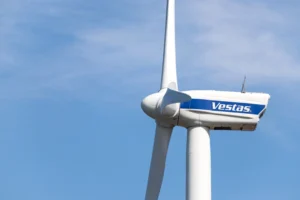
The warning comes at a delicate time for Europe’s renewable industry. Manufacturers such as Nordex, Vestas, and Siemens Gamesa hold a dominant position in the regional market, but face growing pressure from Chinese companies able to offer equipment at lower cost and with faster delivery times.
Among the names cited are Goldwind, Windey, and Ming Yang, companies that have gained international presence in a sector where price, industrial scale, and component availability increasingly weigh in project awards.
Moreover, the debate is no longer limited to the physical origin of components. In modern turbines, digital control systems, remote management, sensors, and predictive maintenance platforms are part of critical infrastructure. For that reason, the discussion about high-risk suppliers intersects with energy security and European technological sovereignty.
Brussels tightens oversight of clean technologies
The European Commission has begun to take action. Among its recent measures is the exclusion of public funding for solar, wind, and storage projects that use inverters from countries considered high risk, such as China, Russia, Iran, and North Korea.
Likewise, Brussels opened an investigation into Goldwind over possible unfair subsidies. The case reflects a broader concern: preventing the European wind sector from following the path of solar manufacturing, where much of the industrial capacity ended up shifting to Asia.
The United Kingdom also set a precedent by blocking Ming Yang’s participation in the offshore wind market on national security grounds. That decision strengthened the argument of those advocating stricter screening for technologies installed in critical infrastructure.
Competition, protectionism, and the costs of the energy transition
However, a more restrictive policy also raises dilemmas. Limiting access for Chinese manufacturers could increase the costs of new wind farms, reduce options for developers, and slow some green energy projects.
At the same time, the European Union must balance three objectives that do not always move at the same pace: accelerating the energy transition, preserving market competition, and protecting its industrial autonomy. Nordex’s call sits precisely at that intersection.
From the China Chamber of Commerce to the EU, the approach has been described as discriminatory. The organization argues that suppliers should be assessed using objective criteria of security, quality, and performance, without exclusions based on nationality or ownership.
Europe seeks not to repeat the solar case
José Manuel Entrecanales, CEO of Acciona and an executive linked to Nordex’s main shareholder, warned that accepting without screening the competition of non-liberal players in critical infrastructure can become a dangerous gamble.
His stance connects with a widespread concern in Europe: preserving industrial capacity in one of the few climate technologies where the region still competes strongly. In solar photovoltaic energy and storage, China’s industrial advantage is already difficult to reverse.
For that reason, Nordex’s demand is not just a commercial dispute between manufacturers. It is a sign that wind energy is becoming a strategic front where industrial policy, cybersecurity, energy regulation, and technological autonomy converge.
Source: Financial Times
Photo: Shutterstock