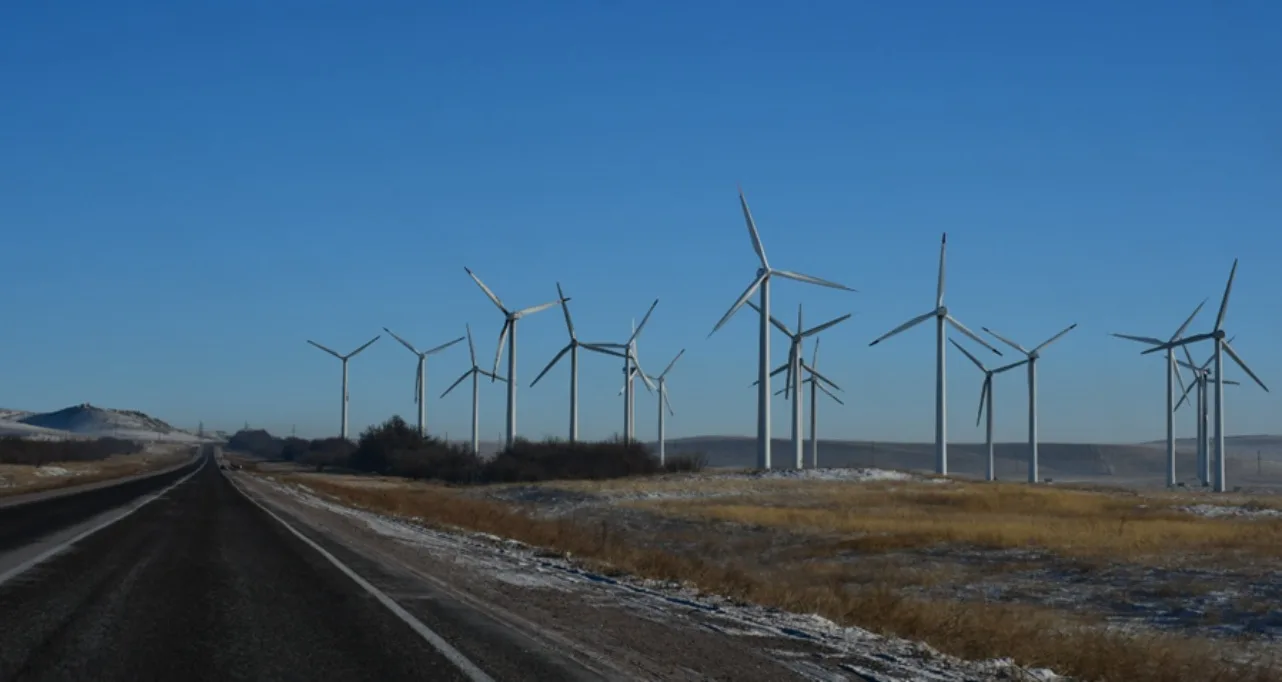
The European Bank for Reconstruction and Development (EBRD) announced on April 24, 2026 an A/B loan of up to $548 million for Aktas Energy to build the Mirny wind farm in the Zhambyl region of Kazakhstan.
The installed capacity of 1 GW, but the essential component is the 300 MW and 600 MWh battery energy storage system (BESS) that will accompany the wind generation, making it the first industrial-scale wind plant with storage in the country.
The distinction is not cosmetic. Kazakhstan operates a 25 GW power system that relies dominantly on coal, a source of generation with thermal inertia and manageable dispatch.
Why BESS matters more than gigawatts of wind power
Integrating 1 GW of variable power, wind, into a grid built on that logic involves frequency balancing and ramping management challenges that systems without storage cannot solve autonomously.
The 600 MWh BESS acts as an active buffer: it absorbs surpluses at times of high wind generation and injects them into the grid when production drops, reducing dependence on thermal plants as a regulation reserve.
For a grid that aims to incorporate 10 GW of renewables by 2035, Kazakhstan’s official target, the Mirny wind farm is not just a facility: it is the operational test bed that will demonstrate whether wind plus BESS architecture can work on an industrial scale under the country’s grid conditions.
Financing structure: A/B loan and multilaterals consortium
The financing is articulated through an A/B loan structure that combines EBRD’s own resources with syndicated capital to international private co-lenders.
The A loan, of up to $250 million, comes directly from the EBRD’s balance sheet. The B loan, up to $298 million, is syndicated to a consortium including China Construction Bank, Qatar National Bank, Société Générale and Standard Chartered.
The EBRD investment will be further co-financed by Proparco, a subsidiary of the French Development Agency and DEG, the German Investment Corporation, together with the Development Bank of Kazakhstan.
Kazakhstan and the EBRD: $12 billion towards carbon neutrality 2060
Kazakhstan is the largest recipient of EBRD investments in Central Asia and the longest-standing country in the region in the bank’s portfolio. To date, the EBRD has invested nearly $12 billion in 345 projects in the country.
The Mirny wind farm is part of a broader commitment: Kazakhstan has set a target of carbon neutrality by 2060 and a renewable capacity of 10 GW by 2035, starting from a coal-dominated electricity matrix and unprecedented industrial wind farms with integrated storage.
The Mirny farm will simultaneously address two system gaps: the absence of gigawatt-scale wind generation and the absence of manageable grid storage on the scale of hundreds of megawatts.
Source: https://www.ebrd.com/
Photo: Shutterstock