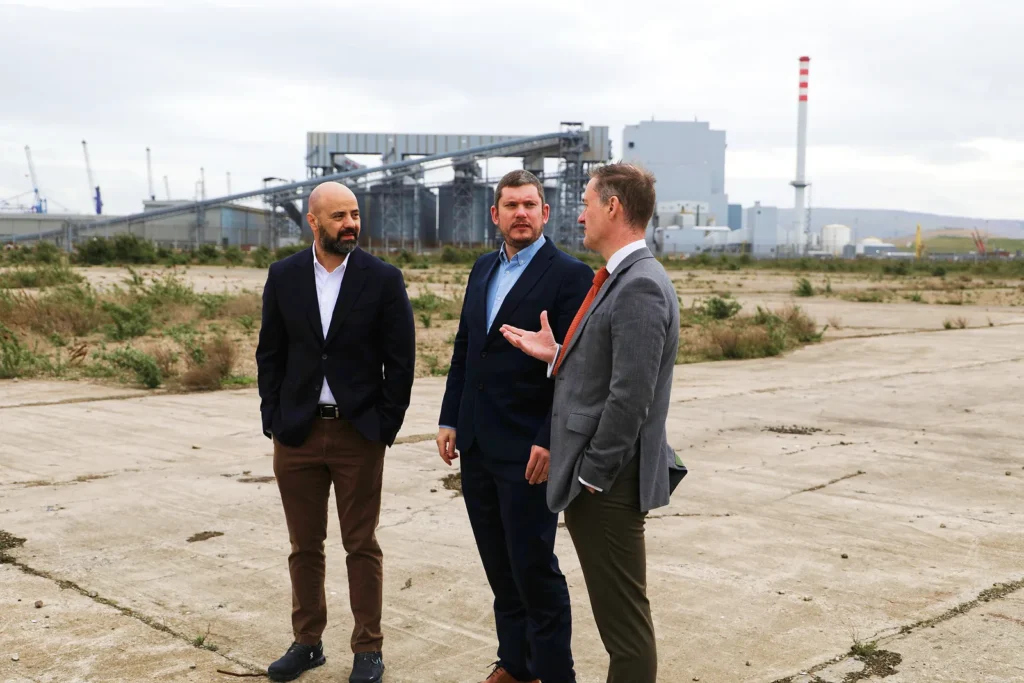
Alfanar, through its Lighthouse Green Fuels (LGF) project, signed a land purchase option agreement that secures the site for a future sustainable aviation fuel (SAF) plant in Seal Sands, Teesside.
The facility, valued at several billion pounds, aims to become one of the world’s largest second-generation SAF plants and the first newly built refinery in the UK since the 1960s.
The project represents a strategic step to strengthen domestic production of sustainable fuels for aviation and expand the country’s industrial capacity through low-carbon technologies.
An integrated plant to produce SAF with sustainable biomass
The future facility will be designed to integrate the entire sustainable aviation fuel production chain, from biomass pretreatment to storage of the final product. Planned feedstocks include forestry and agricultural residues sourced sustainably.
Once Lighthouse Green is operational , the plant will have the capacity to produce 180 million liters per year of sustainable aviation fuel and 30 million liters of renewable naphtha, leveraging its strategic location in Seal Sands and its connection to logistics infrastructure and regional carbon capture and storage (CCS) networks.
Carbon capture will strengthen the project’s environmental performance
One of the differentiating elements of the Lighthouse Green project will be its integration with the carbon capture and storage (CCS) infrastructure developed in Teesside. According to Alfanar, this technology will enable fuel to be produced with net-negative carbon emissions over its life cycle, achieving reductions of more than 200% compared to conventional aviation fuel.
The company estimates that, thanks to this integration, Lighthouse Green Fuels could contribute around 46% of the national emissions-reduction target associated with the UK mandate on sustainable aviation fuels, a figure considerably higher than the estimated contribution without the use of CCS.
The project enters a decisive development phase
LGF recently completed the Front-End Engineering Design (FEED) stage and obtained the necessary technology licenses to move on to the next phases of the project.
In parallel, the environmental permitting process continues through the Development Consent Order (DCO) mechanism, along with the processing of the connection to the future regional carbon capture and storage network.
To date, Alfanar has invested approximately £90 million, with plans to allocate another £100 million before reaching the Final Investment Decision (FID), scheduled for the end of 2027. If the timeline holds, construction would begin in 2028 and commercial production would start in 2031.
Source and photo: https://www.lighthousegreenfuels.co.uk/