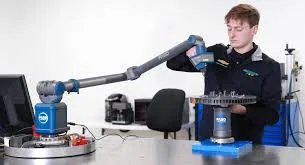
The update to FARO CREAFORM’s Line Laser Probes (LLP) does not rely on new optics or higher resolution sensors. Its invisible protagonist is DTEX, the company’s approved image processing platform that rewrites the logic with which each probe interprets the reflected signal.
The result is a denser and more consistent point cloud on materials that historically penalized cycle times: dark surfaces with low reflectivity, specular finishes, or high-contrast two-tone parts that forced the operator to perform multiple manual passes or parametric adjustments between zones.
What is relevant from a measurement engineering perspective is that DTEX acts at the processing layer, not in the hardware. This means that users of the Quantum X FaroArm and Quantum Max FaroArm series receive the improvements through a software update on existing systems, with no additional capital cost.
8-Axis Max: the range multiplier for large parts
The update is not limited to the processing intelligence of the probes. FARO CREAFORM has taken advantage of the launch to highlight the 8-Axis Max rotary workstation as a structural complement to the LLP workflow.
This system adds a rotation axis controlled by high-precision encoders to the FaroArm ecosystem, allowing the part to rotate synchronously with the arm’s data and expanding the effective measurement volume without the need to relocate the system or create multiple reference setups.
The integration of the 8-Axis Max with DTEX-powered LLPs produces a multiplier effect: the algorithmic improvement in data capture extends to the entire surface of large-format or complex geometry parts in a single coordinate measurement workflow.
FARO CREAFORM: less setup, more production
The most relevant performance indicator of this update is not improved resolution, but reduced operational friction. In manufacturing environments where parts combine glossy finishes with matte areas, or where composite materials exhibit irregular laser light absorptivity, the time spent adjusting acquisition parameters can represent a significant fraction of the total inspection time.
DTEX directly addresses this variable by automating the adaptation of image processing to the conditions of each surface, without manual operator intervention.
This optimization logic aligns with the dominant trend in portable industrial metrology: shifting complexity from the operator to the system. Manufacturers integrating measuring arms into in-line or semi-line inspection cells cannot afford variable setup times between operators or shifts.
The consistency of the result, regardless of the user’s profile, is as critical as data accuracy. FARO CREAFORM addresses both dimensions with a single software layer update, simplifying change management on the plant floor and eliminating the need for equipment requalification.
Source and Photo: https://www.faro.com/