ExxonMobil will assume operatorship of the Papua LNG project, valued at around US$14 billion, as its partners move toward the Final Investment Decision (FID).
The shift puts the US oil major in charge of one of Papua New Guinea’s leading liquefied natural gas projects. TotalEnergies will transfer operatorship to leverage construction and operating synergies with PNG LNG, a facility ExxonMobil already operates in the country.
In addition, the reorganization follows a substantial budget reduction. Design optimization and a new tender for the engineering, procurement and construction (EPC) packages delivered savings of nearly US$4 billion since 2024.
Papua LNG cuts its investment to US$14 billion
Meanwhile, the partners completed the EPC tender process. Recommendations for awarding the contracts are ready, although they still require approval from the participating companies.
The changes implemented in the project brought estimated capital spending to approximately US$14 billion. Cost-reduction measures include adjustments to upstream condensate development, greater integration with existing PNG LNG infrastructure, and the retendering of EPC work.
The latter opened the competition to a broader pool of Asian contractors.
As a result, the CAPEX reduction strengthens the project’s position ahead of adopting an FID. The aim is to develop gas resources from the Elk and Antelope fields, located in Gulf Province.
ExxonMobil moves to control 34.1% of Papua LNG
Likewise, TotalEnergies will sell a 9.1% stake in Papua LNG to the project’s other partners following the exercise of reinvestment rights by the State of Papua New Guinea.
Under the new structure, ExxonMobil will hold 34.1% and act as operator. Santos will control 21%, TotalEnergies will retain 20%, and ENEOS Xplora will hold 2.4%. Kumul Petroleum Holdings Limited and MRDC will jointly account for 22.5%.
Despite reducing its equity stake, TotalEnergies will maintain its LNG offtake share.
The transfer of operatorship to ExxonMobil will enable coordination of Papua LNG with the nearby PNG LNG project. This integration is intended to generate efficiencies during construction and later during the operation of both facilities.
The project will produce 5.6 million tonnes of LNG per year
Papua LNG is designed to reach production of 5.6 million tonnes per year of liquefied natural gas.
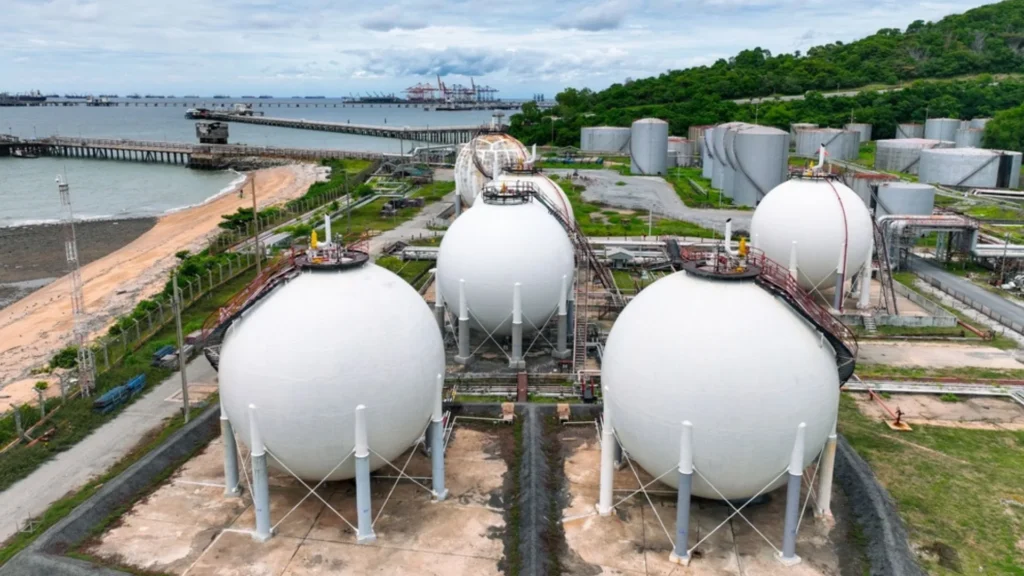
To achieve this, the development includes gas processing facilities and a pipeline that will transport output from the Elk and Antelope fields to the liquefaction infrastructure near Port Moresby.
In addition, the partners finalized amendments to the gas agreement signed with the Government of Papua New Guinea in 2019. The changes reflect the new budget and the optimization of the development plan.
On the commercial front, TotalEnergies and state entities linked to Papua New Guinea established a joint venture to market 2.4 million tonnes per year of LNG from Papua LNG.
TotalEnergies also agreed to access 1.5 million tonnes per year of that volume to add to its global LNG portfolio.
Papua LNG moves toward FID
Meanwhile, the commercial agreements and the new operating structure bring the project closer to its expected Final Investment Decision. However, the FID has not yet been announced.
ExxonMobil’s entry as operator is particularly relevant given its experience with PNG LNG, whose production began in 2014. The company will be able to use existing infrastructure and capabilities to pursue efficiencies across both developments.
If the partners ultimately approve the investment, Papua LNG will expand Papua New Guinea’s production capacity and liquefied natural gas exports, with Asian markets among its main destinations.
The project thus combines a lower cost estimate, a new shareholding structure, and agreements to market part of its future output. These elements will be key to determining its financial viability ahead of the FID.
Source: World Oil
Photo: Shutterstock