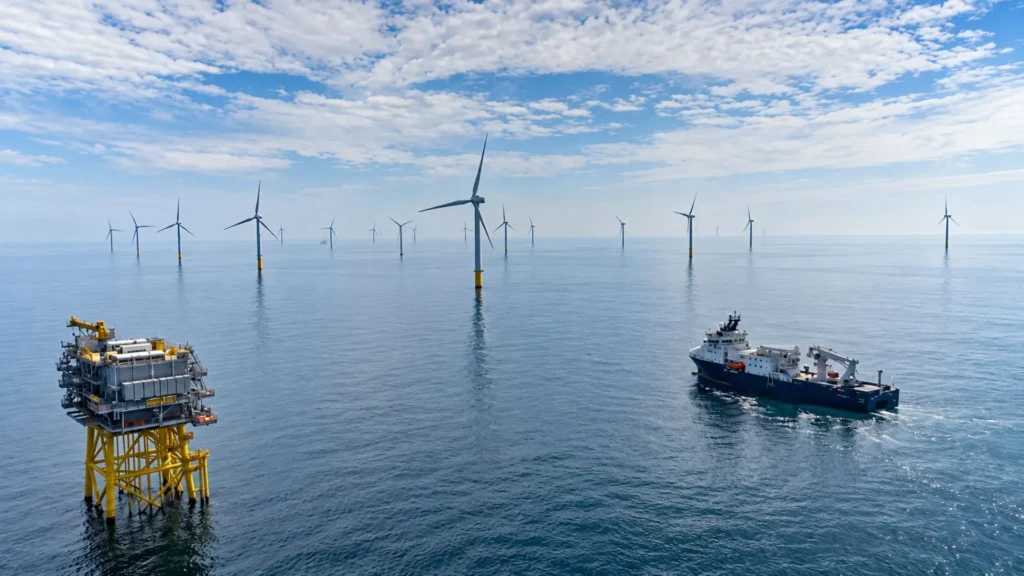
Equinor will incorporate Proserv technology to reinforce the monitoring of the electrical cables of the Dudgeon offshore wind farm, of 402 MW, located off the coast of Norfolk, in the United Kingdom.
The Norwegian energy company awarded Proserv a contract to install a monitoring system that will allow for continuous supervision of the condition of cables and their terminations. Deployment is scheduled to begin in 2027.
The technology will allow for the identification of signs of deterioration or electrical anomalies before they develop into more widespread failures. In this way, Equinor aims to reduce the risk of unplanned outages and improve the maintenance management of infrastructure critical to the park’s operation.
Proserv will integrate ECG and DES technologies
Proserv’s ECG unit will be in charge of implementing the monitoring platform in Dudgeon, the system will collect continuous information on the behavior and condition of the main electrical components associated with the park’s network.
The project will also include technology Distributed Electrical Sensing (DES) from Proserv, which uses the fiber optic infrastructure existing together with passive detection techniques to obtain accurate current and voltage measurements at different points in the electrical network.
The combination of both technologies will provide a more detailed view of the operation of the park’s electrical system, something especially important in offshore installations, where any intervention requires specialized vessels, technical personnel and suitable weather windows.
Monitoring will allow for anticipating electrical failures
Having continuous information on the behavior of cables and terminations will allow for the identification of variations or anomalous signals at early stages.
Based on this data, the operator will be able to prioritize maintenance tasks on those components that show signs of degradation, instead of relying solely on periodic inspections or scheduled interventions.
This approach can also help reduce unnecessary offshore work and promote a maintenance strategy based on the actual condition of the assets.
ECG provides Equinor with greater visibility into the condition and performance of its electrical assets, helping to identify incipient problems before they become costly failures.
Barry Frost, director de ECG en Proserv.
Frost also noted that the integration of ECG with DES will provide a more complete view of the behavior of the electricity grid and will increase the operator’s confidence in the availability of generation.
The Dudgeon offshore wind farm has 67 wind turbines of 6 MW each
The Dudgeon offshore wind farm is located approximately 32 kilometers off the north coast of Norfolk and completed its construction at the end of 2017.
The facility has 67 wind turbines of 6 MW which together reach an installed capacity of 402 MW its electricity production is sufficient to supply more than 430,000 British households.
After several years of operation, monitoring electrical systems becomes more relevant to maintain the availability of the fleet and extend the performance of its assets throughout their useful life.
The cables are one of the critical elements of this infrastructure, as they allow the electricity generated by the wind turbines to be transported through the project’s network.
Dudgeon belongs to Dudgeon Offshore Wind Limited, a joint venture comprised of Equinor, Masdar and China Resources, while Equinor is in charge of operating the park.
With the installation of the new system planned for 2027, Equinor will strengthen its electrical asset management strategy in Dudgeon through continuous monitoring aimed at detecting anomalies before they can affect the availability and production of the park.
Source: Offshore Energy
Photo: Dudgeon Offshore Wind Limited