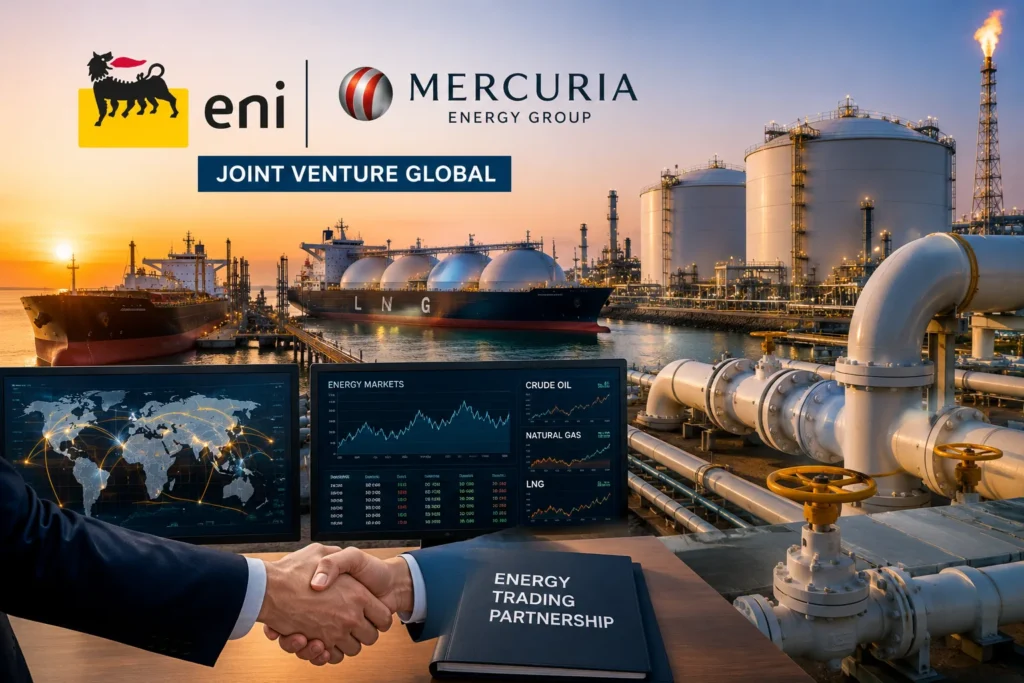
The alliance between Eni and Mercuria announced on July 1, 2026, represents one of the most significant commercial partnerships in the sector this year. Italian company Eni and Swiss independent trader Mercuria Energy Group formalized the creation of a 50-50 joint venture headquartered in Geneva to manage global trading of oil, natural gas, and LNG.
The new entity will operate independently and will be responsible for trading crude oil, refined fuels, biofuels, natural gas, LNG, and LPG, in addition to managing logistical rights and associated energy infrastructure. The operation is subject to corresponding regulatory approvals before formal commencement of activities.
Eni and Mercuria: Structure and Global Reach
Mercuria reported a net profit of US$1.43 billion in 2025, reflecting its ability to operate profitably in volatile markets. The firm manages physical energy flows in more than 50 countries and has direct access to storage, transportation, and logistics infrastructure on an international scale.
Eni, for its part, strengthens its presence in the commercial segment with this agreement. The company already holds a 20% stake in ADNOC Global Trading, the trading platform of Abu Dhabi’s national company, which demonstrates a deliberate strategy of integration between production and commercialization.
“The combination of Mercuria’s trading platform with Eni’s physical flows creates an entity with sufficient scale to compete with the major integrated traders,” noted an energy market analyst quoted by Reuters.
Impact on Logistics and Energy Infrastructure
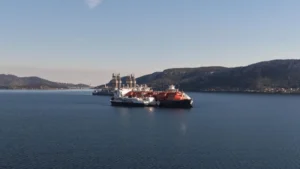
Beyond the commercial dimension, the joint venture will manage logistical rights and physical infrastructure, which involves coordination of LNG shipments, optimization of maritime transport routes, and management of storage terminals. This operational component distinguishes the alliance from a purely financial agreement.
The integration of physical logistics into the trading platform has direct effects on global energy infrastructure: LNG terminals, storage tanks, pipelines, and maritime transport routes become linked to the commercial decisions of the new entity.
“The energy volatility following 2022 demonstrated that companies with integrated access to production, logistics, and trading have structural advantages over players specialized in a single segment,” indicated a sector executive quoted by the Financial Times.
Energy Trading and the Global LNG Market
The global LNG market is undergoing a phase of accelerated expansion, with new liquefaction capacities coming into operation in the United States, Qatar, and Australia. In this context, having an integrated trading platform enables capturing arbitrage opportunities between regions and optimizing the utilization of regasification infrastructure.
The creation of this joint venture responds to a trend that has consolidated among major energy companies in recent years: strengthening the integration between production, logistics, and commercialization to operate with greater flexibility in increasingly volatile markets. In an environment marked by the expansion of international LNG trade, growing demand for natural gas, and the need to optimize global supply chains, having an integrated platform enables improved risk management, access to new arbitrage opportunities, and faster response to changes in supply and demand. This strategy also strengthens the resilience of energy infrastructure in the face of changing geopolitical scenarios.
The alliance also confirms that energy trading is evolving toward increasingly integrated models, where the ability to coordinate physical assets, logistics, and commercialization will be a determining factor for competing in international oil, gas, and LNG markets.
Source: Eni