Table of Contents
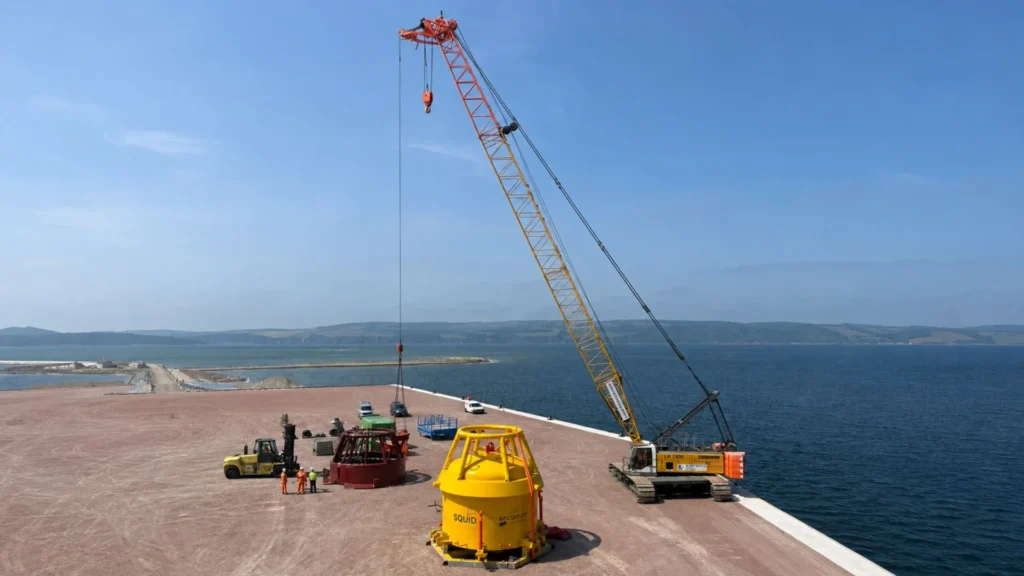
Encomara prepares the coastal trials of its first Squid system a 40-ton connecting structure developed to facilitate the installation and operation of floating wind turbines. The technology will be tested at the installation of Ardersier’s energy transition, in Scotland.
The system has been under development for over five years and is designed to keep mooring lines, power cables, and underwater connectors above the seabed. This allows these components to be installed before the floating turbine arrives at the site.
The Squid system seeks to accelerate the connection of floating turbines
By design, Squid allows for the preparation of part of the underwater infrastructure before installing the generating unit. This approach aims to reduce the operations that must be carried out offshore during the connection of the floating wind turbines.
Encomara maintains that the system can accelerate both the connection and disconnection of the units, this is especially relevant when a turbine needs to be uncoupled and towed to port for maintenance work.
Furthermore, the pre-installation of moorings and cables can decrease dependence on certain offshore operations and reduce exposure to weather conditions during construction.
The tests would take the technology up to TRL 8
The coastal trials are scheduled to conclude during August, so according to Encomara once the program is completed, Squid would reach Technology Maturity Level 8 (TRL 8).
The advance comes after the technology received Product Design Evaluation accreditation from the American Bureau of Shipping (ABS) in June.
Reaching this stage would bring the system closer to commercial application in floating offshore wind projects, a segment where installation, connection and maintenance operations represent relevant factors in project costs.
Encomara estimates a reduction of up to 15% in the LCoE
Furthermore, Encomara’s models indicate that Squid could reduce the levelized cost of energy (LCoE) by up to 15%. The company attributes this potential to several operational factors, including the pre-installation of moorings and cables, faster offshore connections, lower vessel-related costs, and a reduction in production time lost during interventions.
This combination is especially important for floating wind power, as the turbines are installed in locations where the water depth prevents the use of conventional fixed foundations.
Floating wind power promotes demand for new connections
Encomara is part of Aurora Energy Services and expects demand for Squid to increase as the floating wind energy progress towards commercial-scale projects.
The company estimates that the development of this technology could support around 130 jobs related to manufacturing and project execution at Aurora’s facilities in Huntly and Inverness by 2030.
Furthermore, the tests will be the first floating offshore wind project of this type carried out at the recently developed Ardersier Energy Transition Facility, owned and operated by Haventus.
Squid arrives at the port of Ardersier to begin testing
To prepare for the campaign, the Squid structure was transported by road from Huntly via Keith and Buckie. The system was then transferred to a vessel for the final sea voyage to the port of Ardersier, located approximately 22.5 kilometers east of Inverness on the Moray Firth.
With the coastal tests, Encomara seeks to demonstrate on an advanced scale that its connection system can simplify one of the fundamental operations of floating wind power: integrating and removing the turbines from their mooring and electrical connection infrastructure.
Source: Offshore Energy
Photo: Encomara