The Australian subsidiary of EDF Power Solutions has formally submitted the Wala Wala hydroelectric project to the Australian federal government. This initiative, designed to offer a capacity of between 300 MW and 400 MW with up to 10 hours of continuous storage, has entered the regulatory assessment phase under the Environment Protection and Biodiversity Conservation Act (EPBC).
Federal assessment of the Wala Wala hydroelectric project
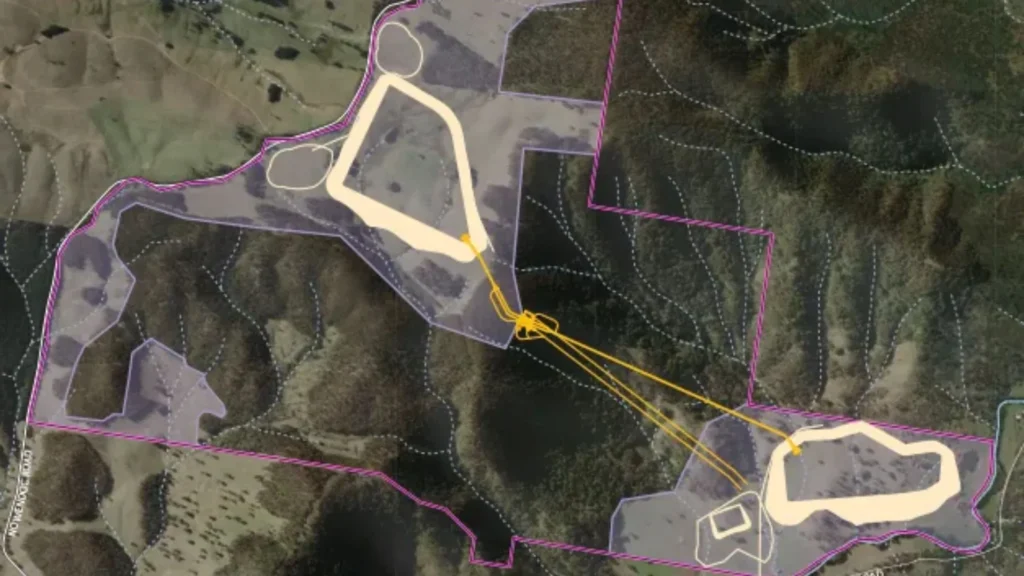
The facilities will be located in the Dungowan Valley, within the regional jurisdiction of Tamworth in New South Wales. The infrastructure will have an estimated volumetric generation capacity of between 3,000 MWh and 4,000 MWh through a two-reservoir off-river scheme, which will be interconnected by underground pipes and a high-tech hydroelectric power plant.
On one hand, the operational dynamics involve pumping water from the lower reservoir to an upper reservoir located at an altitude of 1,131 meters during periods of low energy demand. Subsequently, the water resource will be released to power the grid during peak consumption moments in the regional electrical system.
Furthermore, the grid connection will be executed through a dedicated substation and a 330 kV transmission line connected to Transgrid’s existing infrastructure near Bendemeer. Additionally, the company is evaluating future integration with the New England Renewable Energy Zone transmission line, promoted by the state entity EnergyCo.
Moreover, the final arrangements for water supply are in the technical study phase. The submitted documentation indicates that the initiative will extract part of the resource from the Dungowan Dam through specific pipelines, following an agreement with the Tamworth Regional Council.
Environmental impact assessment and protected species
Regarding the ecological impact, the preliminary assessment identified the potential presence of 80 threatened species in the designated area. Applying the precautionary principle, the company considers that 66 of these species could experience impacts due to the development of the works.
Vulnerable specimens include the regent honeyeater, the koala, the greater glider, the large-eared pied bat, and the spotted-tail quoll, in addition to 26 flora species. Similarly, impacts were confirmed in critical ecological communities such as the New England peppermint woodlands and local grassy woodlands.
According to the planned schedule, the construction phase will start in early 2029 with an estimated duration of four to five years. Commercial operation is projected for mid-2033, with an expected operational lifespan of a century of continuous service.
Consequently, the development responds to the requirements of AEMO’s 2026 Integrated System Plan and the state energy roadmap. New South Wales seeks to consolidate long-duration storage infrastructure to replace firm capacity following the gradual retirement of coal-fired thermal power plants.
Finally, this project joins recent initiatives in the region, such as the approval of the 3.6 GWh Stratford complex at a former coal mine and the declaration of critical infrastructure for the Phoenix and Western Sydney projects. All these schemes aim to streamline regional planning processes to ensure the stability of the electrical grid.
Source and photo: EDF Power Solutions