Table of Contents
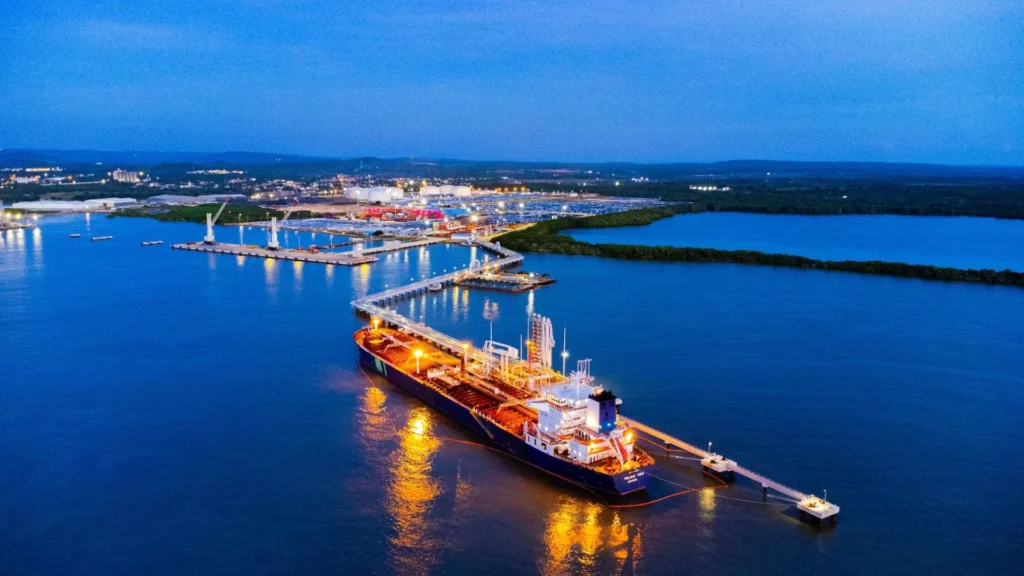
The multinational ECOnnect has finalized an engineering, procurement, and construction (EPC) contract with Sociedad Portuaria Puerto Bahía. The technical agreement aims to implement the liquefied natural gas transfer system known as IQuay F-Class, designed to operate without the need for jetty infrastructure. This initiative seeks to mitigate the vulnerability of the South American country’s energy system, which faces a progressive reduction in local gas extraction and a marked dependence on seasonal hydroelectric generation.
Accelerated deployment through jettyless LNG technology
The new fast-track import terminal projects a supply of approximately 500 million standard cubic feet per day. This capacity will improve the resilience of the national power and thermal supply, particularly during severe weather cycles caused by the El Niño phenomenon.
Regarding execution timelines, Puerto Bahía’s urgency lies in starting gas delivery by early 2027. For this reason, ECOnnect’s technological mechanism was selected, as its main operational advantage lies in eliminating the construction of additional jetties in the port area.
Additionally, the system will establish a direct link between a floating storage and regasification unit (FSRU) and the pre-existing receiving facilities in Cartagena Bay. This engineering approach minimizes deep-sea interventions, reduces overall project time, and significantly decreases highly complex civil works.
Indeed, the selected geographic location offers optimal natural conditions due to its access to deep waters. This physical characteristic allows for the navigation and interaction of deep-draft LNG carriers without requiring complementary maritime dredging. Furthermore, the proximity to industrial consumption centers in the Caribbean region and the ease of interconnection with the national gas transportation system enhance the commercial viability of the energy complex.
Regarding ecological impact, jettyless transfer technology mitigates the alteration of the marine environment by integrating directly with the base port infrastructure. The development represents a design alternative to traditional methods that require heavy underwater foundations.
Finally, this project consolidates the expansion of the technology firm in the Latin American energy market, adding to its previous developments executed in Norway, Mexico, and Germany. The architecture of the transfer system includes future compatibility for handling sustainable energy vectors such as ammonia, hydrogen, bio-LNG, and carbon dioxide capture.
Source and photo: ECOnnect Energy