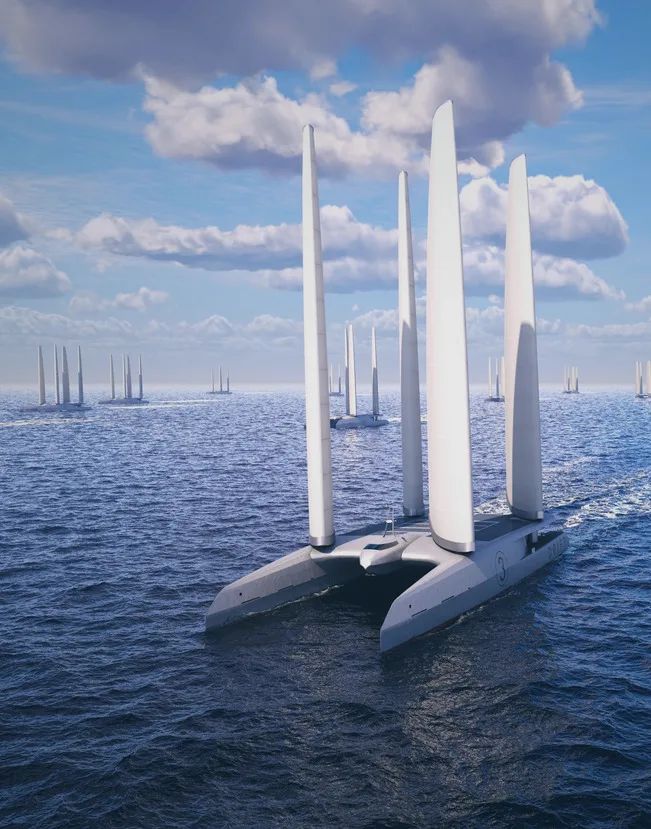
DRIFT Energy signed an exclusive strategic agreement with Commenda Capital Partners to support the commercial development of a program of at least 50 vessels capable of producing green hydrogen using offshore wind energy.
The program contemplates investments exceeding $500 million at the project level through special purpose vehicles (SPVs), a structure widely used in large infrastructure developments to organize financing, ownership, and risk management of each asset independently.
While DRIFT will continue leading technological development, hydrogen production systems, navigation software, and commercialization of the concept, Commenda will assume financial structuring, capital raising, debt processes, and execution of each project.
Energy Harvesting Vessels: Offshore Infrastructure Concept
Unlike conventional vessels, the ships developed by DRIFT do not merely transport energy: they produce it directly during navigation.
The concept combines wind propulsion systems with electrolysis equipment capable of transforming water into hydrogen using energy generated offshore. Subsequently, the hydrogen can be supplied directly to ports, islands, or coastal facilities without the need to build new electrical transmission lines.
This approach presents an alternative for harnessing wind resources far from shore through mobile infrastructure capable of moving energy production to the point of consumption.
Financing Constitutes an Essential Component of Industrial Innovation
The commercialization of new technologies does not depend exclusively on demonstrating their technical viability. It also requires financial structures capable of distributing risks, attracting investors, and ensuring the execution of large-scale projects.
In this context, the use of special purpose vehicles allows each vessel to operate as an independent project, with its own financing, contracts, and revenue stream, a methodology widely employed in wind farms, liquefied natural gas terminals, industrial plants, and other energy infrastructures.
This architecture facilitates the progressive incorporation of new technological concepts into investment markets.
Technical Approval Reduces Uncertainty During Development
The agreement follows DRIFT’s obtaining in 2026 the preliminary approval from RINA for the design of its energy harvesting vessel, considered the first granted to a vessel of this type.
Classification approvals constitute a fundamental stage during the development of new maritime technologies, as they verify that the concept can evolve in accordance with the technical and regulatory requirements demanded for future commercial operations.
Early validation also contributes to reducing uncertainties during subsequent stages of engineering, construction, and financing.
The Convergence Between Engineering and Finance Drives New Energy Infrastructures
The energy transition is promoting the development of assets whose complexity combines technological innovation with new business models.
In this scenario, disciplines such as naval architecture, hydrogen production, risk management, project financing, and systems engineering are beginning to integrate from the earliest development phases.
This convergence is decisive in accelerating the transition from prototypes to infrastructures capable of operating commercially at large scale.
Source and photo: https://drift.energy/