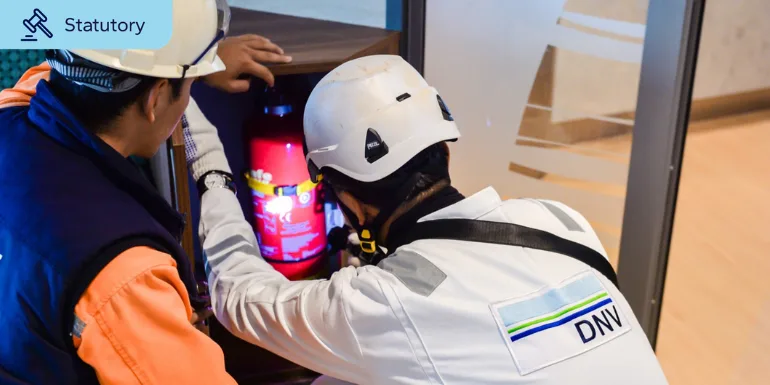
DNV reported that, at the first safety equipment inspection after January 1, 2026, all firefighting foams on board must be PFOS-free and accompanied by documentation verifiable by the corresponding inspector.
The measure applies to both fixed extinguishing systems and portable equipment using foam. Compliance will prevent partial inspections, follow-up actions, or suspension of Authorization Conditions.
PFOS-Free Foams from 2026
The requirement is part of the prohibition on the use or storage of extinguishing media containing perfluorooctanesulfonic acid, known as PFOS, in concentrations exceeding 10 mg/kg, equivalent to 0.001% by weight.
For vessels constructed from January 1, 2026, and subject to SOLAS or the HSC Code, the restriction applies from vessel delivery. For existing vessels, compliance must be verified at the first annual, periodical, or renewal inspection after that date.
DNV indicated that this update supplements a technical communication published in November 2025, which explained the retroactive requirements, regulatory references, and guidelines for foam replacement.
Three Ways to Document Compliance
The classification society indicated that firefighting foams may be documented as PFOS-free through three main pathways. The first consists of a manufacturer’s declaration certifying that the product does not contain PFOS.
The second option is to perform sampling and analysis of the foam according to a recognized standard, through an accredited laboratory. The report must confirm that the PFOS concentration is below 10 mg/kg.
The third pathway, although not mandatory, may be a type approval certificate or a certificate under the Marine Equipment Directive (MED), provided it expressly indicates that the foam does not contain PFOS. In that case, DNV considers it equivalent to a declaration of PFOS absence.
Documentation Must Be Traceable
DNV emphasized that the documentation submitted must be linkable to the actual foam installed or carried on board. Therefore, it must contain sufficient information to enable traceability.
Recommended data include the manufacturer, foam type, production date, batch number, and relevant TA or MED certificate references. Additionally, the marking on containers or systems on board must match the submitted documentation.
When it is not possible to provide a declaration, laboratory test, or valid certificate, the foam must be replaced with a PFOS-free alternative and accompanied by the corresponding documentation.
DNV Recommends Preparing for Inspection
To facilitate the process, DNV prepared a template that manufacturers can use when issuing PFOS absence declarations. Its use is not mandatory, but it can help include the necessary information for verification.
The organization recommended that shipowners, operators, and technical managers begin preparation in advance, review all foams installed or stored on board, and confirm that documentation is available before inspection.
With this measure, the maritime sector advances toward stricter management of persistent substances in safety equipment, while maintaining the operability of firefighting systems and international regulatory compliance.
Source and photo: https://www.dnv.com/