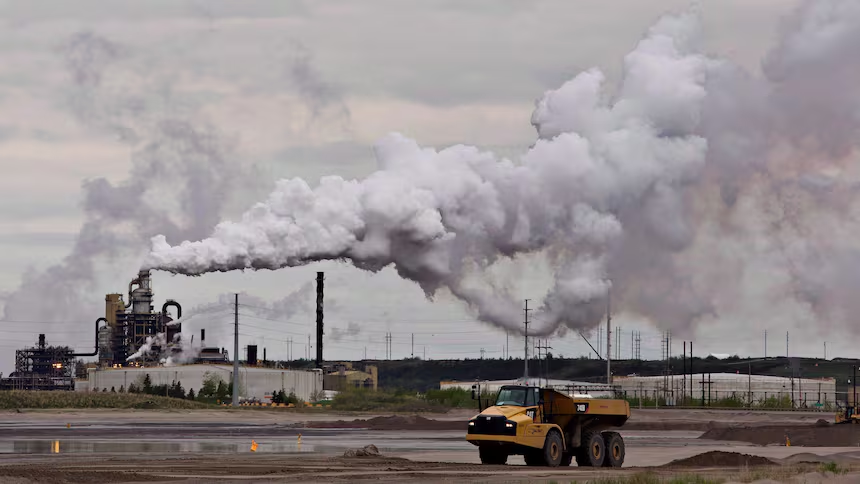
The Government of Canada, the province of Alberta, and five of the leading oil sands operating companies reached an agreement to advance the Pathways Project, an infrastructure designed to capture, transport, and store carbon dioxide (CO₂) from oil facilities in northern Alberta.
The agreement includes regulatory and tax incentives to accelerate private investment, including extending tax credits through 2035 for carbon capture, transportation, and storage equipment, as well as new incentives for enhanced oil recovery projects through CO₂ injection.
The project will be developed in phases. The infrastructure is expected to begin operations in 2032, while full implementation is projected for 2035.
CO₂ is beginning to become energy infrastructure
The most significant component of the Pathways Project is not only carbon capture, but the creation of an integrated CO₂ transportation network, comparable from an engineering standpoint to an oil or gas pipeline system.
The Pathways project envisions a pipeline network that will collect carbon dioxide captured at several oil sands facilities and transport it to a permanent geological storage hub.
This approach reflects a major shift in the evolution of CCS (Carbon Capture and Storage) technologies.
While early carbon capture projects were designed as standalone facilities, the current trend is to develop shared infrastructure capable of serving multiple industrial emitters, reducing per-unit transportation and storage costs.
From a process engineering perspective, this configuration makes it possible to leverage economies of scale, optimize the operation of compression stations, and facilitate the gradual integration of new industrial users into the same network.
Transportation infrastructure will be decisive for CCS growth
Capturing carbon dioxide represents only part of the technological challenge.
Once separated from flue gases, CO₂ must be compressed to reach supercritical conditions, transported through pipelines specifically designed for this fluid, and finally injected into geological formations capable of ensuring its confinement over long periods.
Each of these stages requires specific engineering criteria related to CO₂ thermodynamics, the selection of corrosion-resistant materials, impurity management, pipeline integrity monitoring, and ongoing verification of underground storage.
For this reason, many specialists consider that the main bottleneck for CCS expansion no longer lies in capture technology, but in the availability of infrastructure to transport large volumes of carbon safely and in an economically viable manner.
Pathways Project: Tax incentives seek to accelerate private investment
The agreement includes a set of instruments aimed at reducing the financial risk of projects with high capital requirements.
The federal government will extend tax credits through 2035 for investments in carbon capture and storage, while Alberta will develop complementary incentives to encourage the construction of the necessary infrastructure.
Source and photo: https://www.cbc.ca/