The offshore industry continues to move toward more efficient solutions to meet the technical challenges of ultra-deepwater operations. Baker Hughes and Strohm announced the signing of a memorandum of understanding to develop an innovative hybrid flexible pipe (HFP) for flowline and subsea riser applications at depths exceeding 3,000 meters.
The collaboration seeks to meet the growing demand for lightweight, corrosion-resistant, and economically viable solutions for the development of offshore resources in increasingly complex environments.
As deepwater basins represent a larger share of global hydrocarbon production, operators require technologies capable of reducing operational risks and installation costs.
A new generation of offshore pipelines
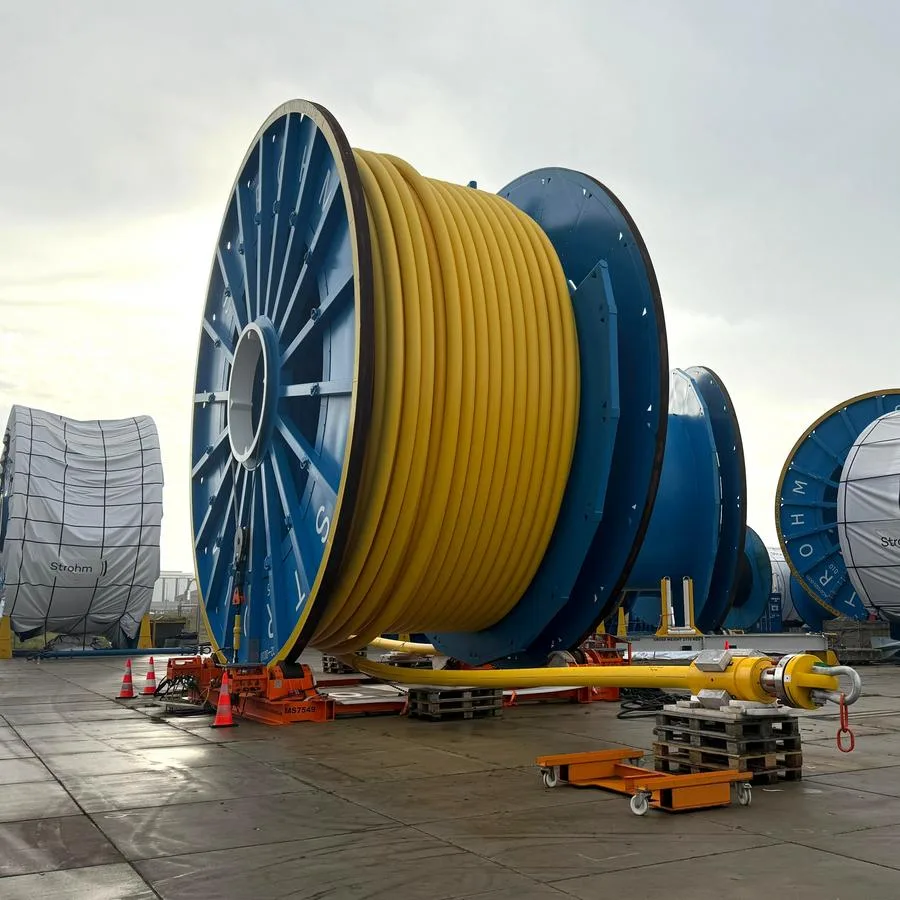
The HFP solution combines features of conventional flexible pipes with the advantages of thermoplastic composite pipes (TCP). In the joint design, TCP replaces critical elements such as the standard carcass, internal liner, and pressure armor, while maintaining the tensile armor and end fittings characteristic of traditional flexible systems.
This approach allows for the integration of the high mechanical strength of conventional flexible pipes with the reduced weight and smooth internal surface of TCP solutions. The result is a pipe optimized for ultra-deepwater operations, where weight and tension limitations represent one of the primary technical challenges.
According to Strohm, the new system will reduce total weight by approximately 50% compared to conventional solutions. Even at depths exceeding 3,000 meters, the suspended weight will be around 40% lower than traditional systems used at shallower depths.
Lower weight and greater operational flexibility
The weight reduction offers strategic advantages for the entire offshore chain. Currently, the market faces limited availability of new installation vessels with high-tension capabilities, especially for ultra-deepwater projects.
Thanks to the reduction in suspended weight, the new HFP will allow the use of existing installation vessels, avoiding costly structural modifications and reducing project lead times.
Furthermore, the lightweight design improves logistics operations and simplifies offshore installation, increasing flexibility for subsea operators and contractors.
Corrosion-resistant technology and low emissions
Another relevant aspect of TCP technology is its natural resistance to corrosion, a fundamental characteristic for aggressive subsea environments and long-term operations.
Strohm highlighted that its TCP pipes have an operational track record with no recorded failures, establishing themselves as a reliable alternative to traditional metallic solutions.
Baker Hughes noted that this collaboration reflects both companies’ commitment to technological innovation and the development of advanced solutions for global subsea production.
Commercial availability expected by 2028
The hybrid solution is currently in the development and technical validation phase. The companies have already manufactured qualification pipes for operational testing and certification processes.
The new generation of hybrid flexible pipes is expected to be commercially available starting in 2028, coinciding with the planned expansion of multiple ultra-deepwater offshore projects around the world.
The alliance between Baker Hughes and Strohm could become a turning point for the subsea market, driving lighter, more efficient, and sustainable systems for the next generation of offshore energy developments.
Source and photo: https://strohm.eu/