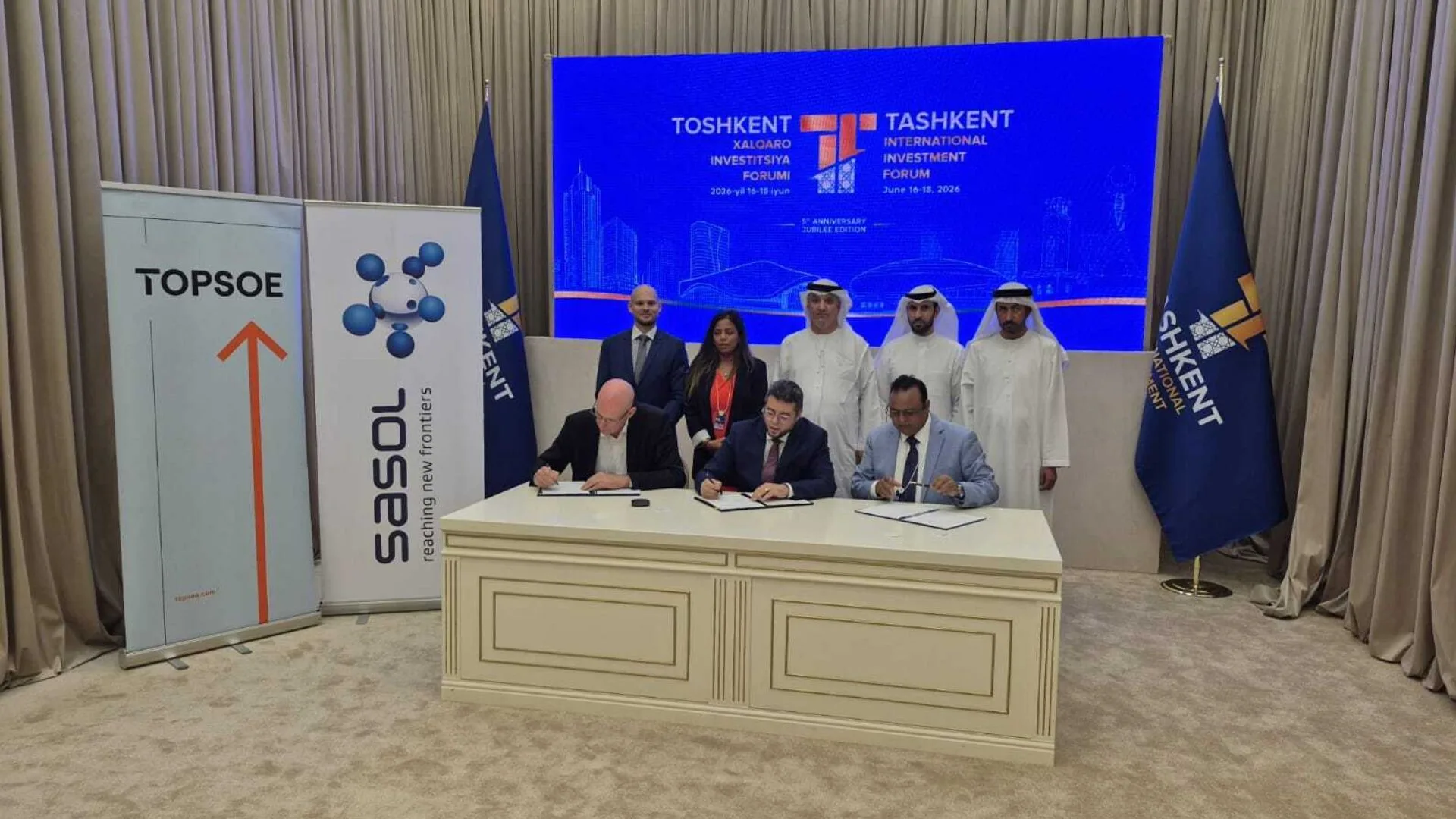
The company Allied Biofuels selected the consortium made up of Topsoe and Sasol to provide technology licenses and engineering services for the eSAF complex in the Jorezm region, Uzbekistan. Consequently, this collaboration will enable the construction of the first integrated clean fuels complex powered by solar energy in Central Asia. Additionally, the planned facility will focus its production on electro-sustainable aviation fuel and advanced biofuels to meet the growing demand from the international aviation sector.
The technological scope of the industrial synthesis process
Therefore, the technology partners will integrate the proprietary Gas-to-Liquids technology to convert captured carbon dioxide and green hydrogen into synthetic fuel. In this regard, the technical solution will combine Topsoe’s SynCor reforming system, Sasol’s low-temperature Fischer-Tropsch synthesis process, and Topsoe’s hydroprocessing solutions. Likewise, this scheme will make it possible to fractionate and saturate the molecules required to produce renewable diesel, naphtha, and high-quality eSAF.
On the other hand, the technological infrastructure will be supported by low-carbon hydrogen production units designed by Topsoe. Likewise, the projected capacity will exceed 300,000 tonnes per year of combined clean fuels. In parallel, the complex will use biologically derived feedstocks, such as waste oils and fats, ensuring a significantly reduced emissions profile.
The production capacity of the eSAF complex
Regarding operating figures, the project driven by Allied Biofuels envisages a total investment of $6.1 billion in the region. For this reason, the facility anticipates a production capacity of 257,000 tonnes per year of eSAF, 160,400 tonnes per year of SAF, and 5,040 tonnes per year of renewable diesel. In addition, the industrial site will support its operations through a renewable network of 4.45 GW of solar power, 1,600 MWh of battery storage, and 2.4 GW in electrolyzers supplied by Plug Power Inc.
In this regard, Allied Biofuels CEO Alfred Benedict highlighted that the award represents a strategic step to position the Jorezm region as a hub for green industrial development. In addition, the initiative aligns with international regulatory frameworks such as the European ReFuelEU Aviation regulation, which requires a progressive quota of synthetic fuels at European Union airports by 2030.
Finally, the business partners indicated that the final investment decision for the project will be formally made in 2027. As a result of this timeline, the facilities will reach full commercial operating capacity in 2030. Therefore, the development will consolidate Central Asia’s role in the scalable supply of low-emission energy for commercial aviation.
Source and photo: Topsoe