Table of Contents
- Thermodynamics: The origin of the corrosive tendency
- Why corrosion cannot be explained by thermodynamics alone
- Electrochemical kinetics: from possibility to reality
- Thermodynamics as a bridge between corrosion and kinetics
- Implications in industrial systems
- Electrochemical interpretation of the corrosion phenomenon
- Conclusions
- References
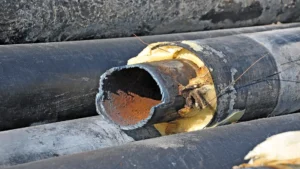
Electrochemical corrosion in industry is one of the most complex degradation mechanisms of metallic materials in equipment, pipelines, and processing systems. Its rigorous analysis requires the integration of two fundamental approaches: thermodynamics, which establishes the possibility of the process, and electrochemical kinetics, which determines its actual rate. Both do not act sequentially, but as complementary descriptions of the same charge transfer phenomenon at the metal–electrolyte interface.
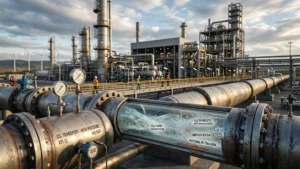
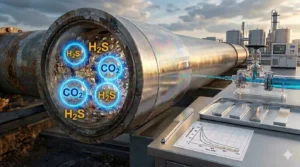
Electrochemical corrosion in industry represents one of the most complex phenomena in the degradation of metallic materials, particularly in the oil industry, where highly aggressive environments and variable operational conditions coexist. Its rigorous understanding requires integrating two fundamental approaches: thermodynamics, which defines the possibility of the process, and electrochemical kinetics, which determines its actual rate through charge transfer mechanisms at the metal–electrolyte interface.
Thermodynamics: The origin of the corrosive tendency
From a thermodynamic point of view, corrosion is a consequence of the instability of metals in natural environments. Most metals used in industry are found in a high-energy state compared to their oxidized forms, which implies a spontaneous tendency to transform.
This behavior is described using Gibbs free energy (ΔG). When ΔG is negative, the metal oxidation reaction is thermodynamically favorable. In electrochemical terms, this condition translates into electrode potentials that indicate the possibility of coupled anodic and cathodic reactions.
However, this perspective presents a critical limitation: not every thermodynamically possible reaction occurs in practice. Many industrial systems operate under conditions where corrosion is favorable, but not necessarily rapid or detectable.
Why corrosion cannot be explained by thermodynamics alone
Electrochemical corrosion in industry is a phenomenon that cannot be interpreted solely from the natural tendency of materials to degrade. Although thermodynamics establishes whether a reaction is possible, in practice many systems remain stable for long periods, even when their degradation is energetically favorable.
This apparent contradiction is resolved by incorporating electrochemical kinetics. In this context, corrosion must be understood as the result of two inseparable dimensions: thermodynamic possibility and kinetic rate. The connection between both constitutes the basis for interpreting the real behavior of materials in industrial environments.
Electrochemical kinetics: from possibility to reality
This is where electrochemical kinetics comes into play, responsible for describing the rate of charge transfer reactions at the metal–electrolyte interface.
Electrochemical corrosion involves two simultaneous processes:
- Anodic reaction: oxidation of the metal (electron release)
- Cathodic reaction: reduction of species in the environment (such as oxygen or protons)
The rate of these reactions depends on factors such as overpotential, exchange current density, and resistance to charge and mass transport.
In this context, kinetics defines whether a system:
- Remains practically inert (negligible corrosion)
- Presents moderate degradation
- Evolves toward accelerated failure
Therefore, while thermodynamics answers the question “can corrosion occur?”, kinetics answers “how fast does it occur?”.
Thermodynamics as a bridge between corrosion and kinetics
The link between both disciplines is not merely complementary, but structural. Thermodynamics establishes the framework within which kinetics operates.
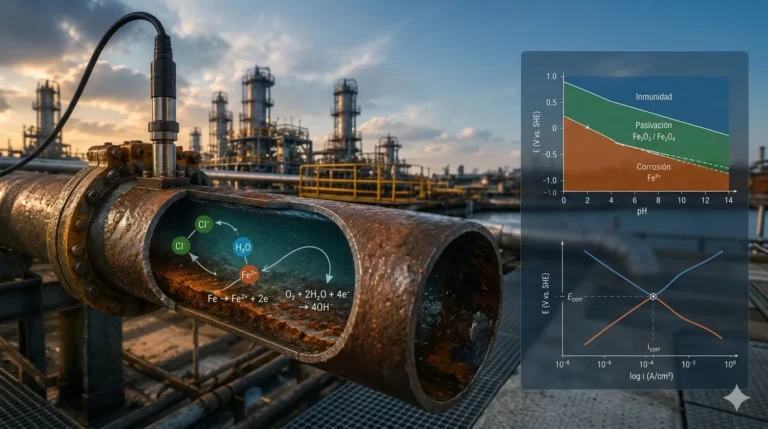
The equilibrium potential of a system, defined thermodynamically, serves as a reference to evaluate deviations (overpotentials) that control the rate of electrochemical reactions. It is precisely this deviation that activates kinetic mechanisms.
In other words:
- Thermodynamics defines the equilibrium state
- Kinetics describes the path and speed to reach it
This conceptual bridge explains why thermodynamically unstable materials can show high corrosion resistance: the presence of kinetic barriers, such as passive films or diffusion limitations, slows down the process.
Implications in industrial systems
In industrial environments, this interaction is clearly manifested. Systems such as pipelines, tanks, or equipment in contact with electrolytes often operate under conditions where corrosion is thermodynamically possible.
However, their actual behavior depends on kinetic variables such as:
- Concentration of reactive species
- Medium conductivity
- Formation of corrosion products
- Hydrodynamic conditions
This explains why small environmental variations can generate significant changes in corrosion rate, even without altering the thermodynamic favorability of the system.
Electrochemical interpretation of the corrosion phenomenon
The combined analysis of thermodynamics and kinetics allows corrosion to be interpreted as a dynamic equilibrium phenomenon. The corrosion potential is established at the point where anodic and cathodic reaction rates are equal.
This point does not represent the absence of reaction, but rather a state where metal dissolution occurs at a constant rate. The magnitude of this rate is directly related to the corrosion current density, a key parameter in damage evaluation.
Conclusions
Understanding electrochemical corrosion in industry requires integrating thermodynamics and kinetics within a single conceptual framework. The former defines the natural direction of the system, while the latter determines its evolution over time.
Thermodynamics, acting as a bridge, connects the intrinsic tendency of materials to degrade with the real manifestation of that degradation. This approach not only enriches the interpretation of the corrosion phenomenon but also provides a solid foundation for its analysis and control in industrial conditions.
References
- Bard, A. J., & Faulkner, L. R. (2001). Electrochemical methods: Fundamentals and applications (2nd ed.). Wiley.
- Fontana, M. G. (1986). Corrosion engineering (3rd ed.). McGraw-Hill.
- Jones, D. A. (1996). Principles and prevention of corrosion (2nd ed.). Prentice Hall.
- Revie, R. W., & Uhlig, H. H. (2008). Corrosion and corrosion control: An introduction to corrosion science and engineering (4th ed.). Wiley-Interscience.
- Pourbaix, M. (1974). Atlas of electrochemical equilibria in aqueous solutions. National Association of Corrosion Engineers.