
Table of Contents
- 15 MW wind turbines: Wind technological innovation
- Structural monitoring in 15 MW turbines
- What is SHM in wind turbines and how does it work?
- How SHM anticipates structural failures
- How is the data acquisition process?
- Structural sensors: The measurement architecture in 15 MW
- Early detection of fatigue in blades and towers
- Real time analysis and predictive maintenance: From data to decision
- Continuous monitoring to reduce structural failures
- Conclusions
- References
- Frequently asked questions (FAQs)
The rapid ascent of offshore wind turbines beyond the 15 MW threshold is redefining structural engineering challenges within the renewable energy sector. As rotor diameters exceed 240 meters and hub heights reach new limits, the integrity of blades, towers, and foundations increasingly becomes a significant structural progress. In this context, structural monitoring ceases to be optional, turning into the cornerstone of operational reliability and the long-term performance of the assets.
Modern wind turbines operate under highly dynamic and complex loads, including cyclic fatigue, extreme weather events, and aeroelastic interactions. These factors accelerate degradation mechanisms that are not always visible through conventional inspection techniques.
15 MW wind turbines: Wind technological innovation
The 15 MW wind turbines represent the current technological frontier in wind generation. With rotor diameters exceeding 220 meters, blades over 100 meters, and towers up to 150 meters high, these wind turbines subject their structures to dynamic loads, vibrations, and fatigue cycles of an unprecedented magnitude in the industry.
This is where Structural Health Monitoring (SHM) systems come into play, providing continuous, data-driven information on the actual state of critical components.
In sector forums such as WindEurope 2026, held in Copenhagen, structural monitoring has consolidated itself as a strategic axis. Operators, manufacturers (OEMs), and digital solution providers converge toward sensor-based predictive strategies that allow for early damage detection and maintenance optimization.
This article analyzes how SHM in wind turbines, especially in 15 MW machines, is transforming asset management, reducing structural failures, and enabling predictive maintenance through advanced sensing technologies and real-time analysis.
Structural Health Monitoring (SHM), continuous real-time structural monitoring, has become the central tool to manage this complexity without resorting to costly manual inspections or accepting the risk of unanticipated failures.
Structural monitoring in 15 MW turbines
The structural complexity of 15 MW turbines demands a paradigm shift in supervision strategies. Traditional approaches based on periodic inspections are insufficient for structures of this scale, where small defects can propagate rapidly under cyclic loads.
Structural monitoring systems are designed to continuously measure stresses, strains, vibrations, and environmental conditions. These systems generate a “digital footprint” of structural behavior over time, allowing for the detection of deviations from normal conditions.
In offshore environments, where access is limited and operational costs are high, continuous monitoring becomes even more necessary. The ability to assess structural integrity remotely reduces reliance on manual inspections and minimizes downtime.
An essential component of the system is the integration of monitoring data with digital twins. By correlating real-time measurements with simulation models, operators can predict the structural response to future load scenarios.
Ultimately, this monitoring in large-scale turbines improves reliability, extends service life, and reduces the Levelized Cost of Energy (LCOE), making offshore wind energy more competitive.
What is SHM in wind turbines and how does it work?
SHM in wind turbines is a system for the continuous acquisition, transmission, and analysis of physical data coming from sensors embedded in the essential structural components of the wind turbine. Unlike calendar-based preventive maintenance or post-failure corrective maintenance, SHM operates in real time: it detects deviations in structural behavior before they reach irreversible damage thresholds.
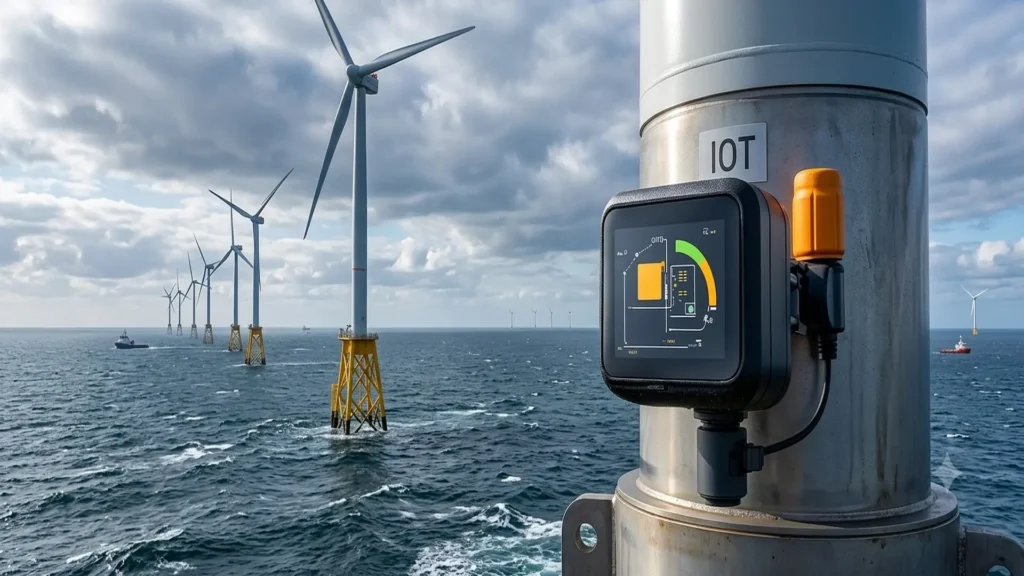
In a 15 MW turbine, the SHM system integrates multiple measurement layers: fiber-optic Bragg grating (FBG) sensors distributed along the blades to capture local deformations with millimeter-level resolution. Triaxial accelerometers on the nacelle, hub, and tower segments to record the vibration spectrum in each frequency mode; strain gauges at the tower flange joints to monitor accumulated bending loads; and acoustic emission sensors capable of detecting the propagation of microcracks in composite materials before they become visible. The following image provides a graphical representation of this concept.
All these data streams converge into an onboard processing unit that applies modal analysis algorithms, Fourier transforms, and accumulated damage models, typically based on the Palmgren-Miner rule for calculating the Damage Equivalent Load (DEL), to generate a structural health index per component in real time.
How SHM anticipates structural failures
Structural health monitoring systems act as early warning mechanisms, identifying anomalies before they evolve into catastrophic failures. This predictive capability is especially valuable in high-power turbines, where failures involve significant economic and safety impacts.
SHM relies on reference data obtained during commissioning. Over time, the system compares live data with this baseline to detect subtle deviations in the structural response.
Increasingly, machine learning algorithms are employed to identify patterns associated with damage progression. These models allow for distinguishing between normal operational variability and early signs of structural degradation. For example, changes in vibration signatures or strain distribution can indicate the initiation of cracks in the blades or fatigue accumulation in the tower welds.
By detecting these changes early, operators can plan maintenance proactively, avoiding catastrophic failures and optimizing resource allocation.
Comparative table of wind turbine technologies
| Feature | Horizontal Axis (HAWT) | Vertical Axis (VAWT) | Offshore Turbines (Marine) |
|---|---|---|---|
| Common Use | Commercial onshore wind farms. | Urban or residential environments. | Open sea installations. |
| Efficiency | High: Captures wind optimally at high altitudes. | Medium/Low: Lower aerodynamic efficiency. | Very High: Stronger and more constant marine winds. |
| Mechanism | Requires a yaw system to face the wind. | Omnidirectional; captures wind from any direction. | Similar to HAWT, but with floating or anchored bases. |
| Advantages | Maximum energy production per unit. | Simple maintenance (motor at ground level). | Lower visual impact and larger power scale. |
| Challenges | Costly installation and long blade transport. | Lower durability due to centrifugal forces. | Extreme maintenance costs due to corrosion. |
How is the data acquisition process?
SHM systems in 15 MW turbines are based on distributed networks of sensors integrated into critical structural components. The data acquisition process involves high-frequency sampling to capture dynamic responses under varying load conditions, such as wind turbulence, waves, and operational stresses.
Advanced signal processing techniques are applied to filter noise and extract relevant features from raw data. These features are subsequently analyzed to evaluate structural health.
Cloud-based platforms allow for real-time visualization and remote diagnostics. Engineers can access dashboards showing indicators with direct impact on operational performance efficiency, alerts, and trend analysis.
Integration with SCADA systems provides a holistic view of turbine behavior, combining structural data with operational parameters such as generated power and rotor speed.
Structural sensors: The measurement architecture in 15 MW
The sensor architecture of an SHM system for 15 MW turbines must solve a specific challenge: instrumenting large-scale components exposed to extreme environmental conditions with technologies that maintain their calibration throughout the asset’s useful life—typically 25 to 30 years—without requiring frequent replacement.
FBG fiber optic sensors are currently the dominant standard in blades due to their electromagnetic immunity, low weight, and ability to multiplex dozens of measurement points on a single fiber.
In the tower and foundation—whether an offshore monopile or an onshore footing—SHM systems combine high-precision inclinometers with low-frequency accelerometers (0.1–10 Hz) to capture the overall vibration modes of the structure.
The natural frequency of the first bending mode of a 15 MW tower typically lies in the 0.20–0.25 Hz range, within the so-called 1P-3P rotor band.
The SHM continuously monitors that this frequency does not drift into resonance zones with the blade-passing frequency or with seabed excitation, which in offshore turbines can trigger accelerated fatigue in the transition piece and foundation welds.
Acoustic emission (AE) systems add a differential capability: they detect the propagation of sub-millimeter defects by analyzing the elastic waves generated by the opening or slipping of a crack.
In composite material blades, carbon/glass epoxy in the latest-generation turbines, AE can identify delaminations, fiber breakages, and adhesive joint failures in the spar, which are the most critical damage modes and the hardest to detect with visual inspection or manual ultrasound.
Types of structural sensors
A wide variety of structural sensors is employed in SHM systems, each designed to capture specific aspects of structural behavior. Selection depends on the component to be monitored and the type of loads it experiences.
Strain gauges are commonly used to measure deformations in blades and towers, providing direct information on stress distribution.
Fiber optic sensors, especially those based on Fiber Bragg Gratings (FBG), offer high sensitivity and resistance to electromagnetic interference, making them ideal for offshore environments. Accelerometers allow for monitoring vibrations and dynamic responses. Changes in vibratory patterns can indicate structural damage or imbalances.
Acoustic emission sensors detect high-frequency signals generated by crack growth or material failures, facilitating the early detection of damage. Environmental sensors, such as temperature and humidity, provide context to structural data, helping to differentiate between environmental effects and real damage.
Early detection of fatigue in blades and towers
Fatigue is one of the most critical failure mechanisms in wind turbines. Repetitive loads generate micro-cracks that can grow over time, leading to structural failures if not detected early.
In blades, fatigue is driven by aerodynamic loads and gravitational forces. SHM systems monitor strains and vibrations to identify changes in load distribution.
Advanced analysis allows for estimating the Remaining Useful Life (RUL) based on fatigue accumulation, facilitating maintenance planning driven by actual condition. Early detection not only prevents failures but also reduces repair costs by intervening before damage worsens.
Real time analysis and predictive maintenance: From data to decision
The operational value of SHM lies not in data capture but in its real-time interpretation. Modern systems integrate structural digital twins—finite element models calibrated with the asset’s real data—which allow for correlating sensor readings with the current load status and projecting the remaining useful life of each component.
This capability transforms predictive maintenance: instead of scheduling interventions based on operating hours or calendar dates, O&M teams act when the digital model indicates that the remaining fatigue margin has fallen below the operational safety threshold.
In 15 MW turbines, where an unplanned shutdown at an offshore wind farm can cost between 50,000 and 150,000 euros daily in lost generation and service vessel mobilization, the ability to anticipate failure weeks or months in advance has a direct and quantifiable economic impact.
Machine learning algorithms trained on SHM time series add an extra layer: they detect anomalous degradation patterns that do not match any known failure mode, acting as an early warning system against emerging damage mechanisms, such as White Etching Cracks (WEC) in main bearings or accelerated corrosion in stress concentration zones of offshore foundations.
Integration of SHM with turbine control protocols
Particularly, integration with Individual Pitch Control (IPC) opens an active mitigation path: when blade sensors detect asymmetric load imbalances or gust loads exceeding design limits, the IPC can adjust the pitch angle of each blade independently to redistribute the load before it generates accumulated damage.
Real-time analysis is a key feature of modern SHM systems. By continuously processing incoming data, these systems provide immediate information on structural status.
Predictive maintenance strategies rely on this data to anticipate future failures. Instead of reacting to breakdowns, operators can intervene before the damage becomes critical. Data-driven decision-making improves maintenance efficiency, reducing unnecessary inspections and focusing resources where they are truly needed.
Integration with artificial intelligence and machine learning enhances predictive capabilities, allowing for more precise forecasts of failure modes. As turbines continue to increase in size, real-time SHM will be fundamental to ensuring reliability, safety, and economic viability.
Continuous monitoring to reduce structural failures
Continuous monitoring transforms the management of structural integrity in wind turbines. Instead of periodic evaluations, operators have a constant stream of information regarding the asset’s condition.
This approach significantly reduces the risk of unexpected failures, which can be costly and dangerous, especially in offshore environments. By maintaining a complete history of structural behavior, SHM systems enable long-term trend analysis and performance optimization.
Regulatory bodies and insurance companies increasingly recognize the value of continuous monitoring, incorporating it into regulations and risk assessments. In the long term, the widespread adoption of SHM will contribute to a more resilient wind infrastructure, supporting the global transition toward renewable energy.
Conclusions
As wind turbines scale up to 15 MW and beyond, traditional periodic manual inspections become obsolete due to the unprecedented magnitude of dynamic and cyclic loads. Continuous Structural Health Monitoring (SHM) shifts the paradigm from reactive or schedule-based maintenance to a data-driven approach, preventing rapid defect propagation from escalating into catastrophic failures.
The true operational value of SHM lies in its integration with structural digital twins and machine learning. By transforming raw sensor data into real-time Remaining Useful Life (RUL) projections, operators can mitigate the high financial risks associated with unplanned offshore shutdowns, which can range from €50,000 to €150,000 daily, by planning proactive interventions weeks or months in advance.
Modern 15 MW SHM architecture integrates multiple specialized sensor layers (such as FBG fiber-optic sensors, acoustic emission sensors, and triaxial accelerometers) to safeguard distinct structural boundaries. When paired with advanced control protocols such as Individual Pitch Control (IPC), the system moves beyond passive diagnosis to actively mitigate mechanical stress in real time, thereby extending the asset’s operational lifespan.
References
- Martinez-Luengo, M., Shafiee, M., & Kolios, A. (2016). Structural health monitoring of offshore wind turbines: A review of technology and methods. Renewable and Sustainable Energy Reviews, 62, 591-608. https://doi.org/10.1016/j.rser.2016.04.044
- Palmgren, A. (1924). Die Lebensdauer von Kugellagern [The lifetime of ball bearings]. Verfahrenstechnik, 68, 339–341.
- Schubel, P. J., & Crossley, R. J. (2012). Wind turbine blade design. Wind Engineering, 36(4), 365-388. https://doi.org/10.1260/0309-524X.36.4.365
- WindEurope. (2026). Annual Conference Proceedings: Market trends and digital solutions in next-generation offshore assets. WindEurope Copenhagen.
Frequently asked questions (FAQs)
What is SHM in wind turbines?
SHM (Structural Health Monitoring) is the continuous structural monitoring system that, through embedded sensor networks and real-time analysis, evaluates the health status of turbine components, blades, tower, foundation, and drivetrain, to anticipate failures and optimize predictive maintenance.
What sensors does a 15 MW turbine use?
SHM systems in 15 MW turbines integrate FBG fiber optic sensors in blades, triaxial accelerometers in the nacelle and tower, strain gauges on structural flanges, precision inclinometers on the foundation, and acoustic emission sensors for micro-crack detection in composite materials.
How does structural monitoring detect fatigue?
SHM calculates the Damage Equivalent Load (DEL) in real time by recording the load cycles captured by the sensors and analyzing them with Palmgren-Miner models. When the accumulated damage index exceeds design thresholds, the system issues alerts that allow for intervention planning before the crack reaches a critical size.
What advantages does real-time SHM offer?
Real-time SHM enables shifting from calendar-based maintenance to maintenance driven by the asset’s actual condition, reducing both unnecessary interventions and unplanned shutdowns. In 15 MW offshore wind farms, operational studies show reductions of 30–40% in unscheduled maintenance costs and an extension of the effective useful life of key components like blades and foundations.