Table of Contents
- From traditional inventory to Smart traceability at terminals
- Custody data as a validation layer
- Digital twins and advanced data reconciliation
- Predictive capability in terminal operations management
- Impact of digital integration on terminal design and operation
- Smart traceability as a competitive advantage
- Conclusions
- References
Smart traceability in terminals has become an essential element in the modern operation of bulk liquid and gas storage and distribution facilities. In an industrial environment where accuracy, transparency, and regulatory compliance are increasingly demanding, the integration of tank level data with custody transfer systems is redefining how terminals manage their operations.
This approach enables a transition from traditional systems based on isolated records and manual reconciliations to real-time digital architectures. In this new model, every product volume is continuously tracked, validated, and correlated, strengthening data reliability and improving operational decision-making.
Smart traceability in terminals not only represents a technological improvement but also a structural change in how operational integrity is understood within the logistics chain.
From traditional inventory to Smart traceability at terminals
Traditionally, tank level measurement was used for inventory control through radar or servo gauges. In parallel, custody transfer relied on certified flowmeters to determine billable volumes.
For decades, terminals have operated with separate systems for inventory control and fiscal measurement. On one hand, tank level systems provided volumetric information using technologies such as radar or servo gauges. On the other hand, custody transfer was managed through certified flowmeters to determine transaction volumes.
This separation generated recurring discrepancies between physical inventory and fiscal data, requiring manual reconciliation processes. These processes were not only slow but also introduced uncertainty into operations.
The evolution toward Smart traceability at terminals integrates these systems into a single digital architecture. Variables such as level, temperature, density, and flow are synchronized in real time, enabling the construction of a dynamic and continuous mass balance.
This approach eliminates dependence on periodic reconciliations and establishes a single reliable source of information, improving accuracy and operational efficiency. The result is a dynamic mass balance that reduces deviations, enhances precision, and ensures a single trusted data source. Thus, traceability shifts from a reactive process to a continuous and verifiable system.
Custody data as a validation layer
In the context of smart traceability in terminals, custody transfer systems evolve from purely fiscal tools into a critical data validation layer.
By cross-referencing tank level data with transfer measurements, terminals can identify operational inconsistencies in near real time. This enables the detection of losses, deviations, or instrumentation failures before they lead to significant economic impacts.
This approach is especially relevant for high-value products such as LNG, refined fuels, and chemicals, where even small deviations can have major consequences. Additionally, data integration enhances system auditability, enabling detailed reconstruction of operational events and facilitating regulatory compliance and ESG reporting.
Digital twins and advanced data reconciliation
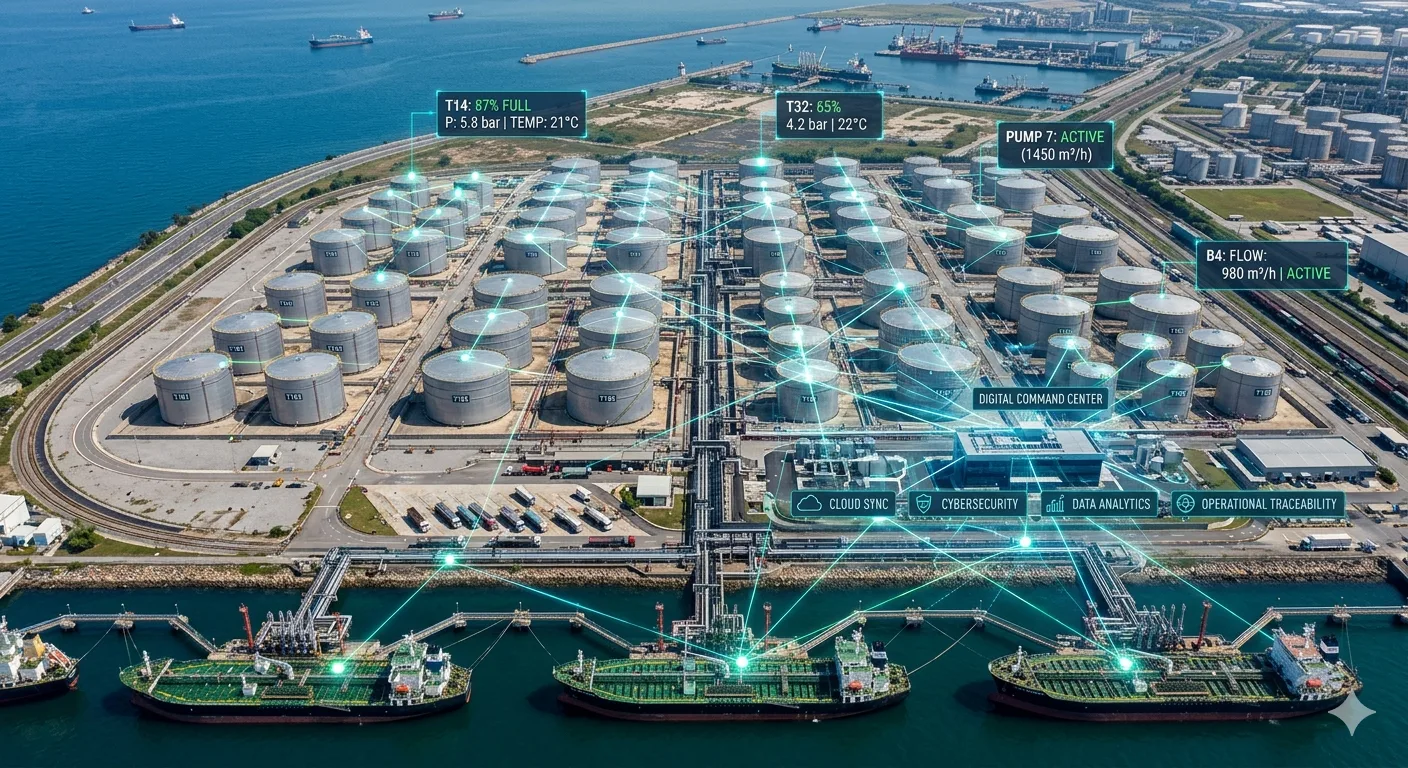
In liquid storage terminals, the implementation of smart traceability in terminals is significantly enhanced by the use of digital twins applied to tank systems, transfer lines, and loading and unloading operations.
These digital models replicate with high fidelity the behavior of the terminal’s physical infrastructure, including storage tanks, pumping systems, pipelines, and level measurement systems. This virtual representation allows real-time monitoring of critical variables such as volume, temperature, density, and inventory balance for each tank or tank group.
In this context, digital twins enable simulation and validation of dynamic mass balance within the terminal, facilitating the detection of deviations between theoretical inventory and actual measurements. This provides a key advantage: the ability to evaluate operational scenarios before executing transfer operations, reducing risks associated with overfilling, losses, or accounting errors.
At the core of this architecture are data reconciliation engines designed to integrate information from multiple sources, including level measurement systems, custody transfer flowmeters, temperature sensors, and industrial automation systems. These engines adjust measurements within defined uncertainty margins, generating a consistent and coherent inventory dynamic mass balance across the entire terminal.
As a result, a unified and reliable view of tank conditions is achieved, improving the quality of information used by operations, maintenance, and integrity teams. This level of integration reduces historical discrepancies between physical and fiscal inventory, one of the main challenges in liquid storage terminals.
Predictive capability in terminal operations management
Smart traceability in terminals is further strengthened by the implementation of digital twins that virtually replicate the physical infrastructure, including storage tanks, transfer lines, pumping systems, and measurement equipment associated with loading and unloading operations.
The predictive capability of these systems represents a significant advancement in the operational management of liquid terminals, as it enables continuous analysis of tank behavior based on critical variables such as level, temperature, density, and inventory balance.
This real-time analysis allows the anticipation of operational conditions that were previously identified only reactively, such as incipient leaks, product stratification within tanks, or deviations in level measurement instrumentation. In this way, terminals evolve into intelligent systems capable of self-validating their operational data, reducing reliance on manual reconciliations and improving inventory reliability.
Under this approach, decision-making in liquid terminals moves away from reliance on historical records or periodic inspections and instead is supported by continuous simulation of system behavior. Digital twins serve as decision-support tools, enabling evaluation of the impact of each action on inventory, product transfer, and asset integrity before field execution.
In this context, the main challenge is no longer technological availability, but the organizational ability to correctly interpret generated data, trust predictive models, and translate them into effective operational actions. This transition requires an evolution in operational culture, where data shifts from static records to the central axis of terminal management.
Impact of digital integration on terminal design and operation
The convergence between tank level measurement systems and custody transfer is redefining the design and operation of liquid terminals. New projects are developed with fully integrated digital architectures from the conceptual phase, while existing facilities are advancing through modernization processes based on data digitalization and process automation.
Key elements of this approach include high-precision instrumentation for level and flow measurement, certified custody transfer systems, industrial data integration platforms such as SCADA and cloud analytics for real-time data processing, and cybersecurity frameworks to protect operational information.
From an operational perspective, this integration significantly reduces manual intervention, lowers the likelihood of errors in inventory reconciliation, and improves loss control in storage and transfer operations.
From a strategic standpoint, terminal digitalization enables organizations to meet increasing regulatory demands, improve sustainability indicators, and enhance competitiveness in an increasingly demanding energy landscape. This transformation positions terminals as highly automated systems focused on efficiency, traceability, and data-driven decision-making.
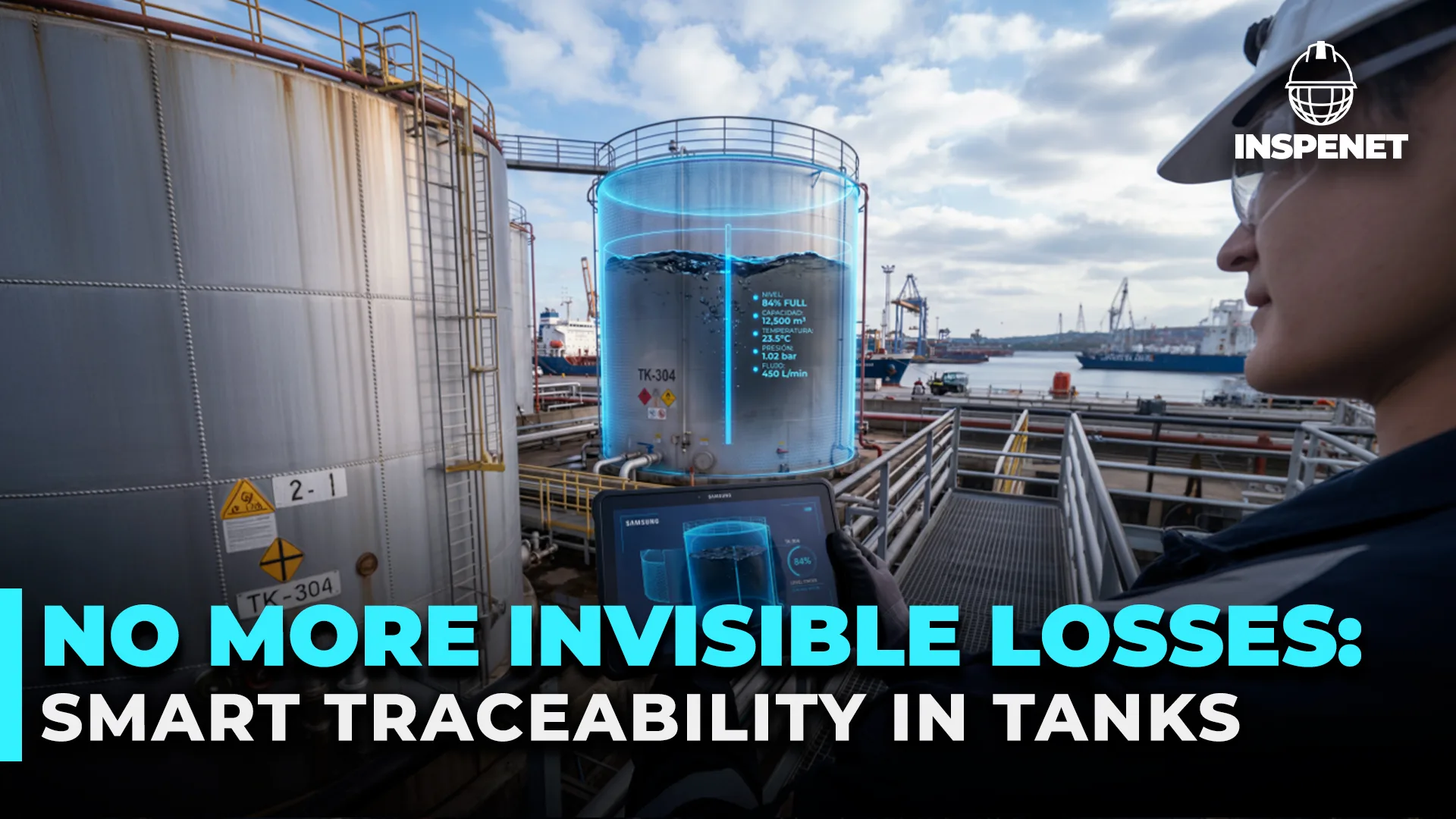
The following video details the implementation of digital architectures and advanced instrumentation to optimize the transfer of custody at terminals.
Smart traceability as a competitive advantage
Smart traceability in terminals marks a turning point in how storage and transfer operations for liquid products are managed. The integration of level and custody data not only increases measurement accuracy but also strengthens operational intelligence by providing reliable, continuous, and traceable information across the value chain.
In an environment where digitalization is rapidly advancing, traceability shifts from being a regulatory requirement to becoming a key differentiator. Terminals that adopt these systems not only achieve compliance but also optimize operational performance, reduce risks associated with losses or measurement errors, and improve decision-making efficiency.
Smart traceability in terminals enables the transformation of data into value, supporting a more proactive management approach based on predictive analytics and operational simulations. This results in better inventory control, improved operational planning, and a significant reduction in uncertainty.
In this context, the discussion is no longer about whether to integrate these systems, but how quickly organizations can implement them effectively. Terminals that move faster in this digital transformation will be better positioned to compete in a demanding market where reliability, transparency, and operational efficiency are critical.
Conclusions
Smart traceability in terminals enables the effective integration of tank level measurement data with custody transfer systems within a unified digital architecture. This convergence eliminates data fragmentation, significantly reduces operational uncertainty, and improves the reliability of both technical and fiscal information. As a result, terminals can rely on a single source of truth that supports decision-making, minimizes discrepancies, and strengthens real-time inventory control.
The incorporation of digital twins and advanced data reconciliation engines, together with the digitalization of liquid storage terminals, introduces a predictive approach to operational management. These technologies allow more accurate validation of mass balances, anticipation of failures, detection of deviations, and optimization of planning through real-time analysis. Integrated with platforms such as SCADA and cloud analytics, they enable process automation, enhance operational visibility, and reduce manual intervention, minimizing errors and losses. Together, this digital ecosystem transforms decision-making into a proactive model while strengthening regulatory compliance and the generation of reliable and auditable information.
Overall, smart traceability in terminals positions organizations within a new industrial paradigm, where competitiveness depends directly on data quality, predictive capability, and efficient asset management. In an evolving energy landscape, adopting this approach is not only a technological improvement but a strategic decision focused on sustainability, transparency, and operational excellence.
References
- International Organization for Standardization. (2010). ISO 7507: Petroleum and liquid petroleum products, Calibration of vertical cylindrical tanks. ISO.
- Siemens AG. (2021). Digitalization in terminal operations: SCADA and data integration. Siemens Industry Report.