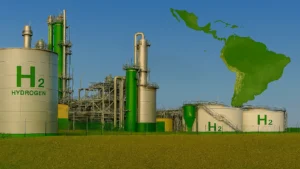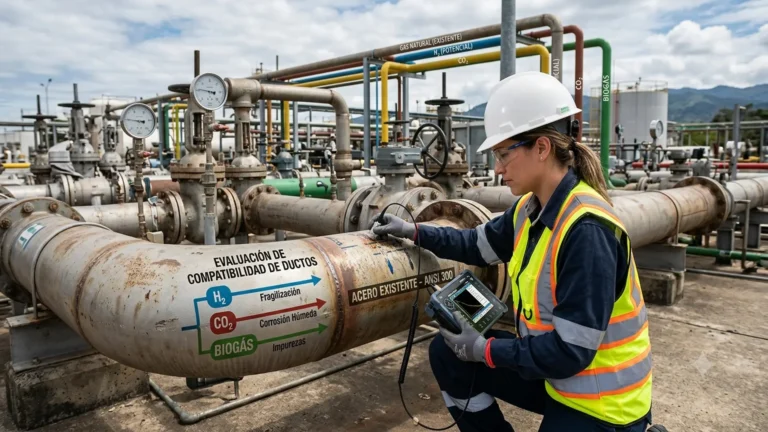
Pipeline compatibility has become a critical aspect for the energy transition, as much of the infrastructure designed to transport natural gas could be reused to carry hydrogen, carbon dioxide (CO₂), biogas, and renewable natural gas (RNG). This alternative reduces investment costs and accelerates the development of new projects, but it also poses challenges related to the mechanical integrity of the pipelines.
The reuse of a pipeline does not depend solely on its structural capacity, but on how the material, the fluid, and the operating conditions interact. Phenomena such as hydrogen embrittlement, corrosion associated with wet CO₂, and the presence of impurities in biogas can modify the behavior of the steel, making it essential to evaluate system compatibility before assigning it to a new service.
What defines a pipeline’s compatibility?
The compatibility of a pipeline can be defined as the ability to transport a specific fluid throughout its useful life without compromising the mechanical integrity, operational safety, or reliability of the system. This concept encompasses the interaction between the material of construction, the transported product, and the operating environment.
Even if two pipelines were manufactured with the same steel grade, their behavior under a new service can be completely different. The chemical composition of the material, the microstructure obtained during the manufacturing process, the quality of the welds, the presence of residual stresses, and the operating history directly influence its performance.
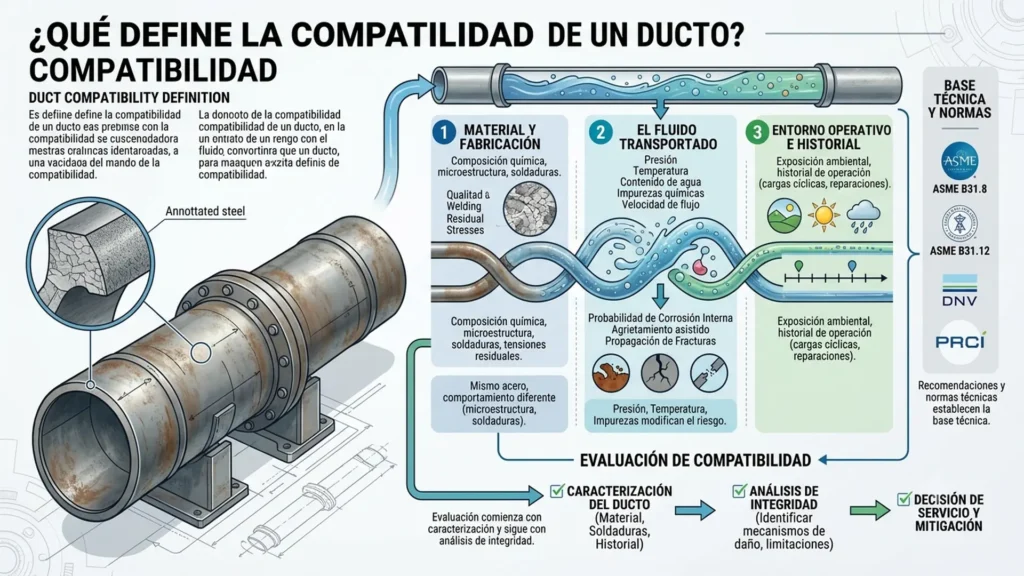
In addition to these factors, the conditions of the transported fluid must be considered. Pressure, temperature, water content, chemical impurities, and flow velocity modify the probability of developing damage mechanisms such as internal corrosion, environmentally assisted cracking, or fracture propagation.
For this reason, the compatibility evaluation begins with a detailed characterization of the pipeline and continues with an integrity analysis to identify the asset’s limitations under the new service. Methodologies established by standards such as ASME B31.8, ASME B31.12, and various recommendations from DNV and PRCI currently constitute the technical basis for this type of evaluation.
Hydrogen: embrittlement and fatigue of steel
Hydrogen is probably the fluid that poses the greatest challenges for existing transport infrastructure. Its small atomic size allows it to diffuse easily within the crystalline structure of the steel, modifying its mechanical behavior and promoting the appearance of fracture mechanisms that do not typically occur during conventional natural gas transport.
The most well-known phenomenon is hydrogen embrittlement, a process by which the material loses ductility and reduces its capacity to deform before fracturing. Under these conditions, small discontinuities present in welds, inclusions, or surface defects can become initiation points for crack growth.
The susceptibility of steel depends on various factors. High-strength materials generally exhibit greater sensitivity than steels with a lower yield strength, while the presence of residual stresses, cyclic pressure variations, and metallurgical defects increases the risk of failure.
In addition to reducing ductility, hydrogen accelerates fatigue crack propagation. A pipeline subjected to frequent pressure fluctuations can experience a significant reduction in its useful life when transporting hydrogen blends, even when stresses remain within the limits established for natural gas.
For this reason, converting pipelines for hydrogen transport demands advanced inspections aimed at detecting cracks, characterizing welds, and verifying material toughness. Many projects also establish limits on the percentage of hydrogen blended with natural gas, especially when dealing with older infrastructure whose response to this gas has not yet been fully characterized.
CO₂: Water, impurities and fracture control
The transport of CO₂ is a fundamental element in carbon capture, utilization, and storage projects, which are considered a strategic tool for reducing industrial emissions. Although dry carbon dioxide exhibits low aggressiveness toward carbon steel, this condition changes radically when free water is present.
The combination of CO₂ and water forms carbonic acid, lowering the pH of the medium and promoting high rates of internal corrosion. Even relatively small amounts of moisture can modify the electrochemical behavior of the system and accelerate pipeline wall thinning.
The problem worsens when the CO₂ contains impurities from the capture processes. Components such as oxygen, hydrogen sulfide, sulfur dioxide, or nitrogen oxides increase the aggressiveness of the medium and can promote additional degradation mechanisms.
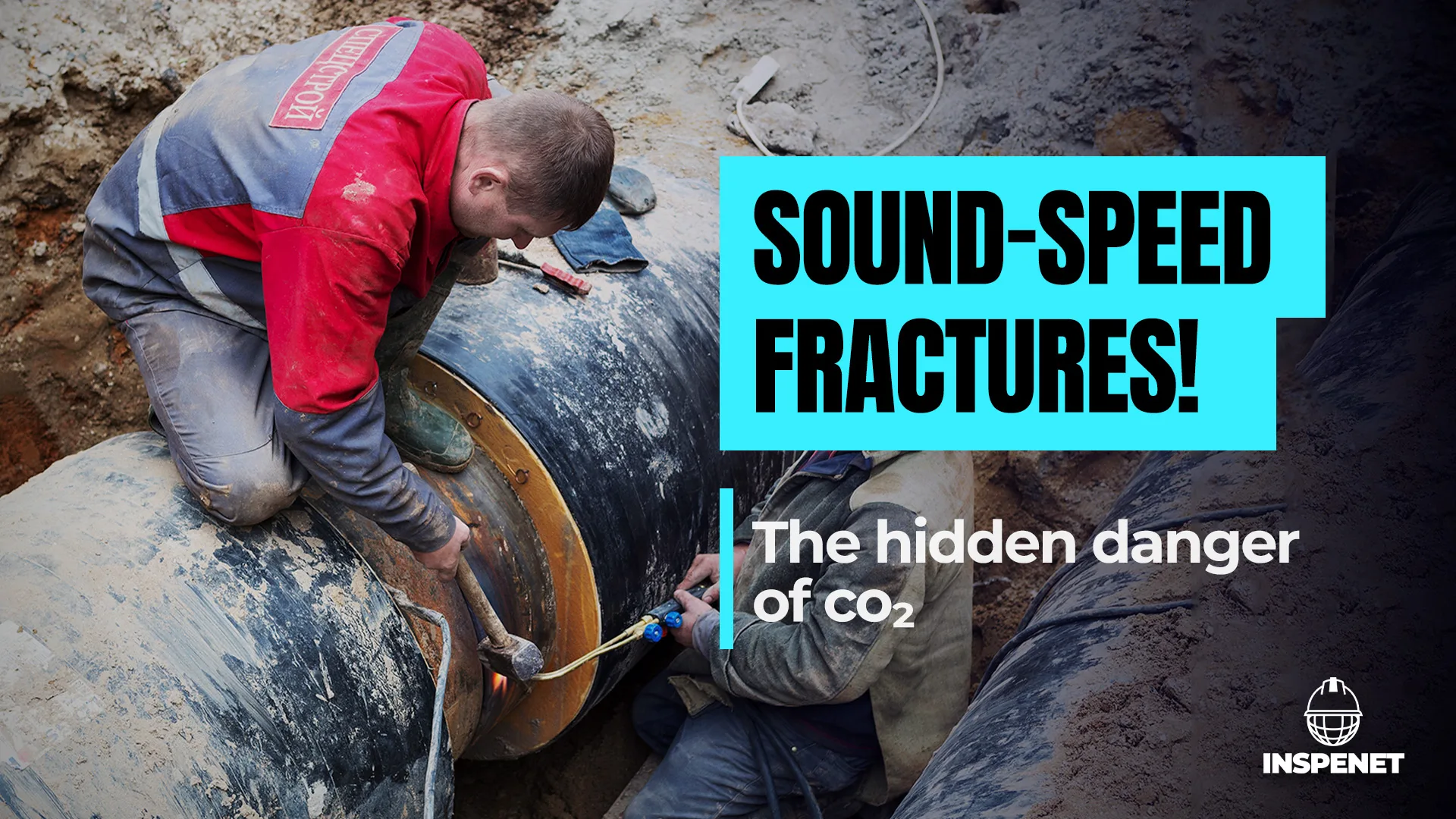
However, corrosion is not the only challenge associated with CO₂ transport. During rapid depressurization, the fluid undergoes an expansion that causes a sharp drop in temperature due to the Joule-Thomson effect. This condition can reduce the effective toughness of the steel and promote high-velocity fracture propagation.
As a consequence, the compatibility analysis must simultaneously consider the control of the CO₂ composition, the maximum allowable water content, material selection, and the pipeline’s capacity to arrest the propagation of a longitudinal fracture. These studies are part of the integrity evaluations developed for pipelines intended for dense-phase CO₂ transport.
Biogas and RNG: gas quality and corrosion
Biogas and renewable natural gas (RNG) represent an alternative to leverage existing infrastructure without substantially modifying gas distribution systems. However, the composition of these fuels depends directly on the feedstock used for their production and the purification process applied before injection into the network.
Unlike conventional natural gas, biogas can contain varying concentrations of water, carbon dioxide, hydrogen sulfide, ammonia, siloxanes, and solid particles. If these contaminants are not properly removed, they can compromise both the integrity of the pipeline and the performance of downstream equipment.
Hydrogen sulfide is one of the most critical contaminants due to its ability to promote internal corrosion processes and, under certain metallurgical and environmental conditions, favor sulfide stress cracking mechanisms. On the other hand, siloxanes generate abrasive silica deposits during combustion, affecting turbines, engines, and other industrial equipment.
Therefore, pipeline compatibility depends heavily on the quality of the injected gas. Moisture content must be kept within strict limits to prevent condensation, while the concentration of contaminants must meet the specifications established by the transport system operator. Proper conditioning of biogas allows its operational behavior to be similar to that of conventional natural gas, considerably reducing the risks associated with corrosion and infrastructure deterioration.
Pipeline compatibility for new services
Reusing pipelines is one of the most promising strategies to accelerate the energy transition, but it also represents a technical challenge that requires specific evaluations for each type of fluid. There is no universal criterion to state that a pipeline is compatible with any new service solely because it was designed to transport gaseous hydrocarbons.
Each project must consider the actual condition of the infrastructure through internal inspections, non-destructive testing, metallurgical analyses, and fitness-for-service studies. This information determines whether the material possesses the necessary strength, ductility, and toughness to operate under the new conditions.
In recent years, the development of in-line inspection (ILI) tools, continuous corrosion monitoring, distributed sensors, and advanced fracture mechanics models has significantly improved the ability to evaluate the conversion of existing pipelines. These technologies make it possible to identify critical zones, estimate damage evolution, and define operational limits that reduce the risk of failure.
International experience shows that some pipelines can be successfully adapted to transport hydrogen blends with natural gas, while others require major modifications or even the replacement of specific sections. Similarly, a system suitable for transporting CO₂ may not be appropriate for biogas with high moisture or contaminant content. Compatibility, therefore, depends not only on the material but on the interaction between the pipeline, the fluid, and the operating environment.
Conclusions
The reuse of pipelines to transport hydrogen, CO₂, biogas, and renewable natural gas constitutes a strategic opportunity to capitalize on existing infrastructure and reduce the costs associated with the energy transition. Nevertheless, the viability of this alternative depends on a rigorous evaluation of the compatibility between the pipeline material and the characteristics of the new fluid.
Hydrogen introduces risks related to steel embrittlement and fatigue; CO₂ demands strict control of moisture, impurities, and fracture propagation; while biogas and RNG require conditioning processes that guarantee a composition compatible with the transport infrastructure. In all cases, pipeline integrity must be backed by advanced inspections, metallurgical characterization, fitness-for-service analyses, and permanent monitoring programs.
The current trend is not merely to reuse pipelines, but to develop methodologies capable of demonstrating, on a technical and regulatory basis, that existing infrastructure can operate safely when facing the new energy vectors that will define the future of gas transport.
Referencias
- American Society of Mechanical Engineers. (2023). ASME B31.12: Hydrogen Piping and Pipelines. ASME.
- American Society of Mechanical Engineers. (2022). ASME B31.8: Gas Transmission and Distribution Piping Systems. ASME.
- DNV. (2021). DNV-RP-F104: Design and Operation of Carbon Dioxide Pipelines. DNV.
- International Organization for Standardization. (2022). ISO 15156 (Partes 1–3): Petroleum and Natural Gas Industries — Materials for Use in H₂S-containing Environments in Oil and Gas Production. ISO.
- Pipeline Research Council International (PRCI). (2023). Hydrogen Pipeline Materials and Integrity Guidance. PRCI.
- API. (2021). API Recommended Practice 1173: Pipeline Safety Management Systems. American Petroleum Institute.